Knives & Cutting
Soba Cutting Board (Manaita)
A large wooden board for cutting hand-rolled soba dough into even, thin noodles.
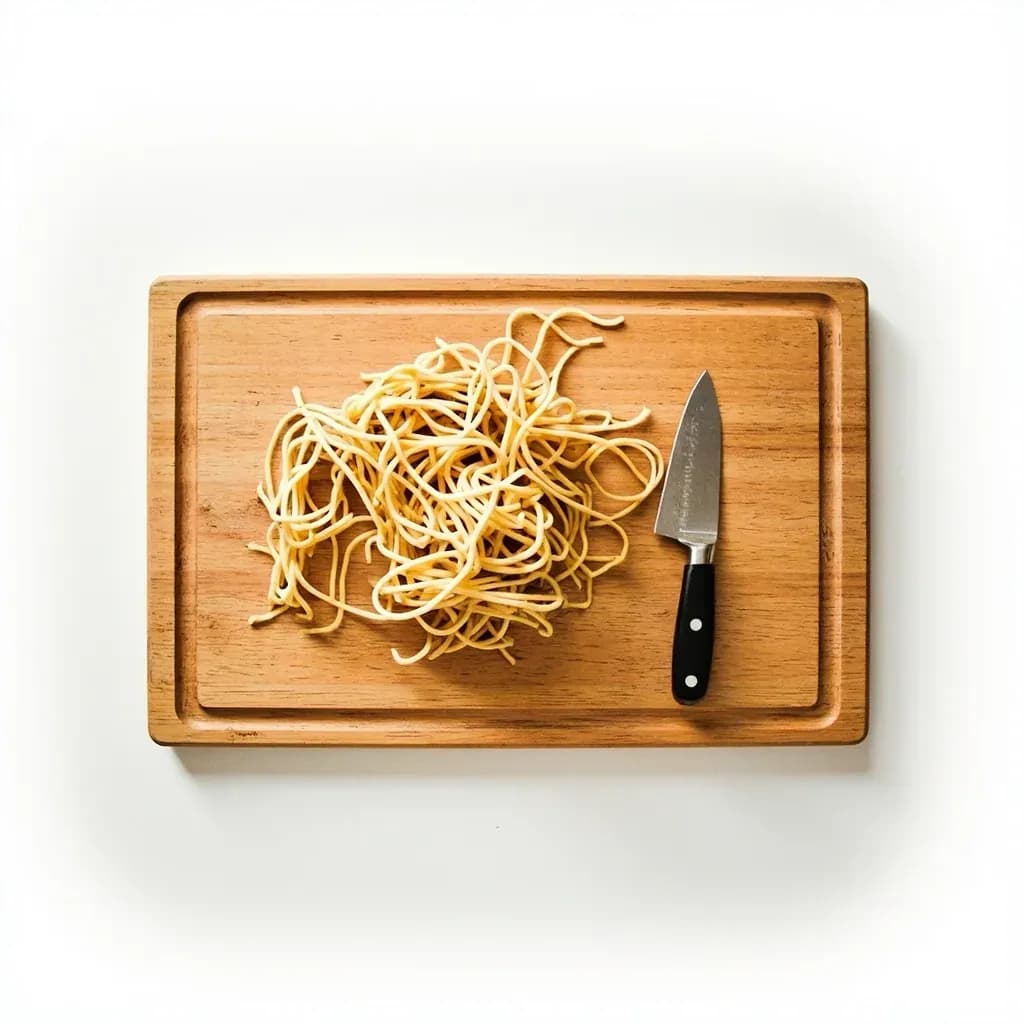
A soba cutting board (manaita) is a broad, flat wooden surface on which sheeted buckwheat dough is folded and sliced into thin, uniform noodles. A wooden cutting guide (komaita) is laid on the dough and stepped along with the knife to keep every cut the same width. The dedicated board gives the long, straight strokes that soba cutting demands.
The soba manaita is not a general-purpose cutting board dressed up for noodles — it is a piece of equipment built around a single partnership: the softwood slab and the wide soba-kiri blade whose guide rides its edge. The board is the rolling surface, the resting surface, the cutting surface, and the catching surface for buckwheat dough, all in one plane, and every choice of material and proportion flows from that job. Soft, resin-free woods like hinoki (Japanese cypress) or kiri (paulownia) are used because they give the single-bevel soba-kiri a kind surface to bite into without dulling it quickly, and because they impart no flavor to a dough that is mostly buckwheat and therefore extremely sensitive to taint.
A defining detail is the one long edge that must remain perfectly straight and undamaged. The soba-kiri's wooden fence slides along that edge as the blade is pushed through the folded dough sheet, and any nick or wobble in the rail translates directly into uneven noodle width across the entire batch. That is also why professional manaita are large — 60 to 70 cm wide and often a meter or more long — and at least 3 to 5 cm thick, with cleats or rubber feet so the board does not walk backward under the force of the cut. At home, a smaller soba set board serves the same geometry, just scaled down.
In practice the manaita, the soba-kiri, the long rolling pin, and the uchiko (fine buckwheat flour) for dusting are bought and used as a matched set. If you only take away one thing from the tool, it is that: the board's value is not in its wood alone, but in the fit between its straight edge and the knife's guide, and the way its soft surface lets the blade glide through a paper-thin buckwheat sheet without tearing it.
Alternatives
Types & varieties
The classic. Hinoki is naturally antibacterial, light, and resin-free, so it does not transfer flavor to the buckwheat dough.
Lighter and cheaper than hinoki, with a very neutral scent; common in home and mid-range setups.
Less common premium option; prized for a tight, even grain.
Large, thick, two-person board used in restaurants, usually cleated directly to the counter.
Smaller and thinner, often sold as a 'soba set' bundled with a soba-kiri and rolling pin.
Modern alternative; easier to sanitize but harder on blade edges and tends to make dough slide rather than grip.
Why the wood is soft
Buckwheat dough is unforgiving. It has very little gluten, dries out fast, and is cut with a long, heavy, single-bevel blade that is itself expensive and time-consuming to sharpen. A hardwood board — end-grain maple, oak, teak — chews into that edge on every stroke and grabs the dough so the sheet tears instead of parting. Softwoods like hinoki and kiri let the blade sink just enough to make a clean cut, then release the noodle, and their straight, even grain is what gives the soba-kiri's guide rail a smooth path to ride. Hinoki's reputation in the Japanese kitchen — from bath buckets to sushi counters — comes from the same qualities that make it ideal here: light, aromatic, gentle on edges, and free of resin that could taint food.
The matched set in practice
A soba workstation is not a board plus a knife plus some flour. It is a system in which each piece constrains the others. The manaita sets the rail width, the soba-kiri sets the noodle thickness, the long rolling pin (genbu or tenobe style) sets the sheet dimensions, and the uchiko sets the friction under the sheet. Change any one of them and the cut changes with it. This is also why a small, dedicated home sobadai is a sensible purchase even for a cook who already owns a fine wooden board: what you are really buying is the matched geometry, not the slab of wood.
- Board, soba-kiri, rolling pin, and uchiko are typically purchased together.
- The board's straight edge is the reference for the soba-kiri's guide — a damaged edge ruins the cut before the knife ever touches dough.
- A home soba set gives you the right geometry in a footprint that fits a normal kitchen counter.
Common uses
Tips & pitfalls
- Dust, don't oil: the soba sheet should sit on a thin, even layer of uchiko, not grease. Too much flour makes the noodles pasty; too little makes them stick and tear.
- Keep one long edge factory-straight and undamaged — the soba-kiri's guide rides on it, and any nick throws off every noodle's width.
- Never soak the board; standing water opens the grain and harbors odor. Scrub with coarse salt and a stiff brush, wipe, and dry upright on edge.
- Season a new hinoki board by wiping it once with food-grade mineral oil, then let it air for a day — and do not oil the cutting face repeatedly or it will slick up the dough.
- Anchor the board with cleats, a damp towel, or non-slip feet; the soba-kiri is pushed forcefully and a wandering board ruins the cut.
- Keep the blade against the dough, not the board: let the knife do the work, since pressing into the wood is what dulls the edge fastest.
- If the dough sheet springs back when you cut, fix the dough, not the board — add uchiko and let it rest under cloth a few more minutes.
- Store on edge in a dry, ventilated spot; flat storage against a wall traps moisture and invites warping.
Good to know
- Japanese name
- Manaita (俎板); soba-specific boards are sometimes called sobadai
- Origin
- Japan; tied to the soba (buckwheat noodle) tradition
- Primary materials
- Hinoki (Japanese cypress, Chamaecyparis obtusa); kiri (paulownia) and katsura are traditional alternatives
- Typical professional size
- Roughly 60–70 cm wide × 90–120 cm long, 3–5 cm thick; home boards are noticeably smaller
- Why softwood
- Softwood is gentle on the single-bevel soba-kiri blade and resists splitting the dough; hardwoods dull the knife and grab the dough
- Companion tool
- Soba-kiri (also called pakkiri-bōchō), a wide rectangular blade with a wooden guide that rides on the board's edge
- Surface treatment
- Dusted with uchiko (fine buckwheat flour) to keep dough from sticking; the working face is not oiled in regular use
- Cleaning
- Coarse salt scrubbed with a stiff brush, then wiped and air-dried standing on edge; never submerged
- Footing
- Often fitted with cleats or non-slip feet so the board stays stationary against the side-to-side cutting force
- Edge profile
- One long edge must be smooth and straight because the soba-kiri's guide rides along it to set noodle width
Also called
Manaita · Soba Cutting Guide · Komaita · Soba Board
Related

Knife
The fundamental cutting tool every kitchen is built around

Chef's Knife
The do-everything blade for chopping, slicing, and mincing

Paring Knife
Small, nimble blade for peeling and detailed in-hand work

Serrated Knife
Saw-toothed blade that slices crusty bread without crushing

Cleaver
Heavy broad blade for chopping through bone and bulk prep

Cutting Board
The stable surface every cut starts on

Mandoline
Adjustable blade for paper-thin, perfectly even slices

Kitchen Shears
Heavy-duty scissors for poultry, herbs, and packaging