Knives & Cutting
Soba Knife (Menkiri Bocho)
Heavy single-bevel Japanese knife that cuts rolled soba dough into uniform thin noodles.
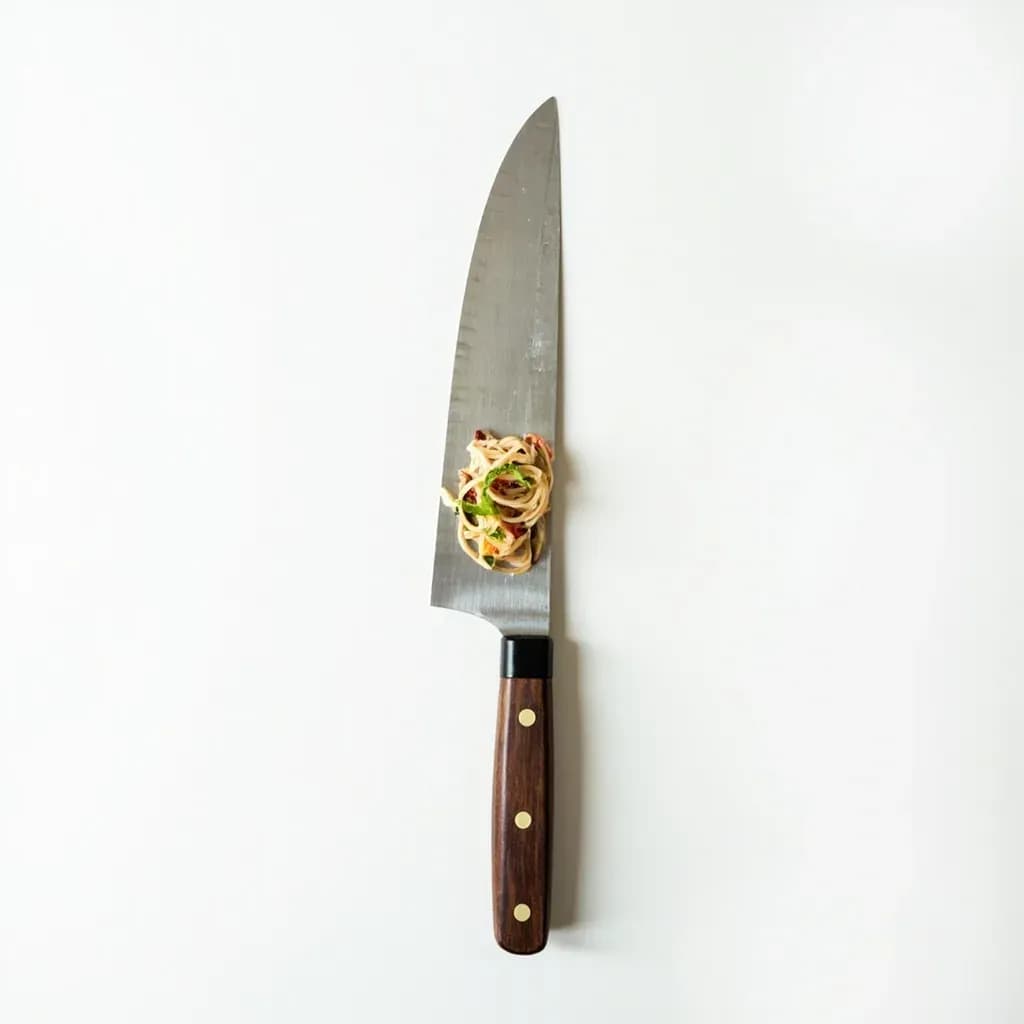
A menkiri bocho is a large, heavy rectangular Japanese knife used to slice folded sheets of buckwheat dough into even soba noodles. Its weight lets the blade drop straight down through the stacked dough, while the flat edge ensures consistent noodle width when used with a guiding board. It's the defining tool of hand-cut soba making.
The menkiri bōchō — literally "noodle-cutting knife" — is the defining tool of the Japanese noodle craftsman. Where a Western chef rocks a chef's knife to slice, the soba knife is held perpendicular to a hardwood board and allowed to fall under its own mass, shearing a rolled log of fresh dough into paper-thin strands through a steady rhythm of clean, decisive drops, one strand per drop. That fall is the whole point: a 1.0–1.8 kg rectangular blade of forged carbon steel, mounted in a wooden sleeve called a dai, uses gravity rather than muscle to do the work, and the resulting cut is clean because the edge never drags through the dough. A properly tuned menkiri paired with a floured soba-kiri ita (cutting board) can produce noodles of almost mathematically uniform width, the kind of consistency that defines a bowl of hand-cut te-uchi soba.
Beyond the cutting action, what distinguishes this knife is its single-bevel geometry. Unlike the symmetric edges of Western or gyuto knives, the menkiri is sharpened only on one face (traditionally the right), which gives it a wedge that enters dough with almost no resistance and a cutting edge that releases cleanly from sticky buckwheat. The rectangular silhouette — typically 30–36 cm along the cutting edge and roughly 7–8 cm from spine to edge — looks more like a slender cleaver than a chef's knife, but the blade is thinner through the body and the spine is not used for chopping. The wooden dai, the orientation of the bevel, the spacing of the board's komi (backstop), and the way the knife is held are all calibrated to one task: turning a sheet or log of dough into noodles of a specific, repeatable width.
Alternatives
Types & varieties
Purely rectangular with a square top and straight cutting edge; the Tokyo standard for delicate te-uchi soba, with maximum sharp edge across the full blade width.
Upper front corner is rounded off (maru-kaku); favored in Osaka and Kyoto for wetter, sturdier doughs like kishimen and Osaka-style soba, where the rounded corner helps the blade enter without tearing.
Shorter 21–24 cm blades used in some traditional shops for very fine strands or smaller batch work; lighter in the hand.
Same form factor as a standard menkiri but matched with a closer-set komi to produce hair-thin strands for kake soba or somen-like cuts.
Modern version with a Western-style handle instead of a wooden dai; easier for home cooks and left-handers, but the lighter balance changes the gravity-driven cut.
Stainless or clad blades aimed at non-professionals; lower maintenance, generally lighter, and not as sharp-holding as traditional carbon.
Thicker, heavier-spined version favored in some shops for stiff, hydrated udon or hiyamugi doughs; silhouette resembles a soba blade but carries more mass behind the edge.
The Cutting Action
The menkiri is not a slicing knife in the Western sense. The user grips the dai, braces the thumb on the top spine, lifts the blade straight up a few centimeters, and lets it fall. Gravity drives the edge through the dough; the hand guides, the weight cuts. Sawing or pressing deforms the dough, drags the komi off-line, and produces ragged, uneven strands. A clean drop produces a distinct, even sound as the edge meets the board, and the blade should rest on the board when it is done, not be driven into it.
This is why a 36 cm professional blade weighs 1.5 kg or more: the mass is the cutting force. Lighter Western-grip models can be used with more deliberate downward pressure, but the signature crisp cut of a Tokyo soba shop comes from the knife doing the work.
- Lift straight up, drop straight down — no horizontal motion.
- Brace the thumb on the spine to control the fall and keep the cut square.
- The blade should feel like a falling weight, not a pushed tool.
The Komi and the Board
The soba-kiri ita is not optional. Its raised wooden backstop, the komi, sits at a fixed distance from the blade's resting position, and that distance is the noodle width. Common komi settings are roughly 1.6 mm, 2.0 mm, 2.4 mm, and 3.0 mm, ranging from fine soba strands at the narrow end to udon and kishimen at the wide end. The same knife cuts all of them; the board is what changes. Keeping the leading edge of the blade and the face of the komi absolutely parallel is the single most important habit of a clean cut.
- Komi width sets noodle width — the knife does not.
- Even a 1 mm misalignment produces visible inconsistency across a portion.
- Dusting the board lightly between cuts prevents the dough from sticking and dragging the komi off-line.
Right-Handed, and Proudly So
Almost every menkiri bōchō in a professional kitchen is sharpened on the right face. The single bevel is not a design oversight — it produces the wedge angle and clean release that make the cut possible. Left-handed craftsmen generally commission a mirror-image hidari blade, and these are rare, expensive, and sometimes passed down. A left-handed home cook using a right-handed knife can still cut soba, but the cut will be slightly ragged and the knife will tend to wander; for serious work, a custom blade is the answer.
- Right-handed bevel is the professional default.
- Left-handed versions are custom-forged and treated as heirlooms.
- Western-handle models are a compromise — easier to use, but not the same tool.
Common uses
Tips & pitfalls
- Let the knife fall under its own weight — pushing or sawing tears the dough and dulls the edge.
- Mount the dai in your hand with the thumb braced on the top spine; this controls the fall and keeps the cut square to the board.
- Keep the komi and the leading edge of the blade at exactly the same width; a wider komi produces noodles that vary from side to side.
- Flour the board and the dough generously (a 1:4 buckwheat-to-wheat dusting works for te-uchi soba); a tacky dough drags and tears.
- Change noodle width by swapping the komi, not the knife — 1.6, 2.0, 2.4, and 3.0 mm are the standard settings.
- Dry a carbon blade immediately after washing and never store it in a damp dai; moisture wicks into the tang and splits the wooden sleeve.
- For home use, a 27–30 cm blade is far more manageable than the 36 cm professional size and still produces a full single portion.
- Curl the cutting-hand fingers into a claw with the index finger bent vertical as a guide — a guard is unnecessary when the knife is dropped straight, and a guard interferes with the rhythm of the cut.
Good to know
- Japanese name
- 麺切り包丁 (menkiri bōchō), also called sobakiri bōchō
- Origin
- Japan; developed during the Edo period (1603–1868) alongside the rise of hand-cut soba
- Blade shape
- Wide rectangular blade, resembling a slender upright cleaver
- Bevel
- Single-bevel (kataba), traditionally on the right side; left-handed versions are custom-forged and rare
- Steel
- Traditional: high-carbon shirogami (white) or aoko (blue) steel; modern stainless and clad versions exist for home cooks
- Typical blade widths
- 24, 27, 30, 33, and 36 cm along the cutting edge; 36 cm is the professional standard for a single portion
- Weight
- Roughly 1.0–1.8 kg for a 36 cm blade; weight is functional, not incidental
- Paired board
- Used on a soba-kiri ita, a hardwood board with a raised wooden komi (backstop) that sets noodle width
- Cutting action
- Held vertically and dropped under gravity; never drawn or sawed
- Famous production centers
- Sakai (Osaka) and Tsubame-Sanjo (Niigata) for professional-grade blades
Also called
Menkiri Bocho · Soba Kiri · Noodle Knife
Related

Knife
The fundamental cutting tool every kitchen is built around

Chef's Knife
The do-everything blade for chopping, slicing, and mincing

Paring Knife
Small, nimble blade for peeling and detailed in-hand work

Serrated Knife
Saw-toothed blade that slices crusty bread without crushing

Cleaver
Heavy broad blade for chopping through bone and bulk prep

Cutting Board
The stable surface every cut starts on

Mandoline
Adjustable blade for paper-thin, perfectly even slices

Kitchen Shears
Heavy-duty scissors for poultry, herbs, and packaging