Cookware
Stainless Steel Skillet
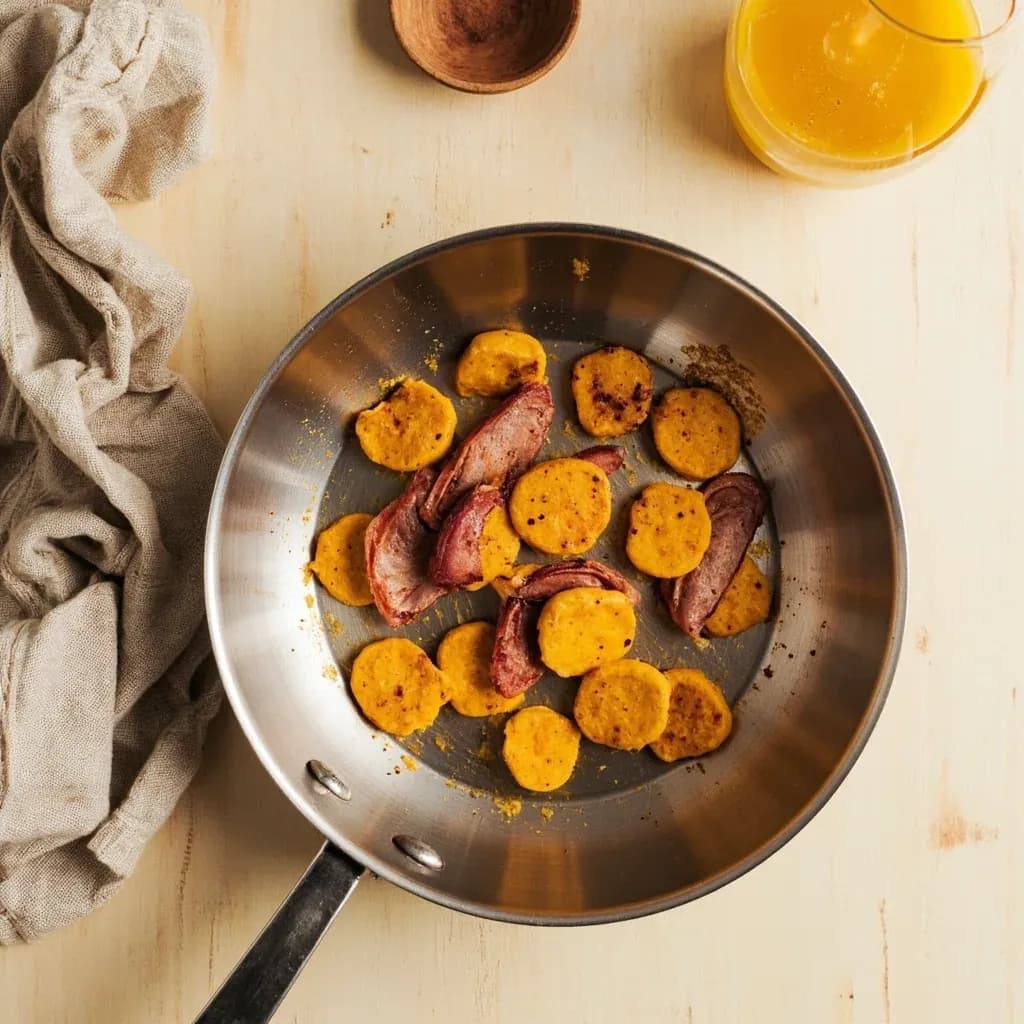
Bare tri-ply stainless skillet that builds deep fond for pan sauces and deglazing; food sticks until properly preheated, unlike a release-coated nonstick or a seasoned cast-iron pan.
The stainless steel skillet is the workhorse of professional kitchens and the most versatile pan in a serious home cook's battery. At its core it is a layer of austenitic stainless steel — typically 18/10 (18% chromium, 10% nickel) — bonded to a core of aluminum or copper that does the actual work of moving heat across the cooking surface. The polished steel interior is non-reactive (it will not leach metallic flavor into tomatoes, wine, or lemon), induction-compatible when the outer layer is magnetic stainless, and oven-safe to 500°F or higher depending on the handle. What sets stainless apart from both cast iron and nonstick is its searing behavior: a properly preheated stainless pan builds a genuinely deep, browned crust through the Maillard reaction and leaves behind fond — those caramelized drippings that become the foundation of a pan sauce.
The pan's reputation for sticking is, paradoxically, its greatest asset. Stainless has no release coating and is not seasoned like cast iron; food bonds to the surface on contact and only releases once a crust has formed. Cooks who learn the cues — the water-bead test, the moment oil shimmers, the visible browning creeping up the side of a steak — find that the pan releases food reliably and the fond can be lifted with wine, stock, or even water for a quick sauce in minutes. This is the same logic behind classic French techniques like steak au poivre, pan-basted fish, and chicken fricassée, and it is why virtually every professional range has at least two or three stainless pans at the ready.
Choosing among tri-ply, five-ply, copper-core, and disc-bottom constructions is mostly a question of how evenly you want the rim to heat and how much weight you are willing to lift. A 10-inch tri-ply skillet weighing roughly 2.5 to 3 pounds is the standard recommendation for a home kitchen; heavier multi-clad and copper-core pans cost more but respond faster and eliminate the hot spot at the rim that plagues cheaper disc-bottom designs, where the cooking surface extends beyond the bonded disc.
Alternatives
Types & varieties
Stainless interior and exterior sandwiching a single aluminum core; the standard construction for most home and restaurant skillets.
Alternating stainless and aluminum (sometimes copper) layers; more even heating and greater heat retention, heavier and pricier.
Stainless-clad copper core for the fastest heat response and the most even rim-to-rim heating; premium price (Demeyere, All-Clad Copper Core, Mauviel M'Cook).
Thick aluminum or steel disc bonded only to the base, not the walls; cheaper, but creates a hot spot at the rim where the cooking surface extends beyond the disc.
18/10 (higher nickel) is the polished, corrosion-resistant interior; 18/0 (magnetic, nickel-free) is the induction-compatible outer layer in most clad pans.
Skillets have sloped sides for tossing and easy slide-out; sauté pans have straight, taller sides and usually a lid. Same construction logic.
The Learning Curve: Preheating and Release
The single biggest adjustment for cooks coming from nonstick is patience at the start. Stainless steel demands a proper preheat before food ever touches the surface, and the cues are physical rather than visual. The standard test is the Leidenfrost point: flick a few drops of water onto the dry, heating pan. If the droplets sit and boil, the pan is too cold. When they bead up and skate across the surface, evaporating in two or three seconds, the pan is at the right temperature for cooking with oil.
- Add oil only after the preheat is complete; it should shimmer and just begin to smoke before food goes in.
- Salt the protein and let it rest at room temperature for 10–15 minutes for a dry surface and even seasoning.
- Resist the urge to peek or flip. A protein releases itself once the Maillard crust is set; if it resists when you nudge it, give it another 30–60 seconds.
- Crowding the pan drops the surface temperature and causes steaming rather than searing. Cook in batches, or use a larger pan.
Why Fond Matters
The browned residue that clings to a stainless pan after searing is not waste — it is concentrated flavor. Deglazing immediately after removing the protein with wine, stock, or even water lifts those caramelized sugars and amino acids into a sauce in under five minutes. This is the mechanic behind pan-basted fish, steak au poivre, and the quick pan sauces that finish a weeknight chicken breast. A stainless skillet is, in practical terms, a sauce pot and a sauté pan in one.
Common uses
Tips & pitfalls
- Preheat the empty pan over medium heat for 2–3 minutes, then test with a few water droplets — they should bead and dance (Leidenfrost) before you add oil.
- Add oil only after the preheat, and wait until it shimmers and just begins to smoke before adding food.
- Resist flipping early. Proteins release naturally once a crust has formed; if it sticks when you nudge it with a spatula, wait another 30–60 seconds.
- Avoid high heat for an empty preheat — overshooting can warp thin pans and pit the steel once salt hits a hot, dry surface.
- Do not run a hot empty pan under cold water. Thermal shock can warp the base or crack handles.
- Clean with hot water, a soft sponge, and a paste of Bar Keepers Friend to remove stuck fond and rainbow discoloration — both are cosmetic, not structural.
- Skip the dishwasher if cosmetics matter: chlorine residues cause iridescent heat tint on the polished interior.
- Store with a paper towel or pan protector between stacked pans to prevent scratches on the polished surface.
Good to know
- Material
- Austenitic stainless steel (typically 18/10 or 18/8 — 18% chromium, 8–10% nickel) with an aluminum or copper core that conducts heat
- Heat conduction
- Aluminum or copper core moves heat roughly 15–20× faster than stainless alone; stainless contributes durability and non-reactivity
- Invention
- Stainless steel developed by Harry Brearley in Sheffield, 1913; clad cookware brought to market by All-Clad in 1971
- Standard sizes
- 8-inch, 10-inch, and 12-inch diameters are most common; 14-inch exists for restaurant ranges
- Typical weight
- 10-inch tri-ply skillet ≈ 2.5–3 lb; 5-ply or copper-core ≈ 3.5–5 lb
- Oven safe
- 500–600°F with all-stainless handles; ~350°F with phenolic or riveted plastic handles
- Reactivity
- Non-reactive with acidic ingredients — tomatoes, wine, citrus — unlike bare aluminum or unseasoned cast iron
- Release cue
- Leidenfrost effect — water droplets bead and dance across the surface when properly preheated
Also called
stainless skillet · tri-ply skillet · fry pan · stainless fry pan
