Knives & Cutting
Steak Knife
Sharp table knife, often serrated, for cleanly cutting cooked meat at the plate.
A sharp, often serrated table knife used to cut cooked steak and other meats while eating. Its keen edge slices through seared crust and fibers without tearing, so each bite stays neat. Steak knives are sold in sets and may be straight-edged for the cleanest cut or serrated for grip on tough crusts.
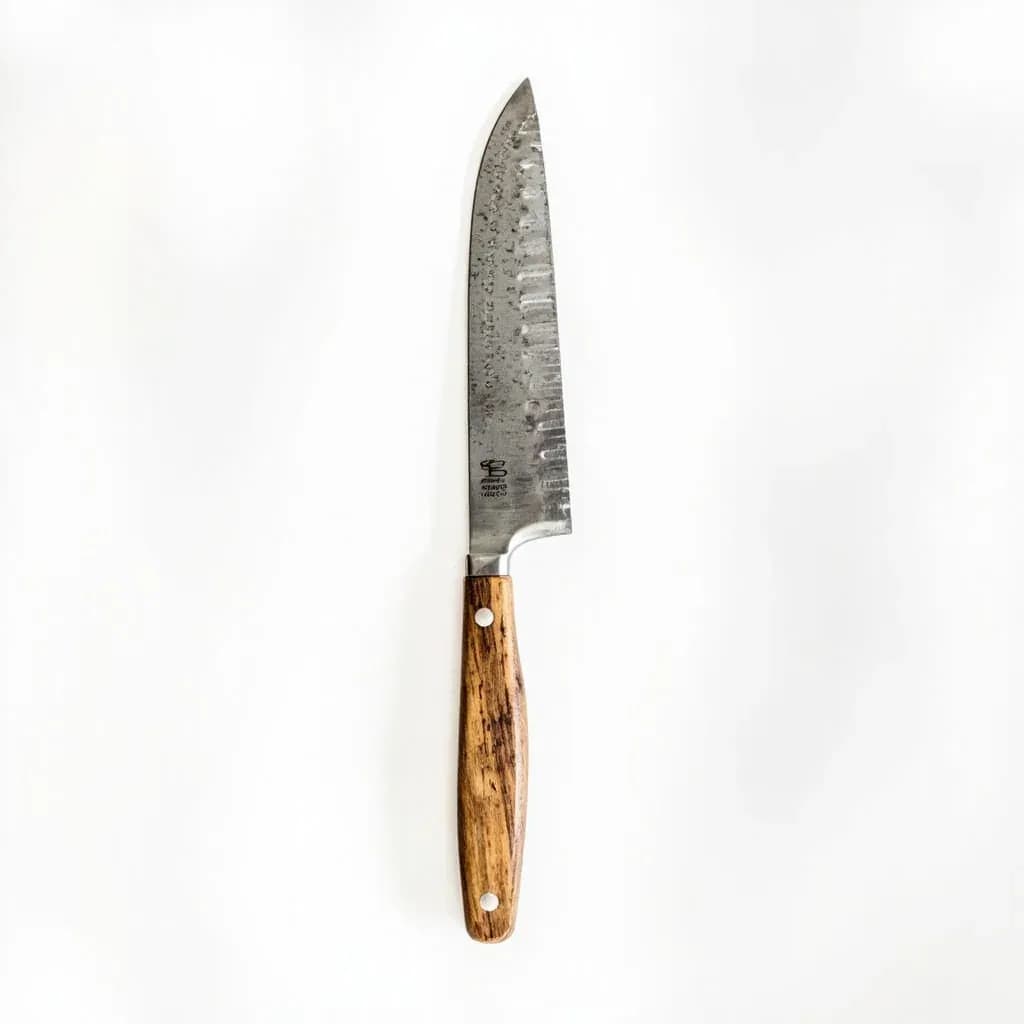
A steak knife is a table-side cutting tool built to slice through cooked meat cleanly without the bulk or profile of a chef's knife. It is almost always full tang — the steel runs continuously from tip through handle — because the twisting forces that come from cutting at the plate demand a rigid spine. Blade length sits in a narrow band of roughly 4 to 5 inches, with about 4.5 inches the most practical size: long enough to span a thick pork chop or a slice of prime rib, short enough to keep the wrist in control over a dinner plate. The shape echoes a small chef's or utility knife, with a pointed or rounded tip and a gently curving edge, sized down to the proportions of a place setting.
The defining design question is serrated versus straight edge, and the two camps reflect different ideas about what a steak knife is for. Aggressive American-style serrations were sold in the mid-20th century as "permanently sharp" — the scalloped teeth saw through meat fibers and keep feeling sharp for years, but they tear more than they slice and are nearly impossible to truly resharpen. Straight edges, favored by most chefs and by European and Japanese makers, glide through protein with less damage and less juice loss, but they ask for periodic honing and the occasional stone. Micro-serrated and granton designs sit between those poles as compromises, trading some cutting purity for some ease of care.
In practical use, a good steak knife should pass through a medium-rare ribeye with the edge doing the work, not the wrist. A dull or wrong-style knife will shred the meat, squeeze out juices onto the plate, and turn a properly cooked steak into a chore to eat. Choosing a set is mostly a matter of deciding how much maintenance you are willing to do, and matching the handle to the hand that will use it.
Alternatives
Types & varieties
The mainstream consumer style. Aggressive scalloped teeth saw through meat and feel sharp for years, but tear rather than slice, and are difficult to truly resharpen.
Preferred by most chefs and serious cooks. Slices cleanly with less tearing and juice loss; needs periodic honing and occasional sharpening on a whetstone.
Very fine, shallow teeth common on Laguiole-style knives. A middle path — some bite through crust, far easier to refresh than deep serrations.
Smooth edge with shallow scalloped dimples along the blade. Reduces sticking when slicing roasts and longer cuts; little benefit on a single steak.
French traditional shape with a slim handle, full tang, and a decorative bolster emblem (often a bee). The Laguiole name is a contested trademark; the design is widely copied.
Forged or stamped blades from makers like Wüsthof, Zwilling J.A. Henckels, Güde, and similar makers. Heavier, with riveted synthetic or wood handles, usually straight edge.
Thin, hard, straight-edge blades that take an extremely fine edge and cut beautifully, but chip more easily against bone or ceramic plates.
Edge Types Explained
Steak knives come in four edge geometries, and choosing between them is the single biggest decision when buying a set. Each is a real trade-off between cutting quality and how much maintenance you are willing to do.
- Serrated: Deep, scalloped teeth that saw through crust and fibers. They feel sharp for a long time because new tooth points keep presenting, but they tear cell walls and produce ragged cuts. Once dull, they need a tapered rod worked inside each gullet — a flat stone will not reach. Best for buyers who never want to think about sharpening.
- Straight edge: A clean, polished bevel that slices rather than saws. Cleaner cuts, less juice loss, easy to maintain on a standard whetstone. The cost is honest: a straight edge needs periodic honing and occasional full sharpening.
- Micro-serrated: Very fine, shallow teeth, often on Laguiole-style knives. They give some bite through crust without the tearing of aggressive serrations, and are far easier to refresh on a fine rod or small stone. A good middle path.
- Granton (hollow-edge): A smooth edge with shallow dimples along the blade. The dimples create tiny air pockets that reduce sticking on long slices through roasts. On a single steak it cuts much like a plain straight edge; the benefit shows up with longer work.
Common uses
Tips & pitfalls
- Choose straight edge over heavily serrated if you want clean slices with less tearing and less juice loss; the occasional stone sharpening is a small price for a better bite.
- Test sharpness on a ripe tomato set on a cutting board — the knife should pierce the skin with almost no downward pressure.
- Maintain serrated blades with a tapered rod worked inside each gullet; a flat whetstone will not reach the cutting surfaces.
- Hand wash and towel dry immediately after use. Dishwasher heat warps thin handles, loosens rivets, and pits the edge.
- Store so the edge never touches another knife — a wooden block, an in-drawer tray, or a magnetic strip all work; loose drawer storage is the fastest way to ruin a set.
- Choose handle shape by feel, not by looks. Round, slim Laguiole handles suit small hands; contoured German handles suit larger grips. Balance should sit just forward of the bolster.
- Replace one knife at a time rather than re-buying a whole set — quality makers sell individual pieces to extend the life of a good set.
- Cut straight down and pull back to slice; avoid dragging the edge sideways across stoneware or ceramic plates, which dulls even hard steel quickly.
Good to know
- Blade length
- Typically 4–5 in (10–13 cm); 4.25–4.75 in is the practical sweet spot
- Blade steel
- Usually high-carbon stainless steel such as X50CrMoV15 in German makes; AUS-10 or VG-10 in premium Japanese-style blades
- Rockwell hardness
- Around 55–58 HRC for German-style blades; 58–60 HRC for harder Japanese-style steels
- Construction
- Almost always full tang (riveted or one-piece) to resist twisting force at the table
- Edge types
- Serrated, micro-serrated, straight (smooth), and granton (hollow-ground scallops)
- Handle materials
- Pakkawood, rosewood, olive wood, stabilized hardwood, stainless steel, POM resin, bone, and occasionally horn
- Typical set size
- Sold in sets of 4, 6, or 8; quality makers sell individual replacements
- Care
- Hand wash and towel dry; dishwasher heat warps thin handles, loosens rivets, and pits the edge
Also called
Table Knife · Meat Knife
Related

Knife
The fundamental cutting tool every kitchen is built around

Chef's Knife
The do-everything blade for chopping, slicing, and mincing

Paring Knife
Small, nimble blade for peeling and detailed in-hand work

Serrated Knife
Saw-toothed blade that slices crusty bread without crushing

Cleaver
Heavy broad blade for chopping through bone and bulk prep

Cutting Board
The stable surface every cut starts on

Mandoline
Adjustable blade for paper-thin, perfectly even slices

Kitchen Shears
Heavy-duty scissors for poultry, herbs, and packaging