Cookware
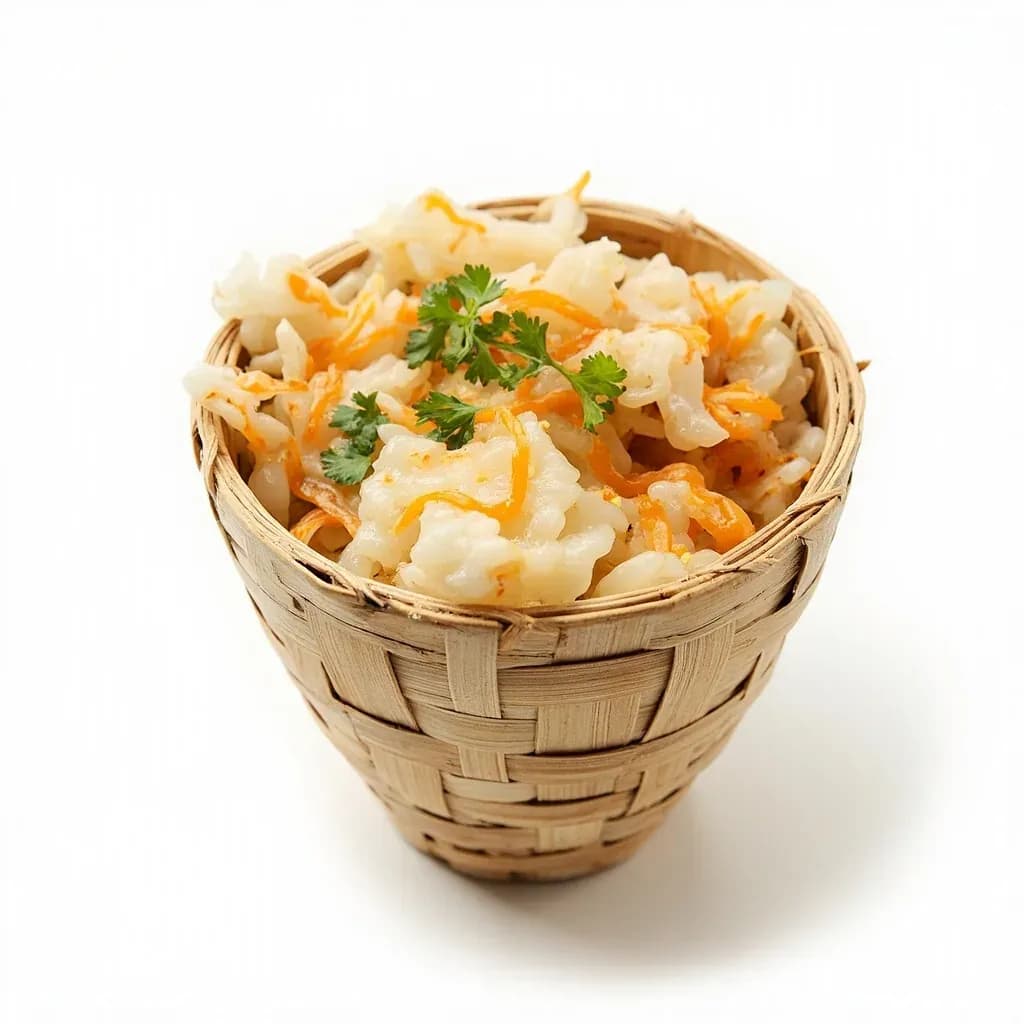
Woven Sticky Rice Basket (Kratip Khao)
A woven bamboo basket for steaming and serving Lao and Thai sticky rice.
A sticky rice basket is a conical or bell-shaped woven bamboo basket used in Laos and northern Thailand to steam soaked glutinous rice over a pot of boiling water. The open weave lets steam pass through while keeping grains together, producing fluffy, separate sticky rice. A second smaller lidded basket, the kratip, then holds the cooked rice warm at the table.
The kratip khao (Lao: ກະຕິບຂົວ; Thai: กระติบข้าว, literally 'rice basket') is the tall, hand-woven bamboo or rattan container that sits at the center of every Lao meal and on most tables in northeastern Thailand. Despite the name, it is not where sticky rice is cooked — it is where already-steamed glutinous rice is held, served, and kept pliable for the next several hours. Its open, breathable weave does the opposite of what a tight-lidded pot would: it lets excess moisture escape so the grains stay tender and separate instead of collapsing into a gummy mass, and it traps just enough warmth to keep the rice soft while diners eat at their own pace.
What makes the basket matter to a cook is the way it shapes the meal. Diners reach in with their right hand, pinch off a small lump, and roll it between the fingers into a ball before dipping it into jeow (chili-based relishes), larb, som moo, or grilled fish. The same basket is the traditional to-go container: a small individual kratip with its snug lid lets a laborer, market vendor, or schoolchild carry a portion of rice for hours without it going limp or sour. A well-made basket, dried and stored properly, will serve a household for decades.
Alternatives
Types & varieties
Tall, slightly tapered cylinder with a snug domed lid and a tight fine weave that holds warmth without trapping steam
Similar tall cylinder, often with a small loop or knob on the lid; commonly made from dyed bamboo strips
Shorter and rounder, sometimes with a wider mouth; paired with sticky rice eaten alongside northern relishes
Single-serving size carried to market or work; the classic 'sticky rice to go' container
Large size set on the dinner table so diners reach in with their right hand to roll a small ball of rice
Body and domed lid woven as separate nesting pieces; the most common form in Laos
Mass-produced plastic versions mimic the woven look for casual use; they do not breathe like bamboo and can make rice sweat and go soggy
Using the basket at the Lao table
The kratip is set on the table unopened, lid on, and usually placed to the right of the main dish or in the center of a shared spread. The host or a diner lifts the lid just before eating. Everyone uses their right hand only — the left is considered unclean in Lao and Thai etiquette — and takes a small pinch rather than a large handful, so the rice in the basket stays intact and warm for the next person.
- Pinch off a piece roughly the size of a small egg; roll it between the palm and fingertips into a tight ball.
- Press the rice ball into the jeow, or use it to scoop up larb, som moo, or a piece of grilled fish.
- Replace the lid between servings to keep the remaining rice soft and just-warm.
- Never spear the rice with a fork or spoon — at a traditional table there are no utensils for the rice itself.
Care and longevity
A good kratip needs almost nothing, which is exactly why it survives decades in Lao kitchens. Bamboo and rattan are already seasoned by smoke and air during weaving; adding water or soap shortens their life dramatically.
- After each use, shake out loose grains and wipe the interior with a barely damp cloth if needed.
- Sun-dry the basket upside down so air circulates through the weave; store in a dry, ventilated spot.
- Before first use, rinse briefly, air-dry, and rub the inside lightly with coconut oil to condition the fibers.
- If rice starts sticking, the basket or rice is too wet; if the rice dries out fast, mist it lightly before serving.
Common uses
Tips & pitfalls
- Never put the basket on the stove, in the oven, or over steam — it is a serving vessel, not a steamer.
- Let sticky rice cool for a few minutes after steaming before transferring it to the basket so trapped steam does not turn the grains soggy.
- Leave the lid slightly ajar while the rice is still very warm, then close it once the rice is just-warm to keep it soft without making it gummy.
- Eat with the right hand only — pinch a small piece and roll it into a ball before dipping into jeow, larb, or grilled fish.
- To clean, shake out grains, wipe with a barely damp cloth, and sun-dry; do not soak or use dish soap or the weave will swell and split.
- Keep the basket in a dry, ventilated spot — trapped moisture invites mildew and a sour smell in the bamboo.
- Buy from Lao or Isan makers when possible; tightly woven, evenly lashed baskets outlast tourist-market versions with loose splints.
- If rice sticks to the basket, the rice or the weave is too wet; mist the rice lightly or line the basket briefly with a piece of clean banana leaf.
Good to know
- Also called
- Kratip khao (Lao) or krathip khao (Thai); literally 'rice basket'
- Material
- Hand-woven strips of bamboo or rattan, lashed with thin bamboo splints
- Origin
- Laos and the Lao-speaking Isan region of northeastern Thailand; also used in northern Thailand
- Companion rice
- Khao niao / khao neow — Lao and Thai glutinous (sticky) rice
- Role at the table
- Serving and short-term storage vessel for already-steamed sticky rice — never placed over heat
- Typical sizes
- Individual (≈15–20 cm tall, 1–2 servings) to communal (≈25–35 cm, 6–8 servings)
- Lid
- Tight-fitting woven domed or flat cover, sometimes called a kra-tok
- Cleaning
- Air- or sun-dry only; the open weave should never be soaked or scrubbed with soap
Also called
Kratip Khao · Bamboo Sticky Rice Steamer · Huad
Related

Steamer
Gentle moist heat that keeps vegetables, fish, and dumplings tender

Frying Pan
Shallow sloped pan for frying, sautéing, and quick sears

Saucepan
Tall, straight-sided pot for sauces, grains, and small batches

Sauté Pan
Wide straight-sided pan with room to brown and braise

Dutch Oven
Heavy lidded pot that turns tough cuts tender over hours

Stock Pot
Tall, roomy pot for stocks, pasta, and big-batch cooking

Wok
High-sided bowl pan built for blistering-hot stir-fries

Griddle
Flat, broad surface for pancakes, smash burgers, and breakfast