Knives & Cutting
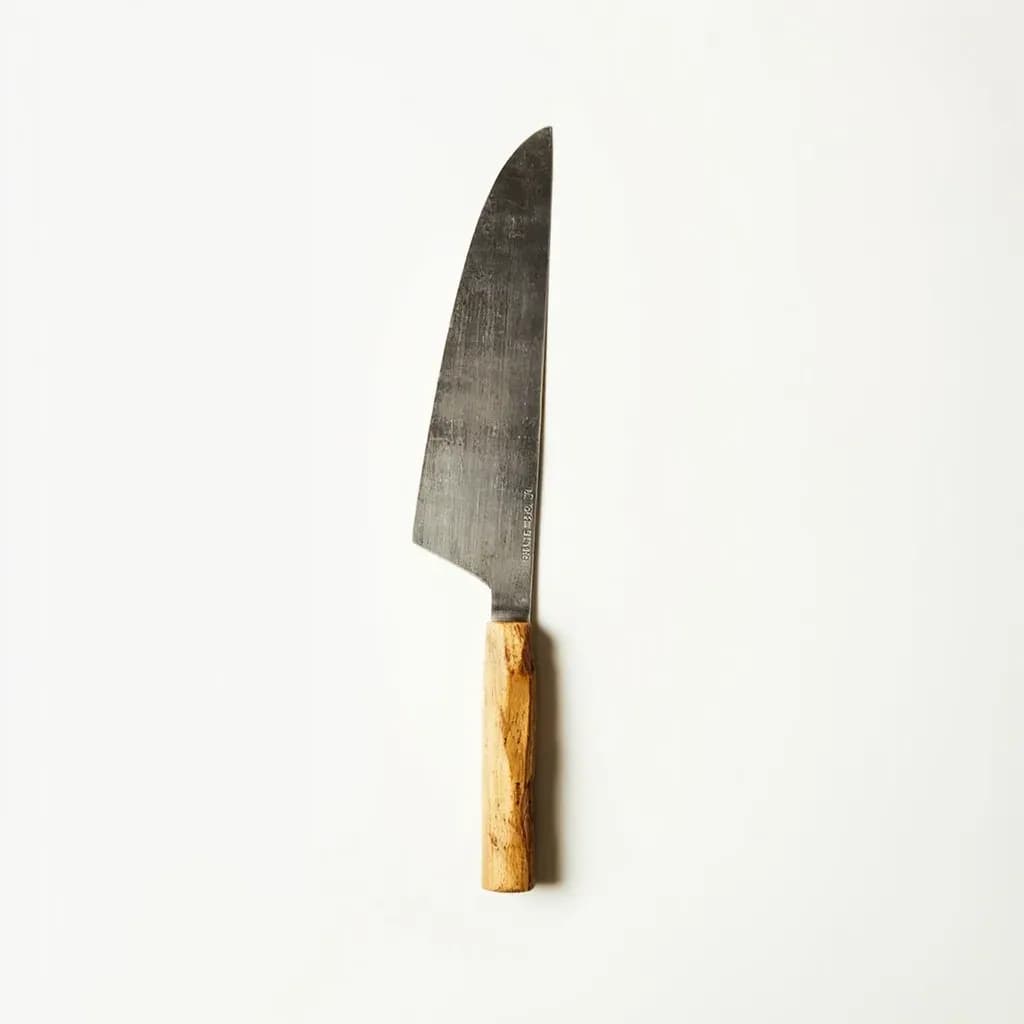
Teppan Palette Knife
Thin flexible blade used on a teppan griddle to slide under, lift, and portion food.
A long thin-bladed palette knife used at the teppanyaki griddle to slide beneath delicate foods, flip them, and portion meats and vegetables. Its flexible edge gets cleanly under fish, eggs, and pancakes on a flat hot surface without tearing them. Teppan chefs often pair it with a spatula for showmanship and precise cutting.
A teppan palette knife is the Japanese hera (へら) in its working clothes: a thin, flat, rectangular blade with a lightly sharpened leading edge and a handle built to live against a 200 °C iron griddle. It is the defining tool of the teppan, the spatula that okonomiyaki, monjayaki, and yaki-udon cooks reach for the moment a batter has set and the work of lifting, folding, and portioning begins. Without it, a delicate cabbage-and-batter cake tears in half; with it, the same cake can be flipped, sliced into wedges, and slid onto a plate in one clean motion.
What separates a hera from a fish spatula, a bench scraper, or a pastry palette is geometry and heat tolerance. The blade is sized to a single griddle portion — typically 10–15 cm wide and only 1–1.5 mm thick — so it slides fully under an okonomiyaki without sawing at the crust. The leading edge is honed just enough to portion food in place, while the sides remain blunt and flat so they do not score the iron. The handle, whether a riveted magnolia grip or a one-piece stainless full tang, is meant to sit over heat for a full service.
In practice, the tool does five jobs at once: lifting, pressing, cutting, scraping, and plating. That combination is why a teppan cook keeps one within arm's reach, and why a chef's knife or a slotted fish spatula, however good they are elsewhere, are poor substitutes on a hot griddle.
Alternatives
Types & varieties
Wide, rectangular, slightly flexible Japanese-style spatula; the classic choice for Osaka-style okonomiyaki.
Smaller, narrower, and often rounded at the tip; sized for working in a shallow monjayaki pan.
Perfectly square leading edge; favored for clean, straight cuts when portioning large griddle items.
Rounded leading corners; gentler under delicate batters, common in casual okonomiyaki restaurants.
Traditional magnolia or walnut handle on a riveted or welded tang; lighter in the hand and cooler to grip.
One-piece stamped or full-tang stainless; preferred in commercial kitchens for sanitation and dishwasher tolerance.
Thinner, stiffer, and holds a sharper portioning edge; requires the same care as a carbon-steel knife.
How it differs from a fish spatula, bench scraper, or pastry palette
These four tools look related, but only one is built for sustained contact with a 200 °C iron surface while a delicate batter is setting underneath. A fish spatula is long, narrow, and angled; it excels at lifting a single fillet from a pan, but its narrow footprint and bent handle make it clumsy when portioning a 25 cm round of okonomiyaki. A bench scraper is stiffer, with a sharp rectangular edge designed to cut cold dough on a marble surface — fine on a counter, too aggressive on a seasoned iron griddle, where the corners will eventually score the metal. A pastry palette (the long, offset, cranked French blade) is built for spreading frosting, not for sliding under wet batter, and its offset geometry leaves the blade tip far from the cook's hand, which is the opposite of what you want on a teppan.
A hera is sized to a single portion, sits flat against the cooking surface, and has a handle aligned with the blade so the cook can see and steer the leading edge. The sides are blunt so they glide along the griddle without cutting it, while only the front edge is sharpened — and only enough to portion, not to chop.
- Fish spatula: long, narrow, angled — good for a single fillet, poor for a 25 cm round of batter.
- Bench scraper: stiff and sharp on three edges — designed for cold dough, will score a seasoned iron griddle.
- Pastry palette: long offset blade — built for frosting and spreading, not for sliding under hot batter.
- Hera (teppan palette knife): flat, portion-sized, blunt on the sides, lightly sharp at the front — built for the griddle.
The hera tradition
The word hera simply means 'spatula' or 'paddle' in Japanese, and the tool family is older than any modern teppanyaki restaurant. Small hera have long been used to portion and serve fish from a grill, fold rice in a hangiri, and spread batter in shallow pans. The wider, griddle-specific version is closely tied to two Osaka street foods — okonomiyaki, the thick savory pancake, and monjayaki, its runnier cousin cooked and eaten from a flat steel teppan — and to the postwar growth of teppanyaki restaurants where cooks build a complete meal in front of the guest on a flat iron surface.
Regionally, Osaka okonomiyaki shops tend to use the wider rectangular hera, sometimes with a wooden handle and a slightly flexible body, while monjayaki specialists prefer a smaller rounded-tip version that fits the shallow pan and can scrape the last caramelized bits toward the diner. Commercial teppanyaki counters often run an all-stainless version that can go through a sanitizer between courses. The differences look minor on a shelf, but a cook who has used both feels them immediately.
- Hera (へら) is a generic Japanese word for spatula or paddle; the teppan version is one specialized branch of that family.
- Osaka okonomiyaki shops typically use the wide, rectangular, slightly flexible hera with a wood handle.
- Monjayaki shops use a smaller, narrower, often round-tipped hera sized to the shallow pan.
- Commercial teppanyaki counters favor one-piece stainless hera for sanitation between courses.
- The English name 'teppan palette knife' is descriptive, not a brand; the underlying design is the same Japanese hera.
Common uses
Tips & pitfalls
- Choke up on the handle — grip close to the blade so the leading edge, not the handle, does the steering.
- Get the blade fully under the food before you lift; a half-inserted blade is the single most common cause of a torn okonomiyaki.
- Keep the leading edge lightly honed; the knife's main job after lifting is portioning, and a dull edge crushes the crust instead of cutting it.
- Wipe carbon-steel versions dry and oil them the moment you finish, exactly as you would a carbon-steel knife, to prevent flash rust.
- Don't pry with the tip — the thin blade will flex and the leading edge can kink. Push straight, don't lever.
- On a hot griddle, slide a damp cloth or brush a thin film of water under the blade to steam-lift sticky batters; the steam release prevents the bottom from tearing.
- Use two hera when flipping a large okonomiyaki: one to lift, one to support the fold. Trying it solo is how half the cake ends up on the griddle.
- Resist the urge to substitute a chef's knife or a slotted fish spatula on a hot teppan; the geometry and heat tolerance are wrong, and you will score the griddle.
Good to know
- Tool type
- Flat, thin-bladed turning tool (a griddle/palette knife) used on a teppan or flat-top griddle
- Primary use
- Sliding under, lifting, flipping, pressing, cutting, and portioning food directly on the cooking surface
- Blade material
- Typically stainless steel; pro or traditional versions are carbon steel for a thinner, stiffer edge
- Blade shape
- Rectangular or gently rounded rectangle, flat with a slight forward bevel; only the leading edge is sharpened
- Typical blade width
- Roughly 4–6 in (10–15 cm) — wide enough to support a whole okonomiyaki or a row of ingredients
- Blade thickness
- Thin, often 1–1.5 mm, so it slides under delicate batters without tearing
- Origin
- Japan — developed for use on a teppan (flat iron griddle) in teppanyaki, okonomiyaki, and monjayaki cooking
- Also known as
- Hera (へら), teppan spatula, griddle palette knife; round-tip Osaka versions are sometimes called ko-zara hera
- Cleaning
- Hand wash and dry immediately; carbon-steel versions need a thin oil coat to prevent rust
Also called
Teppan Palette · Griddle Palette Knife
Related

Knife
The fundamental cutting tool every kitchen is built around

Chef's Knife
The do-everything blade for chopping, slicing, and mincing

Paring Knife
Small, nimble blade for peeling and detailed in-hand work

Serrated Knife
Saw-toothed blade that slices crusty bread without crushing

Cleaver
Heavy broad blade for chopping through bone and bulk prep

Cutting Board
The stable surface every cut starts on

Mandoline
Adjustable blade for paper-thin, perfectly even slices

Kitchen Shears
Heavy-duty scissors for poultry, herbs, and packaging