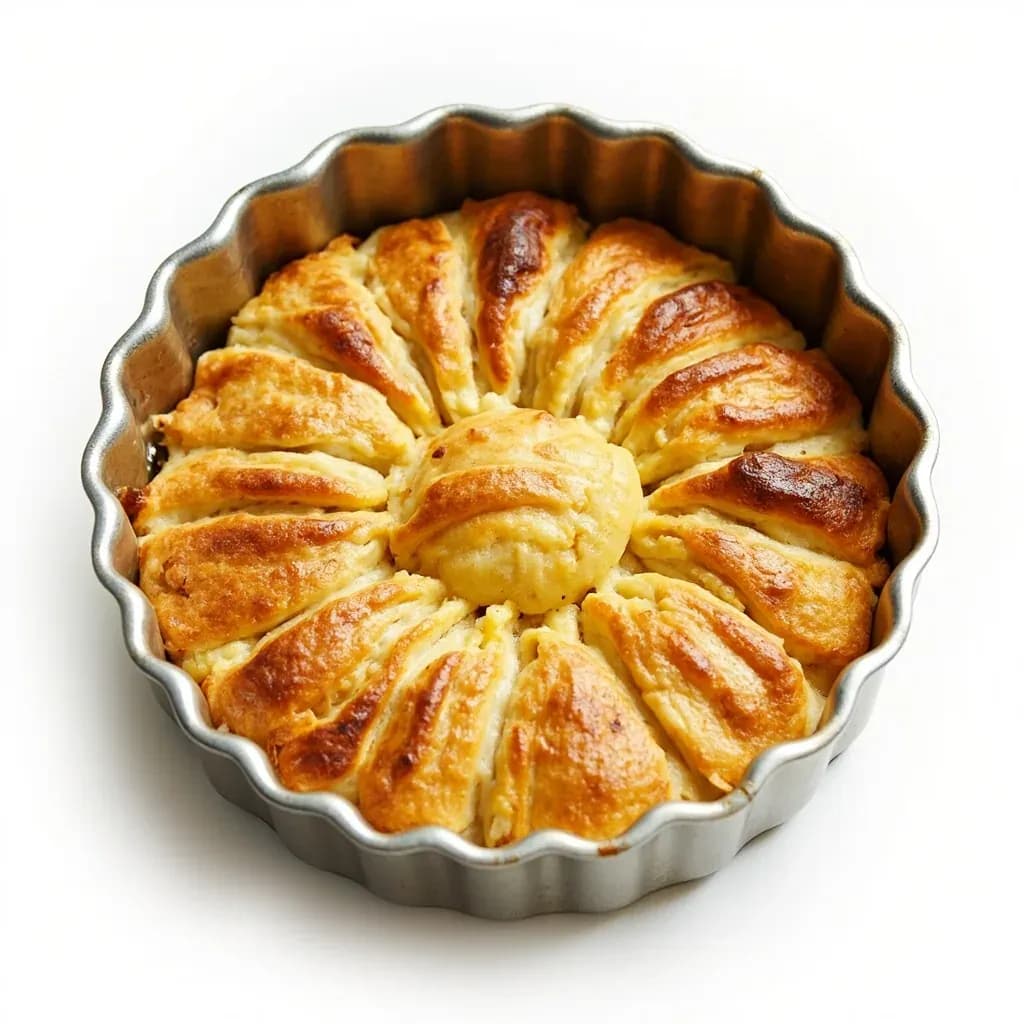
Baking & Pastry
Tourtière Deep-Dish Pan
Deep pie pan for baking the rich double-crust Québécois meat pie called tourtière.
A deep, often fluted pie pan used to bake tourtière, the spiced double-crust meat pie of Québec. Its extra depth holds the generous filling of seasoned ground meat between top and bottom pastry crusts. The deep walls support a tall pie that slices cleanly, a fixture at French-Canadian holiday tables.
A tourtière pan is a deep, straight-sided pie mold engineered for the specific geometry of a French-Canadian tourtière — a thick layer of seasoned minced meat (traditionally pork, often mixed with veal, beef, game such as moose or hare, or poultry) sealed between two pastry disks. The depth, typically 2 to 2.5 inches and occasionally up to 3 inches in traditional Québec molds, gives the filling room to compress under its own weight without spilling, while the vertical walls produce clean, architectural slices that hold their shape on the plate. Standard American pie pans, by contrast, are only about 1.25 to 1.5 inches deep with sloped sides; they will not contain a properly filled tourtière, and the filling will slump over the rim as it bakes.
The pan and the pie share a name in everyday French-Canadian usage — "tourtière" refers to both the vessel and the dish, an etymological echo of the old French tourte, a flat round pie or tart. Tourtière is the centerpiece of Réveillon, the traditional French-Canadian Christmas Eve feast, and is also served at New Year's and through the late-autumn harvest season, which is why most home cooks reach for the mold only once or twice a year. That infrequency is worth noting: a properly made tourtière is a project, and the pan's design — straight walls, a flared rim for crimping, often a rolled lip or hinged side clamp — exists to make that project succeed.
In practical terms, a 9-inch tourtière pan holds roughly 4 to 6 cups (1 to 1.5 L) of cooked filling plus two pastry layers, so recipes written for a standard 9-inch pie pan should be scaled up by 30 to 50 percent when adapted to a true deep-dish mold. The straight sides also expose more surface area to the oven's heat, which is why dark or non-stick pans benefit from a 25 °F (15 °C) temperature drop, and why a sheet tray underneath is essentially mandatory — drips are inevitable, and the tray's mass helps conduct heat up into the bottom crust, the most failure-prone element in the whole pie.
Alternatives
Types & varieties
Tinplate or tinned steel with straight sides, often a side clamp and small handles; the classic Québec form, prized for fast, even browning.
American straight-sided aluminum pan with a rolled rim; the most common supermarket substitute and an acceptable everyday choice.
Removable side wall and base; useful for pâté-style or fragile fillings where the wall must come away cleanly without dragging the crust.
Holds heat well and gives even color, but runs hotter at the rim; drop the oven temperature 25 °F (15 °C) to avoid scorching the pastry edge.
Heavy, retains heat, and browns the bottom crust deeply; needs preheating and careful greasing to prevent sticking.
Single-use, common for Réveillon potluck tourtières; conducts heat well but buckles easily under a heavy filling.
A two-piece design whose clip holds the overhanging pastry in place while the top crust is shaped — a baker's helper for neater crimping.
Choosing the Right Material
Material choice changes how a tourtière behaves in the oven more than most cooks expect. Tinplate and tinned steel — the historical standard — heat quickly, brown the crust evenly, and are malleable enough to be shaped with a rolled rim, but they must be hand-washed and dried to prevent rust. Modern aluminum pans perform almost identically and are slightly lighter, though they dent more readily. Ceramic and stoneware retain heat longer and give a softer, more uniform color but run hotter at the rim, where the pastry edge can scorch if the temperature is not reduced. Cast iron gives the deepest crust color of all but is heavy and can over-brown the bottom if left unattended. Springform versions are not traditional but earn their keep when the filling is loose (a seafood tourtière, say) or when an unblemished side wall matters for presentation.
- Tinplate or aluminum for the most even browning at standard recipe temperatures.
- Ceramic or stoneware for slower, gentler heat and a softer crust color — lower the oven 25 °F (15 °C).
- Cast iron for maximum bottom-crust color; preheat the pan and grease it well.
- Springform for fragile or loose fillings; always wrap the base in foil and set it on a rimmed sheet.
- Disposable aluminum for large Réveillon gatherings when you do not want to wash up.
Why the Bottom Crust Fails (and How to Prevent It)
Because the walls are straight and the filling is deep, the bottom crust of a tourtière is the single most failure-prone element in the pie. A wet, seasoned meat filling sits on top of raw pastry for a long bake, and gravity pulls moisture into the dough while the top crust shields the filling from direct heat. The fix is a combination of three moves: blind-bake the lined shell until the pastry is set and lightly colored, place the filled pan on a preheated sheet tray so heat reaches the base from below, and use a metal — not ceramic — pan so conduction is fast. Skip any one of these and you risk a soggy, pale bottom.
- Blind-bake the lined shell 12–15 minutes under parchment and pie weights.
- Set the filled pan on a preheated sheet tray to drive heat up into the base.
- Use a metal pan (tinplate, tinned steel, or aluminum) for the best conduction.
- Rest the finished pie 20–30 minutes before slicing so the filling sets and stops weeping into the crust.
Common uses
Tips & pitfalls
- Grease and flour the sides even when lining with pastry — the straight walls grip a butter-rich dough, and an ungreased pan causes the crust to slump on unmolding.
- Blind-bake the bottom crust 12–15 minutes under parchment and pie weights; an unbaked shell will stay raw at the center under a wet meat filling.
- Cut steam vents in the top crust or set a pie bird in the center — a deep, moist filling needs a clear escape route for steam or the top will dome and crack.
- Do not fill past the rim line; tourtière filling expands as it heats, and a deep pan exaggerates the overflow.
- Bake on a sheet pan to catch inevitable drips and to help conduct heat up into the bottom crust.
- For even browning in a dark or non-stick pan, drop the oven temperature by 25 °F (15 °C); tinplate and aluminum can take the full recipe temperature.
- Rest the pie 20–30 minutes before slicing — the deep filling needs time to set or the slices will collapse.
- If using a springform tourtière pan, wrap the base in foil and place it on a rimmed sheet; the removable bottom can leak fat.
- Chill the lined shell 15 minutes before filling — a cold pastry holds its shape better against a deep wall of seasoned meat.
- Avoid very loose fillings (rhubarb, raw berry mixtures) unless they have been pre-cooked and thickened; the depth makes a soggy bottom almost guaranteed.
Good to know
- Type
- Deep, straight-sided pie pan / mold
- Origin
- Québec, French Canada
- Traditional material
- Tinned steel or tinplate
- Modern materials
- Aluminum, stainless steel, ceramic, stoneware, cast iron, silicone
- Standard diameters
- 8 in (20 cm) and 9 in (23 cm); 10 in (25 cm) also made
- Wall depth
- 2–2.5 in (5–6.5 cm); traditional Québec molds up to 3 in (7.5 cm)
- Side profile
- Straight (not sloped) with a flared or rolled rim for crimping
- Capacity
- Roughly 4–6 cups (1–1.5 L) of filling in a 9-in pan
- Associated dish
- Tourtière — a double-crusted meat pie of pork, beef, game, or poultry
- Cultural season
- Réveillon (Christmas Eve) and New Year's in Québec; also harvest-season cooking
Also called
Tourtiere Pan · Deep Pie Dish · Meat Pie Pan
Related

Muffin Pan
Multi-cup pan for muffins, cupcakes, and egg bites

Bundt Pan
Fluted ring mold for showstopping cakes with a center hole

Springform Pan
Latch-release pan that frees delicate cakes without flipping

Pie Dish
Sloped round dish for crisp-bottomed pies and quiches

Tart Pan
Fluted pan with a pop-out base for clean-edged tarts

Rolling Pin
Rolls dough into even sheets for pastry and bread

Pastry Brush
Brushes on egg wash, glaze, butter, and marinades

Bench Scraper
Flat blade that divides dough and clears your work surface