Baking & Pastry
Turning Peel (Palino)
A small round peel on a long handle for rotating pizzas inside a hot oven.
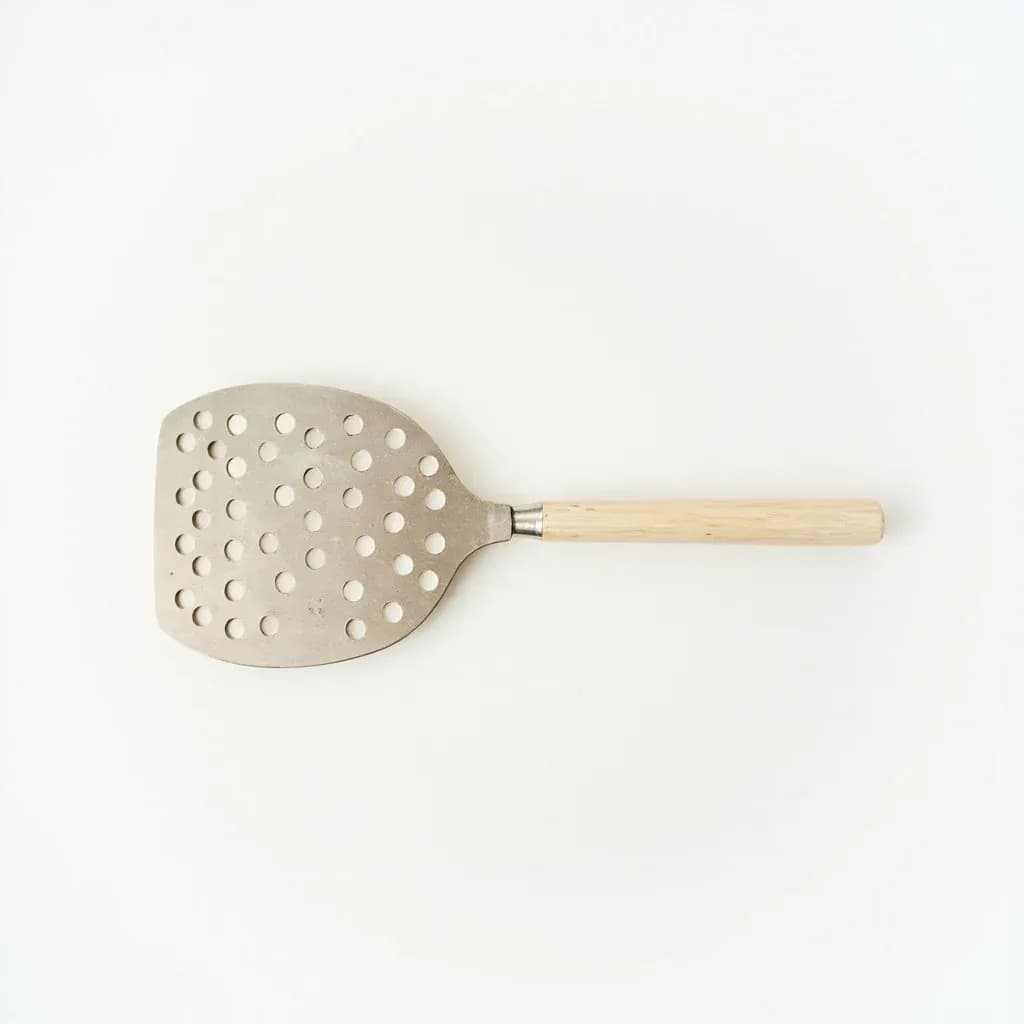
A turning peel, or palino, is a small perforated metal disc fixed to a long handle, used to spin and reposition a pizza as it bakes. Once the pie is launched onto the hot floor it can't be reached by hand, so the cook slides the peel under one edge and rotates it for even charring in a wood-fired or pizza oven. The perforations shed excess flour and the long handle keeps the hand away from the flames.
The turning peel, or palino, is the second tool in a traditional Neapolitan pizzaiolo's kit and the one that does the actual cooking work inside a hot oven. While the large rectangular or round transfer peel (pala or paletta) is used to launch the assembled pizza onto the hearth, the palino manages the pie once it is baking — rotating it to chase even color, repositioning it away from the dome's hottest zone, and lifting the edge to inspect the underside for the dark leopard spots that signal a properly baked, well-leavened crust.
Its design is deliberate and unforgiving: a small round head, typically 15–18 cm across, mounted on a handle that runs 1.2 to 1.8 meters depending on oven depth. The compact disc slips between the dough and the stone with minimal heat loss and minimal disturbance to the airy cornicione, leaving enough clearance for a quick turn without dragging toppings or deflating the rim. Outside a very hot oven — ideally 430–485 °C (800–900 °F) — the palino is largely useless; it is not a serving board, a cutting surface, or a transfer tool, and pressing it into those jobs is the fastest way to ruin a stretched pie or burn a hand.
In a 60–90 second Neapolitan bake, a pizzaiolo may turn the pizza two or three times with the palino, sometimes nudging one edge toward the flame on the dome side to char the cornicione. It is a tool of touch and timing, learned through repetition, and the difference between a fumbling home cook and a confident pizzaiolo is often visible in how quietly the head moves across the stone.
Alternatives
Types & varieties
Standard closed disc head; the traditional and most common form in Naples.
Head punched with small holes; sheds loose flour into the fire, reducing burnt-flour buildup on the oven floor and slightly lightening the tool.
60–90 cm handle sized for countertop deck ovens and home pizza ovens where depth is limited.
1.5 m or longer handle for deep Neapolitan or artisan wood-fired ovens.
Less common; preferred by some pizzaioli for rotating oblong pizzas or working in tight corners.
One-piece stainless head and tube handle; the most durable and dishwasher-friendly option, favored in high-volume pizzerias.
The Two-Peel System
A turning peel is never a standalone tool. In a traditional Neapolitan setup it is the partner to a larger transfer peel, and the two have clearly divided jobs. Learning to switch between them — rather than trying to make one peel do everything — is the single biggest step a new pizzaiolo can take.
- Launch the assembled pizza on the large transfer peel (pala or paletta), which has the surface area to support a stretched dough and its toppings.
- Set the pie on the hottest part of the stone, then immediately switch to the palino for the rest of the bake.
- Turn the pizza 90–180° with the palino every 20–30 seconds, lifting the leading edge slightly so the head slides under the cornicione without compressing it.
- Use the palino to reposition the pie away from the dome's hottest spot once the rim begins to char, and back toward it if browning stalls.
- Retrieve the finished pizza on the transfer peel — its large, flat head is the only safe way to extract a fully topped, hot pie from a deep oven.
Common uses
Tips & pitfalls
- Use quick, short motions — a turning peel should not rest in the oven; the long handle exists specifically to keep hands out of radiant heat.
- Hold the head flat under the pizza, then spin the wrist to turn the dough; do not drag or push, which tears the cornicione and smears toppings.
- Keep the head lightly floured and bone dry between pies — wet dough welds itself to cold steel, and most ruined palino extractions start there.
- Pair the palino with a larger transfer peel rather than substituting one for the other; the small head cannot safely launch a raw, topped pizza.
- Choose perforated heads in ovens with a lot of airborne flour: the holes drop loose flour into the fire instead of letting it scorch on the stone and produce acrid smoke.
- Angle the head slightly so the leading edge slides under the crust; attacking flat-on compresses the air in the cornicione and can deflate the rim.
- Match handle length to oven depth — too short puts the hand in the heat, too long costs the wrist the fine control that turning requires.
- Wooden handles char and splinter near a live flame over time; stainless or aluminum tube handles survive a busy pizzaiolo's schedule far better.
Good to know
- Also known as
- Palino, turning peel, rotating peel, pizza turning peel
- Origin
- Italy, rooted in Neapolitan pizza tradition
- Typical head diameter
- 15–18 cm (6–7 in); some as small as 13 cm
- Handle length
- 120–180 cm (4–6 ft) for commercial wood-fired ovens; 60–90 cm for home or deck ovens
- Head material
- Stainless steel (most common) or aluminum
- Overall length
- Usually 1.5–2 m (5–6.5 ft) for a full-size wood-fired setup
- Weight
- Typically 0.7–1.5 kg (1.5–3 lb)
- Distinct from
- The transfer or loading peel (pala/paletta) used to launch raw pizzas into the oven
Also called
Palino · Perforated Aluminum Peel · Perforated Pizza Peel · Pizza Turning Peel
Related

Muffin Pan
Multi-cup pan for muffins, cupcakes, and egg bites

Bundt Pan
Fluted ring mold for showstopping cakes with a center hole

Springform Pan
Latch-release pan that frees delicate cakes without flipping

Pie Dish
Sloped round dish for crisp-bottomed pies and quiches

Tart Pan
Fluted pan with a pop-out base for clean-edged tarts

Rolling Pin
Rolls dough into even sheets for pastry and bread

Pastry Brush
Brushes on egg wash, glaze, butter, and marinades

Bench Scraper
Flat blade that divides dough and clears your work surface