Cookware
Uruli (Bronze Bell-Metal Pan)
A wide, shallow round bell-metal pan from South India for slow-simmering and serving.
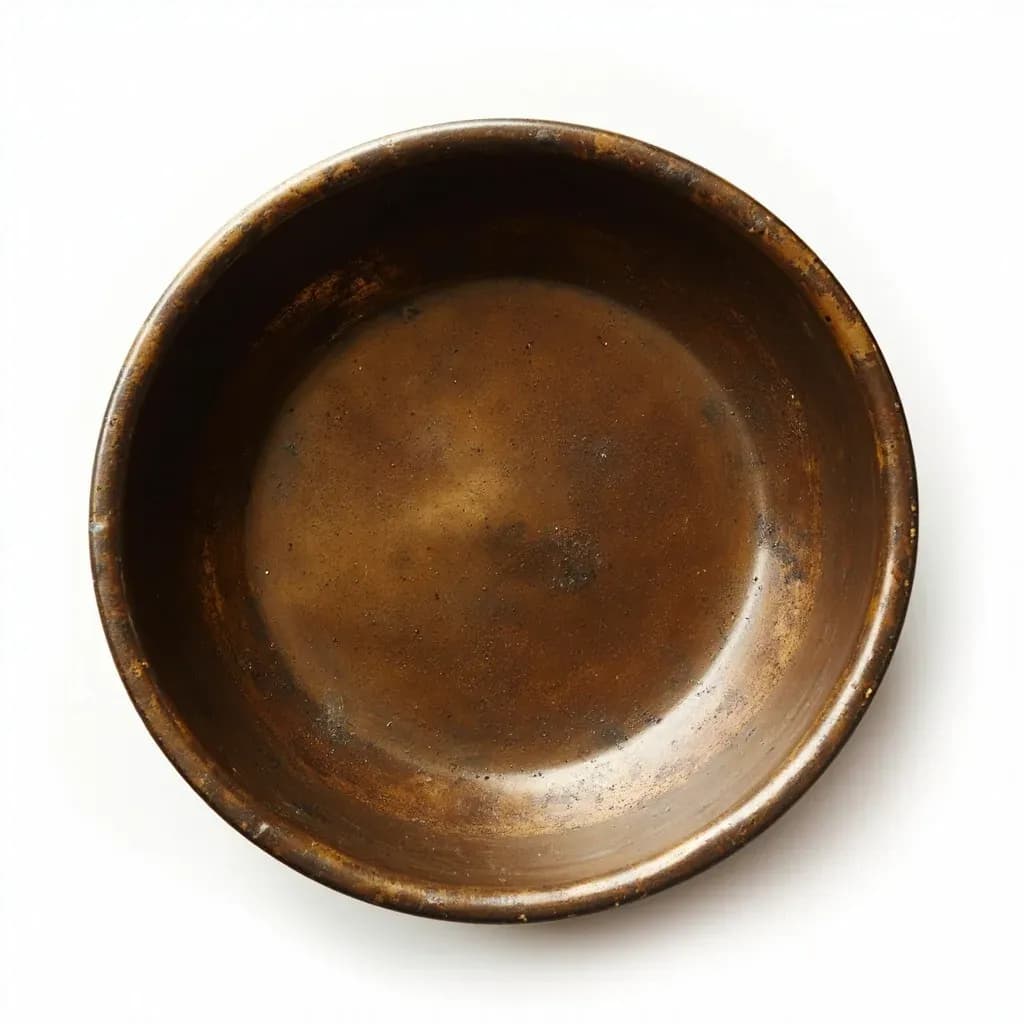
An uruli is a heavy, wide, shallow cooking vessel cast from bell metal or bronze, traditional to Kerala and Tamil Nadu, used to slow-cook payasam, curries, and sweets. Its broad surface and thick walls spread heat evenly for gentle, prolonged simmering without scorching. Beyond cooking it is often repurposed as a decorative water-and-flower bowl.
The uruli is a wide, shallow, round pan cast from bell metal — an alloy of roughly 78–80% copper and 20–22% tin — and is the defining cookware of Kerala's temple and home kitchens. Its broad, low-walled shape is unusual among Indian vessels: where most Indian cooking pans are deep and narrow, the uruli spreads outward like a low cauldron, giving it enormous surface area relative to its depth. That geometry, combined with the dense metal's thermal mass, makes it exceptional at gentle, slow simmering — the pan heats slowly, holds heat with remarkable steadiness, and resists the scorching that ruins milk-based and coconut-milk dishes. A traditional cooking uruli is tinned on the inside with a thin layer of tin (kalai), which protects the underlying copper from leaching into acidic foods and gives the inner surface a pale silvery look. New urulis ship with a bright golden-bronze patina on the outside that darkens to a deep oxidized brown with years of use; the tin inside must be renewed periodically by a kalaiwala (itinerant tinker) once it wears through.
Beyond its cooking function, the uruli carries real cultural weight. It is the vessel of choice for Onam sadya payasam — slow-stirred rice-and-milk desserts that can take two hours or more — and appears in temple kitchens where food is cooked in vast volumes for community feasts. The same pan is then carried to the table, since the uruli doubles as a serving dish: ladling payasam directly into bowls from the cooking vessel at the center of a banana-leaf meal is part of the visual ritual of Kerala dining. This stove-to-table continuity is one of the uruli's quiet pleasures.
Alternatives
Types & varieties
Smaller pan, roughly 10–14 in (25–36 cm) diameter, sized for daily family cooking of payasam, olan, and avial
Very large, 18–24 in (45–60 cm) or more, used in temple kitchens for Onam sadya, weddings, and festival-scale payasam
Polished, shallower versions brought to the table to present payasam, vada, or fruit — sometimes decorative rather than cooking-grade
Some makers add two cast loop handles on the rim for lifting; traditional household urulis are typically hand-held by the rim with a folded cloth
Less-polished, more rustic surface that some cooks prefer for grip on wooden ladles and lower reflectivity during long stovetop sessions
The bell-metal tradition and why the shape matters
Bell metal has been cast in Kerala for centuries by hereditary metalsmiths who pour the molten alloy into sand molds and finish each piece by hand-hammering. The uruli is part of a wider Indian bell-metal family that includes the kansa kadai, kansa thali, and kansa lota, but its silhouette is uniquely Keralite. The wide, shallow form is dictated by the cuisine: Kerala cooking leans heavily on coconut-milk reductions and milk-based sweets that must simmer for a long time without catching on the bottom. A deep, narrow pot would concentrate heat at the base; the uruli spreads heat across a broad, flat floor and lets steam escape freely, so milk reduces without scalding. This is also why a uruli is almost always paired with a wooden or silicone palaka (flat ladle) — constant gentle stirring across the wide surface is part of how these dishes are made.
Seasoning, tin care, and signs the uruli needs re-tinning
A genuine cooking uruli arrives with a silvery tin coating on the inside and a golden-bronze patina outside. The tin is functional, not decorative — it prevents copper from leaching into acidic foods like payasam (which contains jaggery and sometimes cardamom) and tomato-based curries. Over years of use the tin wears through, and the pan must be re-tinned by a kalaiwala, who applies a fresh layer using traditional dipping and fluxing. Cooks learn to read the signs of wear.
- Bluish-green tarnish creeping up the inner walls means the tin has gone and copper is exposed
- A faint metallic taste in food, especially in milky desserts, is the most reliable warning sign
- Dark spotting or pitting on the inside surface, rather than smooth silvery wear, suggests the tin has been scrubbed away
- A newly re-tinned uruli should be seasoned before first use: simmer water with rice flour or tamarind for 20–30 minutes, then rub the inside with sesame oil
How to spot a real cooking uruli versus a decorative one
Urulis have become popular as garden planters and decorative vessels, which has flooded the market with thin, un-tinned lookalikes. A working cooking uruli is unmistakable once you know the cues.
- It feels heavy for its size — bell metal is dense, and a 12 in cooking uruli is genuinely weighty in the hand
- It rings with a clear, bell-like tone when tapped; decorative brass or aluminum versions sound dull
- The inside is pale silvery from the tin coating, not coppery-orange
- Buying directly from Kerala-based artisan clusters (Mannan, Kuzhalmannam, and foundries around Thrissur and Palakkad) is the traditional route to a genuine piece
Common uses
Tips & pitfalls
- Bring the uruli up to temperature gradually — slamming a cold, thick-walled pan onto a high flame can crack the casting; medium-low heat for the first few minutes is the safe habit.
- Use only wooden or silicone ladles (the flat Kerala palaka or a silicone spatula); metal scrapes and eventually wears through the inner tin coating.
- Never leave salty, acidic, or sour foods sitting in the uruli overnight — transfer cooled leftovers to glass or stainless steel, since prolonged contact strips the tin and lets copper leach.
- Watch for a faint metallic taste in food or bluish-green tarnish on the inner walls; both signal the tin layer has worn and the pan needs re-tinning by a kalaiwala before further use.
- Clean tarnish by rubbing with tamarind pulp, a lemon half dipped in salt, or a paste of rice flour and vinegar — then rinse and dry immediately; avoid steel wool, scouring pads, and dishwashers.
- Dry the uruli thoroughly over low heat before storing; trapped moisture under a lid causes black spotting on the tin surface.
- Lift the pan by cradling the rim with a folded kitchen cloth — it is heavy and most urulis have no standard handle.
- For induction cooking, only use urulis explicitly made induction-ready with a flat, bonded base; traditional cast bottoms may not couple efficiently and will heat poorly.
Good to know
- Origin
- Kerala, South India, where bell-metal casting is concentrated in artisan clusters around Thrissur, Palakkad, Mannan, and Kuzhalmannam
- Material
- Bell metal — about 78–80% copper and 20–22% tin, sometimes with trace elements; the same alloy family is called kansa in North India
- Shape
- Wide, shallow, round pan with gently sloping or curving sides and a flat bottom; essentially a low-walled, broad cauldron
- Typical sizes
- Diameter 8–24 in (20–60 cm); depth 1.5–4 in (4–10 cm); ceremonial temple urulis are the largest
- Heat behavior
- High thermal mass — heats slowly but holds heat exceptionally well, ideal for long, gentle simmering without scorching
- Inner finish
- Traditionally tinned (kalai) on the inside, like other Indian bell-metal vessels; the tin layer is what protects food from the underlying copper
- Cooktop compatibility
- Gas, wood, and charcoal stoves work directly; induction only with flat-bottomed urulis explicitly made induction-ready; never in a microwave
- Weight
- Substantial — a 14 in household uruli weighs roughly 3–5 kg; large ceremonial ones can exceed 10 kg
Also called
uruli · Bronze Pan · Bell-Metal Pan
Related

Steamer
Gentle moist heat that keeps vegetables, fish, and dumplings tender

Frying Pan
Shallow sloped pan for frying, sautéing, and quick sears

Saucepan
Tall, straight-sided pot for sauces, grains, and small batches

Sauté Pan
Wide straight-sided pan with room to brown and braise

Dutch Oven
Heavy lidded pot that turns tough cuts tender over hours

Stock Pot
Tall, roomy pot for stocks, pasta, and big-batch cooking

Wok
High-sided bowl pan built for blistering-hot stir-fries

Griddle
Flat, broad surface for pancakes, smash burgers, and breakfast