Knives & Cutting
Utility Knife
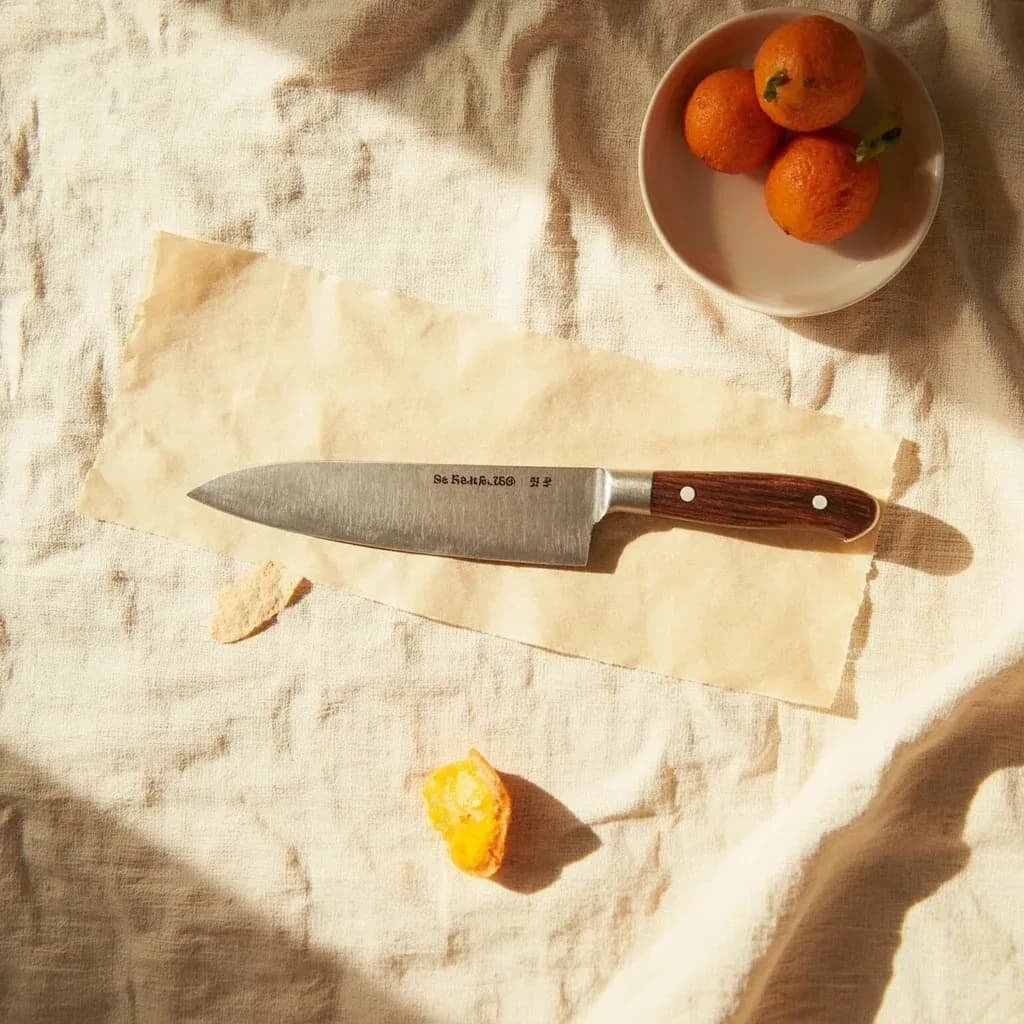
A mid-size blade between a paring and chef's knife, nimble for trimming, slicing sandwiches, and smaller produce where a chef's knife feels oversized and a paring too short.
The utility knife is the in-between blade that earns its place in a crowded drawer by handling the work a chef's knife treats as too small and a paring knife treats as too big. Most run 4 to 7 inches along the edge, with a profile that narrows gently toward a pointed tip — long enough to bear down on a ripe tomato or trim a chicken breast, short enough that you can still steer it tip-first across a cutting board without feeling like you're driving a bus. Its lightness matters: with less blade mass than a chef's knife, the utility knife responds more directly to hand movement, which is why it's a favorite for sandwiches, lunch prep, and any task where control matters more than power.
In feel and intent it overlaps heavily with the Japanese petty knife, which has become a popular alternative in modern Western kitchens. A petty tends to be thinner, harder, and ground more aggressively for fine work, while a Western utility knife is usually a touch thicker and sturdier, a better bridge to heavier prep. Many cooks discover they reach for the utility knife far more often than they expected — especially for trimming silver skin, breaking down shallots, slicing fruit, and any quick cut that doesn't justify pulling out the 8-inch chef's knife.
The right utility knife quietly becomes the most-used tool on the board. It doesn't have the theatrical presence of a chef's knife, but for the long middle stretch of cooking — the chopping, slicing, and trimming that fills most prep time — its size, weight, and maneuverable control are exactly what the hand wants.
Alternatives
Types & varieties
The classic all-purpose version; smooth edge for clean slicing of produce, small proteins, and sandwiches.
Small serrations for bread, tomatoes, and citrus; a midpoint between a paring knife and a bread knife.
Dimples or scallops along the blade reduce friction and prevent sticking when slicing cooked meats or starchy vegetables.
The Japanese counterpart; lighter, thinner, and harder-edged, favored for detail work and small produce.
Choosing Between Plain, Serrated, and Granton
The blade style should match the kind of cutting you actually do, not the one that looks best on the magnetic strip.
- Plain edge: the right default for general prep — slicing sandwiches, trimming meat, breaking down shallots, cutting fruit. Clean cuts, easiest to sharpen at home.
- Serrated: buy this only if your daily use leans toward crusty bread, bagels, tomatoes, or citrus. The small teeth saw through skin without crushing flesh, but the edge is harder to refresh and produces rougher cuts on herbs and proteins.
- Granton (hollow-ground): the dimples aren't decoration — they create small air pockets that keep slices of boneless chicken, roast, or starchy vegetables from clinging to the blade. Worth it if you slice a lot of cooked meat.
Care, Sharpening, and Storage
A utility knife is small enough to neglect and expensive enough that neglect is a waste.
- Hand wash and dry right away. Even blades labeled dishwasher-safe lose edge retention faster in the detergent and humidity.
- Hone the plain edge regularly with a honing rod; sharpen on a 1000/4000 whetstone or quality pull-through when the edge stops shaving hair.
- Serrated edges need a tapered diamond or ceramic rod worked through each scallop — a flat stone or pull-through won't reach the bottom of the teeth.
- Use wood or quality plastic boards. Glass, marble, stone, and resin-bound bamboo boards will dull or chip the edge quickly.
- Store in a block, on a magnetic strip, in an in-drawer tray, or with a blade guard. Loose drawer storage is the leading cause of tip damage.
Common uses
Tips & pitfalls
- Match the knife to the task: if you find yourself reaching past it for the chef's knife constantly, the utility is undersized for your workflow; if you grab a paring knife instead, it's oversized.
- Choose a straight edge for general prep and reserve a serrated version specifically for sandwiches, bread, and tomatoes — owning one of each is more useful than a single compromise.
- Hand wash and dry immediately; the harsh detergent and prolonged moisture of a dishwasher dull even good stainless steel noticeably faster.
- Cut on wood or quality plastic boards. Glass, marble, and stone boards will dull the edge quickly.
- Never pry, twist sideways, or cut through bones, frozen food, or hard squash — the shorter, thinner blade is more prone to chipping or snapping than a chef's knife.
- Hone the straight-edge version regularly with a honing rod and resharpen on a whetstone as needed; serrated versions require a tapered diamond or ceramic rod worked tooth by tooth.
- Store in a block, magnetic strip, or with a blade guard. A loose drawer is the most common cause of tip chips and nicked edges on smaller knives.
- Resist the urge to use it as a utility belt tool for opening packages, scraping labels, or prying lids — those tasks destroy edges faster than any kitchen work.
Good to know
- Typical blade length
- 4 to 7 inches (most commonly around 5 inches / 12–13 cm)
- Profile
- Narrower and shorter than a chef's knife, longer than a paring knife; gently tapered toward the tip
- Edge styles
- Plain edge, serrated, or granton (hollow-ground)
- Common blade materials
- Stainless steel, high-carbon stainless steel, or ceramic
- Handle materials
- Molded polymer, riveted wood, pakkawood, or composite
- Japanese equivalent
- The 'petty' (petit) knife, typically with a 4–6 inch blade
- Category role
- Sits between paring knives (2–4 in) and chef's knives (8–10 in)
- Weight
- Generally lighter than an equivalent chef's knife for nimble control
Also called
utility blade · all-purpose knife · sandwich knife
