Knives & Cutting
Chinese Vegetable Cleaver (Caidao)
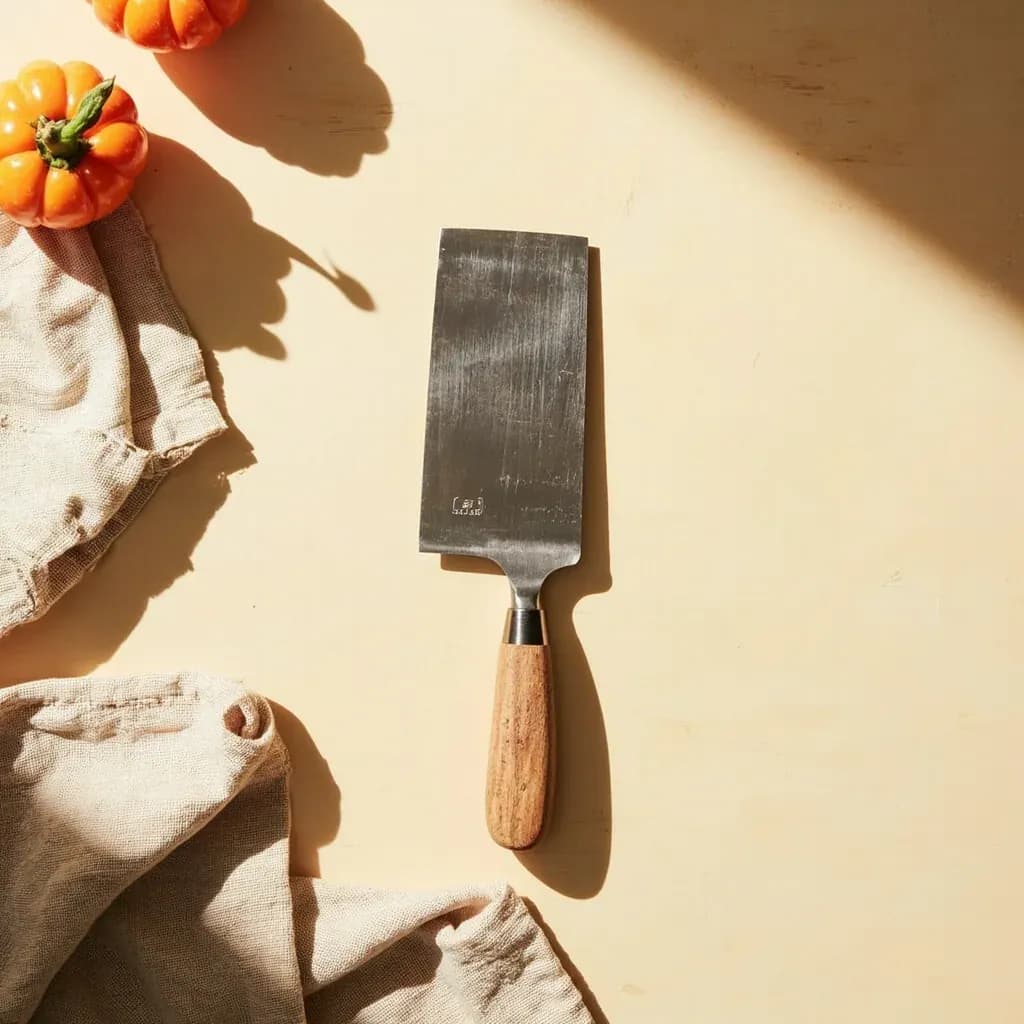
Thin, lightweight rectangular caidao for slicing, julienning and scooping vegetables and boneless meat; its broad flat blade smashes garlic and ginger, but it is not for hacking through bone like a heavy cleaver.
The Chinese vegetable cleaver — 菜刀 (càidāo), literally "vegetable knife" — is a thin, rectangular blade that looks intimidating to cooks raised on Western chef's knives but behaves more like a cross between a slicer, a bench scraper, and a small spatula. Where a Western chef's knife is curved and rocked, the caidao's spine and edge run nearly parallel from heel to a small squared or rounded tip, and the blade is light enough (typically 200–400 g) to be wielded in long, single-pass push cuts. That geometry is the source of its versatility: the same tool slices, juliennes, minces, smashes, scoops, and transfers food into the wok, replacing two or three knives in a typical home kit.
What separates a vegetable cleaver from its heavier cousin, the Chinese bone cleaver (sometimes also called a caidao in casual speech) is thickness and intent. A bone cleaver is a thick, wedge-shaped chopper designed to split ribs and crack through frozen food. A true vegetable cleaver is roughly 2–3 mm at the spine, double-beveled, and balanced for finesse work — aromatics, herbs, leafy greens, boneless proteins, and fish. Treat it as you would a Japanese gyuto or a French slicing knife and it will reward you; treat it like an axe and the edge will chip.
In a working Chinese kitchen the caidao is rarely a specialty tool — it is the daily driver, used for nearly every prep task from smashing garlic to portioning steamed chicken. Outside Asia it has become a favorite of cooks who do a lot of stir-fry and vegetable prep, because the broad blade functions as a built-in scoop, sliding chopped ingredients cleanly into a hot wok without a separate spatula.
Alternatives
Types & varieties
The everyday general-purpose Chinese vegetable cleaver: thin rectangular blade around 19 cm, balanced for slicing, mincing, and scooping.
An even thinner, lighter variant optimized for paper-thin slicing of vegetables and boneless proteins; closely associated with Cantonese kitchens, less common elsewhere.
Tends to be thinner, lighter, and more slice-oriented, reflecting the Cantonese emphasis on fine, precise knife work.
Slightly heavier and sturdier than Cantonese versions, suited to the coarser chopping of northern Chinese cookery — still not a bone cleaver.
Traditional material prized for taking a keener edge; favored by professionals but requires prompt drying to prevent rust and may develop a patina.
The modern, low-maintenance majority; easier to care for, with edge-holding that generally lags behind high-carbon steel.
Why the push cut matters
The caidao's flat geometry only works if you change your stroke. A Western chef's knife invites a rocking motion that uses the belly of the blade; the caidao has almost no belly, so rocking leaves a wedge of uncut food on the board. Instead, hold the handle loosely, rest your fingertips in a claw, and push the blade straight down and forward in a single motion, letting the full length of the edge do the work. The food stays on the board, the slices are uniform, and the blade — which is light but long — feels almost effortless after a few sessions.
Caidao vs. bone cleaver
The two are not interchangeable, and calling any rectangular Chinese blade a "cleaver" has caused more chipped edges than anything else in the kitchen. The vegetable cleaver is a slicer in cleaver clothing; the bone cleaver is a wedge. Use a vegetable cleaver for what it was made for — produce, aromatics, boneless meat, fish — and reach for a heavy bone cleaver or a small hatchet for ribs, poultry bones, and frozen product.
Choosing your first caidao
For a first purchase, a 19 cm stainless-steel model in the $40–100 range hits the sweet spot of price, weight, and forgiveness; CCK makes solid cleavers across that range. Premium hand-forged makers such as Suisin and Shibata sit well above $150 and are worth chasing once you know what weight and balance suit you. Carbon steel rewards experienced sharpeners and cooks who dry the blade the moment it leaves the sink, but a stainless blade will serve most home cooks for years. Avoid the very cheap no-name cleavers with welded-on D-handles and visibly soft steel: the geometry may look right, but the edge will roll in a week.
Common uses
Tips & pitfalls
- Use a push cut — push the blade straight down and forward through the food — rather than rocking; the flat geometry is built for it
- Curl your fingertips into a claw and let the flat of the blade rest against your knuckles as a guide; the broad blade makes this easier than with a chef's knife
- Never hack through bone, frozen food, or hard winter squash with a caidao — the thin blade can chip or bend; reach for a bone cleaver instead
- Smash garlic by laying the clove on the board, pressing the flat blade down with your palm, then giving a quick firm tap
- Reserve a dedicated caidao for vegetables; acids and strong flavors from raw meat or fish can linger on the steel and affect delicate dishes
- Hand wash, rinse, and dry immediately — never put a caidao in the dishwasher, and don't leave it sitting in the sink where moisture pits the edge
- For carbon-steel blades, wipe a thin film of food-safe mineral oil on the dry blade if you won't use it for a while; a light patina is cosmetic and harmless, but rust is not
- Hone the edge with a honing rod or the back of a ceramic plate before heavy prep, and true the edge on a 1000/6000-grit whetstone a few times a year — thin blades lose their bite faster than thick chef's knives
Good to know
- Chinese name
- 菜刀 (càidāo), literally "vegetable knife"
- Typical blade
- 18–20 cm long, 8–10 cm tall at the heel, ~2–3 mm thick at the spine
- Weight
- 200–400 g (7–14 oz) — light enough for push cuts, heavier than a Western chef's knife
- Steel & hardness
- Stainless steel (HRC 56–60) for most modern versions; traditional high-carbon steel up to HRC 62
- Bevel
- Double-bevel, roughly 15° per side on modern caidao; some traditional pieces are single-bevel
- Handle
- Wood (rosewood, pakkawood) or composite, often D- or C-shaped, usually half-tang with a welded bolster
- Price range
- Entry $15–30, mid-range $40–100, premium handmade (CCK, Suisin, Shibata) $150+
- Care
- Hand wash and dry immediately; hone often, sharpen on a 1000/6000-grit whetstone a few times a year
Also called
caidao · cai dao · chinese chef knife · vegetable knife · wok knife
