Cookware
Vitumbua Rice-Cake Mold Pan
A dimpled cast pan for frying East African vitumbua coconut-rice cakes into rounded shells.
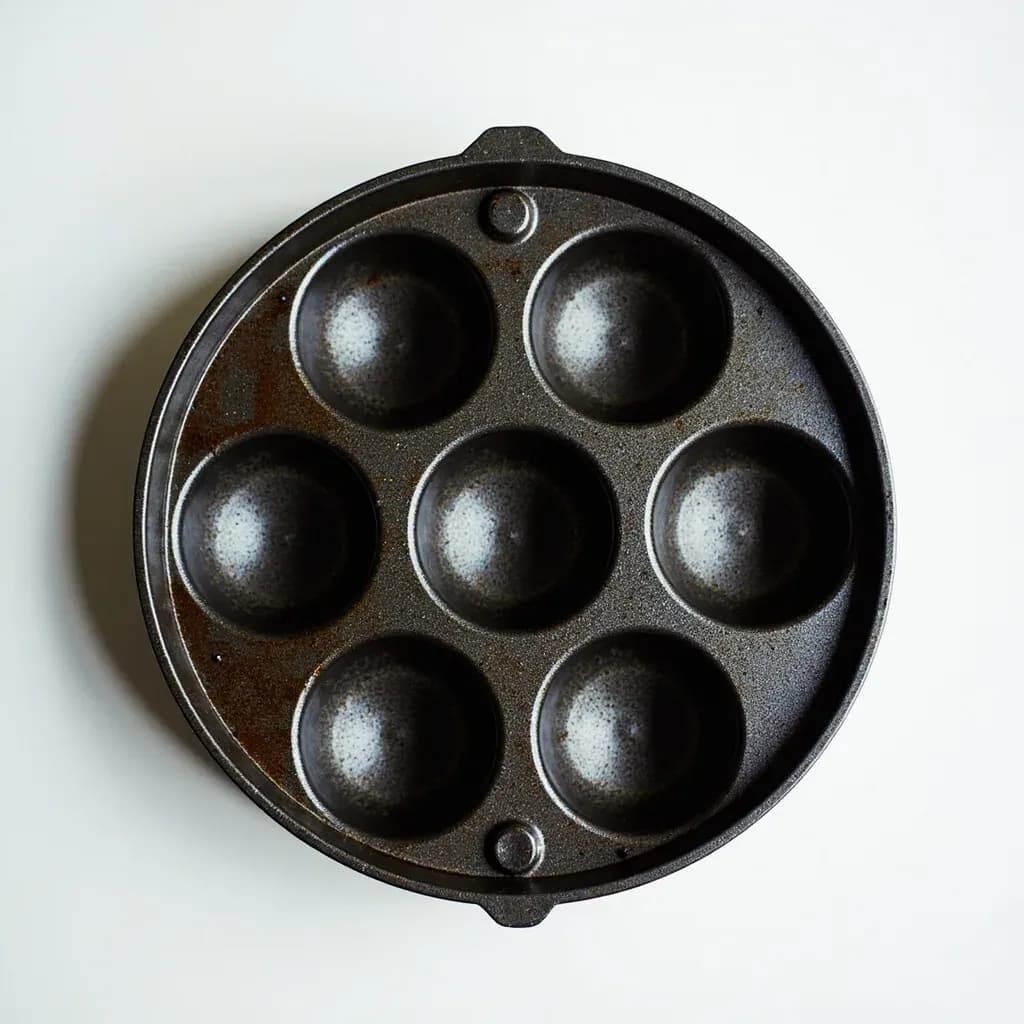
A vitumbua mold pan is a heavy cast-iron or aluminum pan with several rounded hemispherical wells, used in Tanzania and coastal East Africa to fry vitumbua, sweet coconut-rice cakes. Batter is poured into each oiled well over heat, forming crisp, half-sphere cakes that are flipped to brown both sides. The shape is shared with similar molds used for Indian appe and Danish aebleskiver.
A vitumbua pan is a flat cooking surface pierced with a grid of deep, hemispherical wells, the cookware cousin of the well-known aebleskiver and takoyaki pans but built slightly deeper in proportion to its width. That depth is the whole point: when a fermented coconut-and-rice batter is spooned into the well, it climbs the curved sides and closes over the top, producing a sealed, golden-brown dome roughly the size of a golf ball. A flat tawa, a muffin tin, or a shallow pancake pan cannot replicate this geometry — a flat pan will only give you a disc, and a muffin tin's straight walls will give you a cup, not a rounded shell with a hidden seam.
The pan is most strongly associated with the Swahili coast — Zanzibar, coastal Tanzania, and coastal Kenya — where vitumbua (singular: tumbua) are sold by the dozen at street stalls and eaten for breakfast or as an afternoon tea cake. The traditional version is heavy cast iron, heated over a charcoal jiko or a three-stone fire, and seasoned like any other cast-iron cookware. Modern versions in cast aluminum or enameled cast iron are lighter, faster to heat, and far more forgiving for a first-time user, though purists maintain that nothing browns a vitumbua crust quite like a well-aged iron pan.
Functionally, the vitumbua pan is identical to the South Indian appe or paniyaram chatti, and in much of the world that is how the cookware is actually labeled and sold. This makes it the most accessible pan of its type outside East Africa: any shop that stocks South Indian cookware will have one, and the same pan turns out sweet East African rice cakes, savory South Indian lentil-rice snacks, Danish aebleskiver, and Dutch poffertjes with nothing more than a change of batter.
Alternatives
Types & varieties
The traditional choice. Heavy, holds heat very evenly, and gives the deepest crust color. Must be seasoned before first use and dried thoroughly after washing to prevent rust.
Lighter and faster to heat, often factory-coated with a non-stick layer. Easier for beginners but less durable at high heat, and the coating will not tolerate metal tools.
Cast iron with a porcelain enamel lining — no seasoning required and simple to clean. The coating can chip if scraped with a metal skewer, so use wood or silicone for turning.
Functionally identical pan sold for South Indian appe. The most widely available version of the tool outside East Africa and the one most diaspora cooks actually own.
Why the wells are deep, not shallow
The defining feature of this pan — and the reason a regular pancake pan cannot substitute — is the depth-to-width ratio of each well. A shallow hemispherical cup, the kind used for Danish aebleskiver, leaves the batter open at the top and produces a sphere with a small crater. A vitumbua well is deeper than it is wide, so the leavened batter climbs the curved wall and meets itself at the center, sealing over. The seam that forms there becomes the bottom of the finished cake after it is flipped, and the smooth rounded surface becomes the top. This is also why the batter must be properly fermented: only an actively rising batter has the strength to dome up and close over; a flat, unleavened rice-flour mix will simply sit in the well as a disc.
Cross-cultural cousins of the same pan
Several cuisines have independently arrived at the same tool, which is why a single pan in your kitchen can move between recipes with only a batter change. Knowing the cousins is also the easiest way to source a vitumbua pan outside East Africa — look in the South Indian cookware section first.
- Danish aebleskiver pan: shallower wells, used for a yeasted wheat-flour pancake often studded with apple or fruit.
- Dutch poffertjes pan: very shallow, small-diameter wells for tiny buckwheat pancakes finished with butter and powdered sugar.
- Japanese takoyaki pan: many small hemispherical wells (typically 24 or more) in a cast-iron or copper griddle. The same rounded geometry as a vitumbua pan, just smaller and with more wells per batch.
- Indian appe/paniyaram chatti: the closest match — deep hemispherical wells, identical geometry, used for both sweet and savory fermented batters.
Caring for a cast-iron vitumbua pan
Because the wells are deep and curved, a vitumbua pan is more fiddly to clean and dry than a flat skillet. A few habits will keep it serviceable for decades.
- Rinse with hot water and a stiff brush immediately after use; avoid soap on seasoned cast iron.
- Dry the pan on a lit burner for a minute or two to evaporate every trace of moisture from the wells, where rust loves to start.
- Rub a whisper-thin coat of oil over the cooking surface while it is still warm, then wipe off the excess so it does not turn gummy.
- Store with the lid off or loosely covered so air circulates; trapped humidity is the enemy of seasoned iron.
Common uses
Tips & pitfalls
- Season a new cast-iron pan as you would a skillet: rub a thin film of oil over the surface, bake upside-down at about 200 °C / 400 °F for an hour, repeat once or twice, then wipe — do not soak it or run it through a dishwasher.
- Test the heat with a single drop of batter before filling all the wells; a gentle sizzle that sets the drop in a few seconds is right, while a hard hiss means the pan is too hot and will burn the outside before the inside cooks.
- Brush or wipe each well with oil — coconut oil is traditional — before every batch; the wells are deep and the cakes will tear on the way out if any spot is dry.
- Fill each well only two-thirds to three-quarters full so the batter has room to dome up and seal without spilling over into the next well.
- Cover the pan with a lid while the first side cooks; the trapped steam sets the top of the cake so it holds its shape when you flip it.
- Use a thin wooden skewer or knitting needle, not a metal fork, to loosen the edge of each cake and turn it — the rounded bottom of the cake becomes the finished top, so you want a clean, unmarked surface facing up.
- If cakes come out pale, the pan was too cool or the batter was too thin; if they scorch before the center is set, lift the pan off the heat for a minute to let it recover.
- Re-grease and wipe out burnt residue between batches; accumulated burnt batter in a well will cause the next cake to stick and lose its shape.
Good to know
- Origin
- East African Swahili coast — Zanzibar, coastal Tanzania, and coastal Kenya
- Also called
- Tumbua pan, vitumbua pan, Swahili pancake pan; often sold as an appam or paniyaram pan in South Asian cookware shops
- Material
- Cast iron (traditional), cast aluminum (modern), or enameled cast iron
- Geometry
- Hemispherical wells that are noticeably deeper than they are wide, so the batter closes over the top to form a dome rather than a flat disc
- Well count
- Home pans typically have 5, 7, or 9 wells; larger banquet pans hold more
- Heat source
- Gas, electric, or induction (flat-bottomed pans); traditionally a charcoal jiko or three-stone fire
- Finished cake size
- Roughly 4–6 cm across and 3–4 cm tall, depending on well size
- Companion tool
- A thin wooden skewer, knitting needle, or small pick for loosening and turning the cakes in the well
Also called
Vitumbua Pan · Rice Cake Mold Pan · Appe Pan
Related

Steamer
Gentle moist heat that keeps vegetables, fish, and dumplings tender

Frying Pan
Shallow sloped pan for frying, sautéing, and quick sears

Saucepan
Tall, straight-sided pot for sauces, grains, and small batches

Sauté Pan
Wide straight-sided pan with room to brown and braise

Dutch Oven
Heavy lidded pot that turns tough cuts tender over hours

Stock Pot
Tall, roomy pot for stocks, pasta, and big-batch cooking

Wok
High-sided bowl pan built for blistering-hot stir-fries

Griddle
Flat, broad surface for pancakes, smash burgers, and breakfast