Baking & Pastry
Wire Cooling Rack
A raised metal grid that lets baked goods cool with air circulating underneath to prevent sogginess.
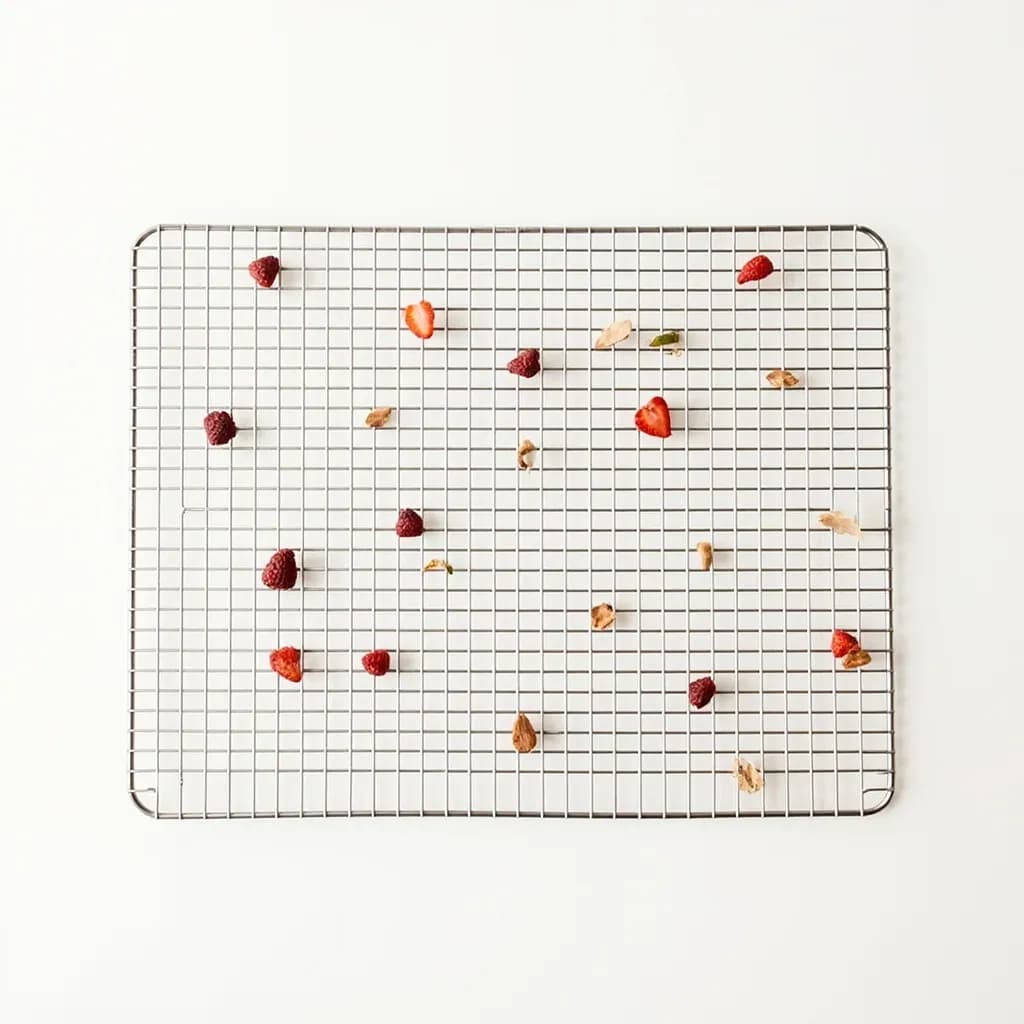
A wire cooling rack is a grid of metal wires on short feet that elevates hot food off the counter. It allows air to flow around all sides of cookies, cakes, and breads so steam escapes instead of condensing and making the bottoms soggy. It also doubles as a drip rack for glazing, draining fried foods, or roasting items above a sheet pan.
A wire cooling rack is a raised metal grid, usually with short feet, that holds baked goods so air can move freely above and below them. The work it does is unglamorous but essential: it lets the heat and steam leaving a hot cookie, cake, or loaf escape into the room rather than puddle beneath the item on a flat surface. A sheet pan or plate traps that moisture, and the trapped steam quickly softens crisp crusts, damp cookie bottoms, and tender cake layers — the difference between a snappy chocolate-chip cookie and a soggy one is often simply the rack. For most home bakers, it is the single most-used tool after a sheet pan and a mixing bowl, and a good one costs very little.
The physics of a rack come down to three details: an open grid, raised feet, and a footprint that suits your pans. The wires create thousands of small channels for steam to escape, the feet lift the food roughly an inch off the counter, and the standard half-sheet size is engineered to nest inside a standard half-sheet pan, which lets the rack double as a glazing, icing, and chocolate-drizzling station. Wire spacing, usually between a half and three-quarters of an inch, is a deliberate compromise — tight enough to support small cookies and the edges of cakes, open enough to let real airflow through.
Material matters more than most home cooks realize. Chrome-plated steel is the cheapest and most common option, and it does the job, but the plating wears at the welds and the joints are the first places to rust if the rack is run through the dishwasher or left damp. Stainless steel racks cost a little more and last dramatically longer, tolerate higher heat, and survive a dishwasher. Non-stick and silicone-coated racks are useful for very delicate items but have a lower heat ceiling and a coating that will eventually flake or degrade.
Alternatives
Types & varieties
The workhorse size, made to nest inside a standard 18 x 13 in half-sheet pan so you can glaze, ice, or drizzle with the pan catching drips.
Smaller counterpart sized for 13 x 9 in pans, useful for small batches and countertop jobs.
Multiple grids that interlock vertically to cool large batches of cookies or macarons without taking over the counter.
Circular grid sized for cake layers, pies, and tarts so the bottom of the round is fully exposed to air.
Pulls out to longer lengths to accommodate baguettes, batards, or jelly-roll sheets.
Vertical three-level unit for very small kitchens or large cookie bakes; airflow is slightly reduced on lower tiers.
Coated wires that release delicate items (meringues, florentines, candied nuts) more easily; lower heat tolerance and a coating that can eventually degrade.
Heavier-gauge, fully welded stainless used in restaurants; dishwasher-safe, rustproof, and holds up to repeated hot use.
Choosing a rack: what to spend the money on
For a home baker buying a first or replacement rack, the only two decisions that matter are size and material. Get the half-sheet size even if you rarely bake in volume; it nests in the half-sheet pan you already own, and you can always cool a smaller item on a larger rack. On material, a stainless half-sheet rack is the best long-term value: it tolerates a dishwasher, does not rust at the welds, and can be slid into a hot oven briefly to crisp the bottom of roasted vegetables or a reheated slice of pizza. Chrome-plated racks are fine for light use, but plan to hand-wash and towel-dry them, and expect the welds to eventually bloom with rust under hard service.
- If you own one rack, make it a stainless half-sheet — it covers the most jobs and pairs with the most common pan in home baking.
- Add a round rack only if you regularly bake layer cakes; the flat rack handles cookies, bars, breads, and roasting without trouble.
- Skip the coated non-stick rack for general use; the coating limits oven use and eventually wears, and a thin spritz of oil on a stainless or chrome rack solves the same sticking problem.
- Stackable or tiered racks are worth the counter space if you bake holiday cookies, macarons, or anything in big batches.
Care and maintenance
Racks are simple, but they are also the one baking tool most likely to fail from neglect rather than use. The enemies are moisture, harsh detergent, and the dishwasher's long, humid cycle, all of which attack the welds where the cross wires meet the frame. A few habits will keep a good rack good for years.
- Hand-wash chrome-plated racks in warm soapy water, rinse, and towel-dry immediately — the welds are where rust starts.
- Stainless racks tolerate the dishwasher; still, drying them on a rack of their own extends their life.
- Don't set a rack on a wet countertop, a damp dish towel, or the lip of a sink; the feet trap moisture and can leave rust rings or stain the counter.
- For sticky residue (caramelized sugar, baked-on chocolate), soak the rack in hot water with a little baking soda, then scrub with a nylon brush rather than steel wool, which can damage chrome plating.
Common uses
Tips & pitfalls
- Let cookies, cakes, and quick breads rest 1–5 minutes in the pan first; moving them while the interior is still very soft can cause breakage, especially with brownies, sponge cakes, and delicate cookies.
- Leave space between items on the rack — edges that touch will stay soft and can stick together as they cool.
- For glazing or drizzling, line the underlying sheet pan with parchment or wax paper so the drippings lift out cleanly and the pan stays clean.
- Hand-wash chrome-plated racks and dry them promptly; the welds and joints are the first places to rust.
- Choose stainless steel if you plan to run racks through the dishwasher or use them for hot jobs — they last far longer than plated steel.
- Use multiple half-sheet racks stacked or set across the stovetop to cool big batches of holiday cookies without crowding a single rack.
- Avoid very high oven contact with non-stick or silicone-coated racks; the coating can degrade above roughly 400°F (200°C).
- If you only own one rack, get the half-sheet size — it nests inside a half-sheet pan, the most common pan in home baking.
Good to know
- Primary materials
- Chrome-plated steel (most common, budget-friendly) or stainless steel (more durable, professional, dishwasher-safe); aluminum and silicone-coated versions also exist
- Standard half-sheet size
- Approximately 18 x 13 in (45 x 33 cm), designed to nest inside a standard half-sheet pan
- Quarter-sheet size
- Approximately 13 x 9 in (33 x 23 cm), fits inside a quarter-sheet pan for small batches
- Foot height
- Typically about 1 in (2.5 cm) of clearance beneath the grid for airflow
- Wire spacing
- Usually 1/2 to 3/4 in (1.3–2 cm) for general-purpose racks; finer grid versions exist for smaller items like macarons
- Heat tolerance
- Bare metal (stainless or chrome) tolerates brief oven contact; non-stick or silicone-coated versions are usually limited to about 400°F (200°C) or below
- Dishwasher safety
- Stainless steel racks are generally dishwasher-safe; chrome-plated racks are best hand-washed and dried promptly to prevent rust at the welds
- Origin
- Wire grid cooling surfaces have been used in bakeries for over a century; the modern home half-sheet rack became standardized alongside commercial half-sheet pans in the mid-20th century
Also called
Wire Rack · cooling rack · baking rack
Related

Muffin Pan
Multi-cup pan for muffins, cupcakes, and egg bites

Bundt Pan
Fluted ring mold for showstopping cakes with a center hole

Springform Pan
Latch-release pan that frees delicate cakes without flipping

Pie Dish
Sloped round dish for crisp-bottomed pies and quiches

Tart Pan
Fluted pan with a pop-out base for clean-edged tarts

Rolling Pin
Rolls dough into even sheets for pastry and bread

Pastry Brush
Brushes on egg wash, glaze, butter, and marinades

Bench Scraper
Flat blade that divides dough and clears your work surface