Cookware
Wok Lid (鍋蓋)
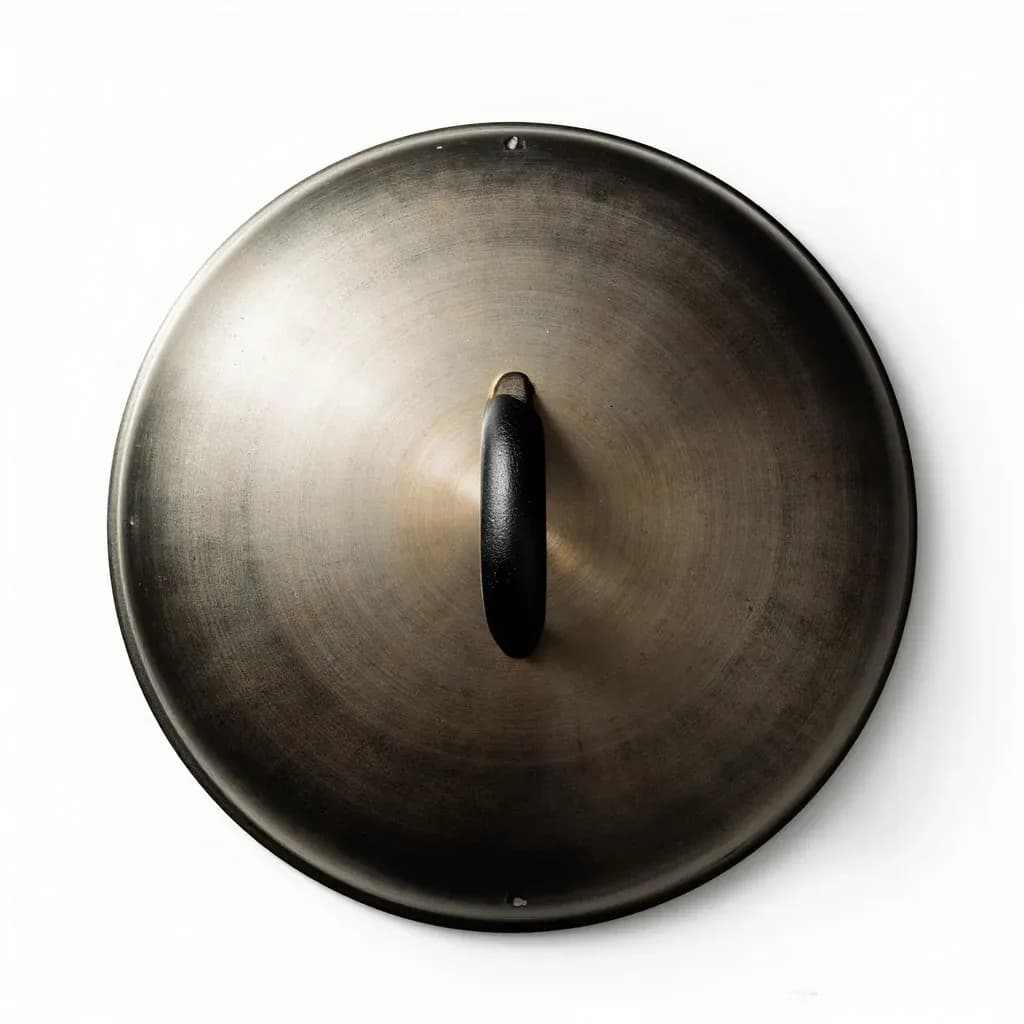
Domed lid that traps steam in a wok for steaming, braising, and quick covered cooking.
A wok lid is a high-domed cover, often aluminum or wood, that fits over a wok to trap heat and steam. It lets a cook steam dumplings and fish, braise and simmer, and quickly wilt greens after a stir-fry. The tall dome gives clearance for stacked steamer items and keeps condensation from dripping directly onto the food.
A wok lid is the most under-used piece of a wok setup, and one of the most consequential. Most home cooks own the wok and a spatula, skip the lid, and then wonder why steamed dishes dry out, braises take forever, or denser vegetables never quite soften through. The lid traps steam, returns condensed moisture to the food, and turns the wok from a pure stir-frying tool into a steamer, a braising pot, and a covered cooking vessel for one-pot rice and congee.
The traditional Chinese wooden lid (木鍋蓋) is the original. It is shallow-domed to nest slightly inside the curved wall of a round-bottom wok, creating an almost airtight seal that holds steam in for bao, dumplings, and red-braised dishes. Modern lids — carbon steel, stainless steel, aluminum, cast iron, and tempered glass — are usually flat and sit on the wok's rim; they pair best with flat-bottom woks and most include a small steam vent to release excess moisture.
Because a wok's geometry is unusual, a generic saucepan lid is rarely a good substitute. The right lid matches the wok's diameter and shape closely enough to contain steam without wobbling or sitting too high above the food, and its material should match the kind of heat the dish needs.
Alternatives
Types & varieties
Lightweight hardwood (often paulownia or poplar), domed to nest slightly inside the wok's curve for a snug steam seal. Stays cool to the touch; absorbs some smoke and oil patina over time.
Woven bamboo, flat or shallow-domed. Used over bamboo steamer tiers stacked in a wok rather than sealing the wok itself; allows controlled steam circulation.
Matches a carbon-steel wok; seasons alongside it; tolerates the highest wok heat.
Heavy; excellent heat retention for braises and long simmers; often sold as part of a cast-iron wok set.
Durable, non-reactive, usually with a steam vent and riveted handle; common in Western-made wok sets.
Lightweight, inexpensive, heats quickly; often flat with a small vent.
Flat with a steam vent; allows visual monitoring but can shatter from sudden temperature change or when water contacts a hot surface.
Modern flat lid with a silicone edge that fits multiple pan sizes including woks; not authentic but handy for non-traditional cookware.
Pairing the lid to the wok
The single biggest variable in wok-lid performance is fit. A round-bottom wok on a wok ring wants a shallow-domed lid that drops partway into the bowl; a flat-bottom wok on a stovetop wants a flat lid that rests cleanly on the rim. Mismatched shapes leak steam at the edges, and a lid that sits too high above the food lets condensation drip back down the wok wall instead of onto the food, leaving the dish dry on top.
- Round-bottom wok + wok ring: choose a traditional wooden lid or a domed metal lid; the curve nests into the bowl and seals.
- Flat-bottom wok: a flat stainless, carbon-steel, or aluminum lid with a vent gives the best contact on the rim.
- Diameter matters more than material: a 35 cm lid on a 40 cm wok leaks steam; a 40 cm lid on a 35 cm wok rocks and lets vapor escape.
- Wooden lids and flat metal lids are not interchangeable in feel — wood is gentler on delicate steamed buns because it doesn't form heavy condensation that drips back onto the surface.
- Bamboo lids belong on bamboo steamer tiers, not directly on a wok rim; their job is to let steam circulate between stacked baskets, not to seal the wok.
Material and heat behavior
Lid material changes how steam and heat move inside the wok. Heavier lids (cast iron, carbon steel) hold more heat and keep braises at a steadier simmer when the burner cycles down. Lighter lids (wood, aluminum) respond quickly when you lift them and lose less heat in the process. Glass sits in the middle on weight and lets you watch the food, but it is the least forgiving of thermal shock.
- Wood: low thermal mass, stays cool, ideal for steaming delicate items; not for high-heat covered stir-fries.
- Carbon steel and cast iron: high heat tolerance, can be used over the highest burner; match seasoning care to the wok itself.
- Stainless steel: durable and non-reactive; a vent is essential to release steam and prevent heavy condensation from dripping back into the food.
- Tempered glass: useful for monitoring reductions and congee; never shock it with cold water on a hot surface.
- Aluminum: light and cheap but can dent; avoid very thin lids that warp and lose seal over time.
Common uses
Tips & pitfalls
- Match the lid diameter to the wok — a snug fit is essential for proper steaming; a too-small lid leaks steam, a too-large one sits poorly.
- Traditional wooden lids are designed to nest slightly inside the curved wall of a round-bottom wok; flat metal lids rely on resting on the rim, so a flat-bottom wok gives the best seal with a flat lid.
- For steaming, place a metal steaming rack or trivet in the wok with 2–3 cm of water below the rack; bring the water to a boil before adding food and the lid.
- Tilt the lid 1–2 cm when reducing a sauce — full coverage steams the food, a partial gap lets vapor escape and concentrates flavors.
- Wooden lids should be wiped (not soaked) and dried upright so air circulates; submerging or running them through a dishwasher causes cracking.
- Never douse a hot glass lid with cold water — thermal shock will shatter tempered glass.
- Carbon-steel and cast-iron lids benefit from the same seasoning routine as the wok itself: a thin oil film rubbed on after drying protects against rust.
- To check on food without lifting the lid (and losing steam), listen to the sounds: a gentle hiss means steady steaming; hard sputtering means the water has run dry — lift and add water immediately.
- When steaming large buns like bao, leave at least 2 cm of space between each bun and the lid so the dough can expand without sticking.
Good to know
- Traditional name
- 鍋蓋 (guō gài)
- Origin
- China, developed alongside the wok for covered cooking and steaming
- Primary materials
- Wood (traditional), carbon steel, cast iron, aluminum, stainless steel, tempered glass, bamboo
- Typical diameters
- 30 cm (12 in), 35 cm (14 in), 40 cm (16 in) — matched to standard wok sizes
- Shape
- Domed or shallow-domed to follow the wok's curved wall; flat lids sit above the rim
- Handle
- Wooden knob (traditional), stainless loop, or riveted metal handle
- Steam vent
- Optional small hole near the rim on many metal and glass lids; absent on most wooden lids
- Heat tolerance
- Wooden: low–medium; metal and carbon steel: high; glass: medium (vulnerable to thermal shock)
- Weight range
- ~0.3 kg (wooden 12 in) to ~2 kg (cast iron 16 in)
- Dishwasher safe
- Metal and glass lids only; wooden lids must be hand-washed and air-dried
- Pairs with
- Carbon-steel, cast-iron, and flat-bottom woks; steaming rack or trivet for steamed dishes
Also called
wok-lid · Wok Cover
Related

Steamer
Gentle moist heat that keeps vegetables, fish, and dumplings tender

Frying Pan
Shallow sloped pan for frying, sautéing, and quick sears

Saucepan
Tall, straight-sided pot for sauces, grains, and small batches

Sauté Pan
Wide straight-sided pan with room to brown and braise

Dutch Oven
Heavy lidded pot that turns tough cuts tender over hours

Stock Pot
Tall, roomy pot for stocks, pasta, and big-batch cooking

Wok
High-sided bowl pan built for blistering-hot stir-fries

Griddle
Flat, broad surface for pancakes, smash burgers, and breakfast