Cookware
Yeast Brink
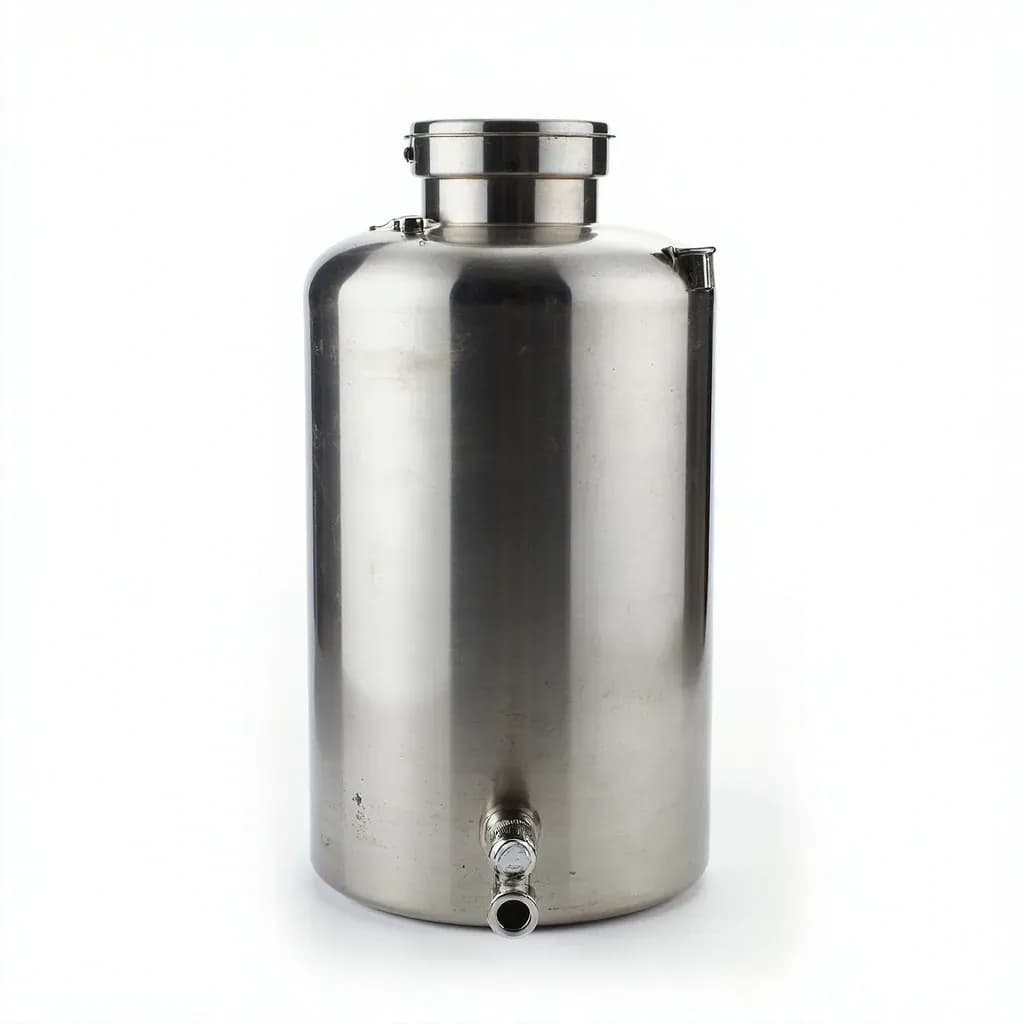
Chilled holding vessel that stores and dispenses live yeast slurry for fermentation.
A yeast brink is a sanitary, usually refrigerated container that holds harvested liquid yeast slurry between batches in brewing and large-scale baking. Keeping the yeast cool and oxygenated preserves its viability until it is pitched into the next wort or dough. It is a fermentation-management tool used in breweries and production bakeries.
A yeast brink is a chilled holding vessel for one specific job: keeping cropped yeast slurry alive and clean between fermentation cycles. In cideries, breweries, and wineries that repitch their own yeast, the brink sits between the fermenter and the next pitch — a refrigerated tank where thick yeast settles, clear supernatant decants away, and a working bank of a healthy strain can be carried from one batch to the next. The word is cidermaker's English; a brink is simply a holding vessel, and prefixing it with yeast tells you what is inside.
The behavior of a brink comes down to tight temperature control and gentle handling. Slurry is piped or pumped in from a fermenter, chilled to 33–39°F (1–4°C), and left quiet so the brewer can draw off clear beer, cider, or wine from above, sample the cake below, and pull thick yeast from a bottom valve when it is time to pitch again. Cold storage slows metabolism, preserves glycogen reserves inside the cells, and discourages bacterial growth — but it does not stop it. Every additional day of holding costs a measurable slice of viability, which is why a brink is treated as a short-term holding tool rather than long-term storage.
This is production equipment, not home cookware. A typical brink is built from food-grade stainless with sanitary fittings, sample valves, and often a glycol jacket. Committed home fermenters occasionally rig improvised brinks from sankey kegs or small conical fermenters, but the design assumptions — capacity, fittings, cleaning access — are sized for a brewery or cidery floor, not a kitchen.
Alternatives
Types & varieties
Sloped base funnels yeast to a bottom valve for easy slurry removal and cleaner separation.
Double-walled with glycol cooling for precise temperature control in larger production.
Unjacketed stainless vessel cooled by an ice bath or fridge; typical for small or home setups.
Allows clear supernatant to be drawn off before harvesting the thick yeast layer underneath.
Wider opening for manual cleaning and inspection of the yeast cake.
Acid-washing: when and how
Acid-washing is a debated practice that belongs in any honest discussion of brinks. The technique mixes harvested slurry with a dilute food-acid solution (typically phosphoric or citric) for a short contact time, then decants. The intent is to drop the pH low enough to kill or suppress contaminating bacteria while leaving the more acid-tolerant yeast cells viable. Used selectively on slurry pulled from a fermenter showing early signs of souring or off-character, it can rescue a strain bank. Used routinely on healthy slurry, it trims cell count and stresses the very population you are trying to keep. Treat acid-washing as a salvage tool, not a maintenance step, and always follow with a viability stain and a small fermentation test before pitching the washed slurry into a full batch.
- Acid-wash only when bacterial contamination is suspected, not on every harvest.
- Aim slurry pH around 2.0–2.5 for roughly two hours, then decant and rinse with cold sterile water.
- Always run a methylene blue viability count after washing; a modest drop in live cells is normal, a steep drop is not.
Improvised brinks for the home fermenter
Home brewers and cider makers who repitch yeast across batches can build a serviceable brink without buying a purpose-built tank. The usual candidates are a 3- or 5-gallon sankey keg with the spear plumbed as a bottom dump, or a small conical fermenter placed inside a fridge or cooler with an ice bath. The principles are the same as in a commercial brink: chill to 33–39°F, keep the vessel sealed, label every batch with strain and harvest date, and pull slurry from the bottom rather than the top. Improvised versions lack the polished sanitary welds of commercial brinks, which means cleaning discipline matters more, not less.
- A sankey keg with a bottom valve mimics a conical brink at low cost.
- A small conical fermenter set in a fridge acts as brink and fermenter in one; works for 1–3 gallon repitching banks.
- A food-grade plastic carboy in an ice bath is the cheapest option, but harder to decant cleanly and more vulnerable to oxygen ingress.
Common uses
Tips & pitfalls
- Hold strictly at 33–39°F (1–4°C); freezing ruptures cells and kills viability, while temperatures above the upper end of the range let metabolism and bacterial growth resume.
- Label every brink with strain name, generation, harvest date, and source batch — slurry from three different strains looks identical in a stainless tank.
- Aim to repitch within 7–14 days; older slurry loses glycogen reserves and off-flavor potential rises as storage extends.
- Stir gently before sampling; never shake or splash, which incorporates oxygen and stresses already tired cells.
- Run a methylene blue viability stain or an actual cell count before pitching; do not pitch on memory or habit.
- Acid-wash only when bacterial contamination is suspected, never as routine, since it trims healthy cell populations.
- Keep the brink sealed and, where possible, under a CO2 blanket to exclude oxygen and wild yeast.
- Sanitize every port, valve, and gasket before transfer; brinks are notorious reservoirs for contamination if fittings are neglected.
- Track generations — most brewing yeasts perform reliably for 8–10 generations before drifting.
- If storing longer than two weeks, build a fresh starter rather than trusting old slurry blindly.
Good to know
- Material
- Food-grade stainless steel, typically 304 grade
- Common capacity
- Homebrew scale 1–5 gallons; commercial 10–60 gallons
- Storage temperature
- 33–39°F (1–4°C) — chilled but not frozen
- Maximum storage time
- 7–14 days for best viability; up to 3–4 weeks with declining health
- Cooling method
- Glycol-jacketed walls, ice bath, or refrigerated cabinet
- Form factor
- Cylindrical with a conical or dished bottom and a bottom dump valve for slurry
- Fittings
- Sample valve, racking arm or port, sanitary clamp fittings, sometimes a top manway
- Yeast state stored
- Thick slurry of cropped yeast, sometimes acid-washed, with most beer, cider, or wine decanted off
- Primary context
- Breweries, cideries, and wineries — not standard home kitchen equipment
- Term origin
- British cidermaking; a brink is a holding vessel, and a yeast brink holds yeast slurry
Also called
yeast brink · yeast storage vessel
Related

Steamer
Gentle moist heat that keeps vegetables, fish, and dumplings tender

Frying Pan
Shallow sloped pan for frying, sautéing, and quick sears

Saucepan
Tall, straight-sided pot for sauces, grains, and small batches

Sauté Pan
Wide straight-sided pan with room to brown and braise

Dutch Oven
Heavy lidded pot that turns tough cuts tender over hours

Stock Pot
Tall, roomy pot for stocks, pasta, and big-batch cooking

Wok
High-sided bowl pan built for blistering-hot stir-fries

Griddle
Flat, broad surface for pancakes, smash burgers, and breakfast