Knife Cuts — Regional & Global
Parsley — Chiffonade vs. Rough Chop for Tabbouleh
Also: parsley chiffonade, rough-chopped parsley, maqdous parsley cut, tabbouleh herb prep
Two competing knife philosophies for tabbouleh parsley — the ultra-fine chiffonade causes bruising and water release; the traditional Levantine rough chop preserves cell integrity, color, and the salad's required dryness.
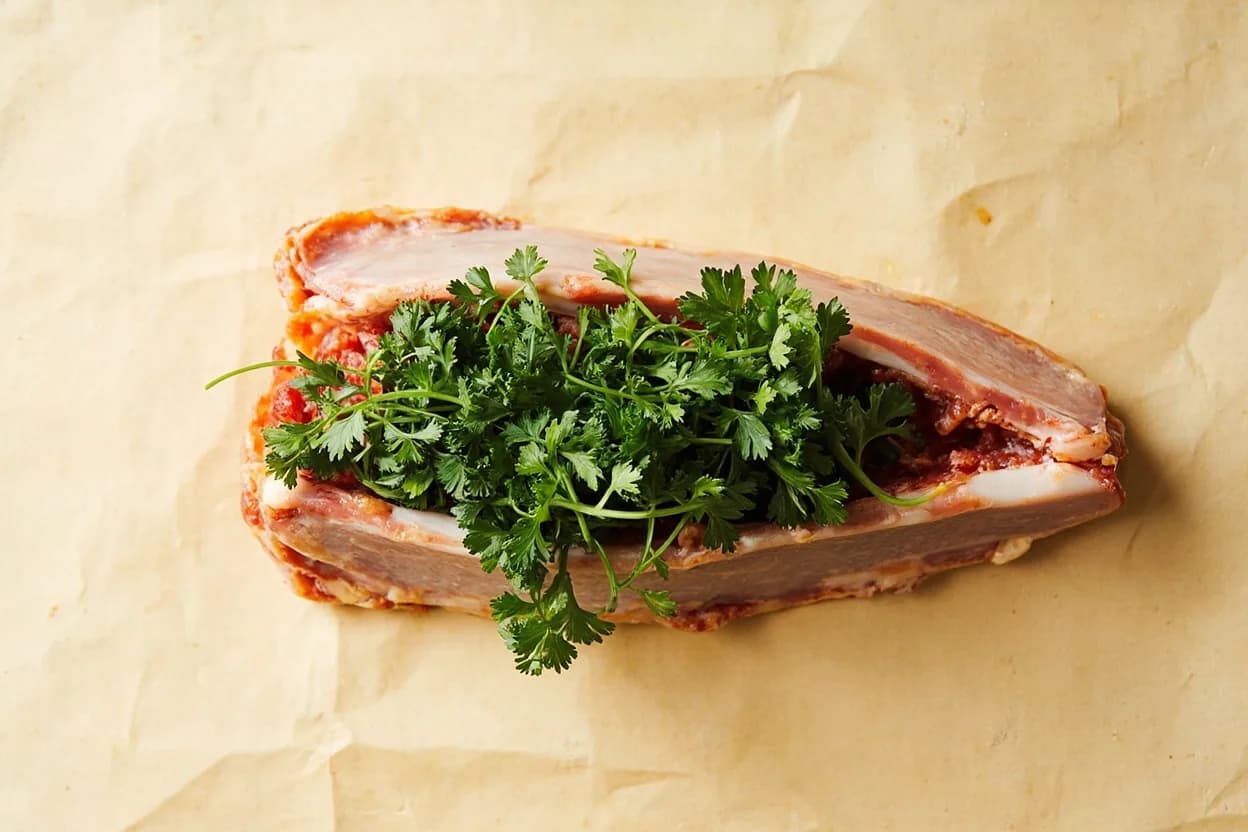
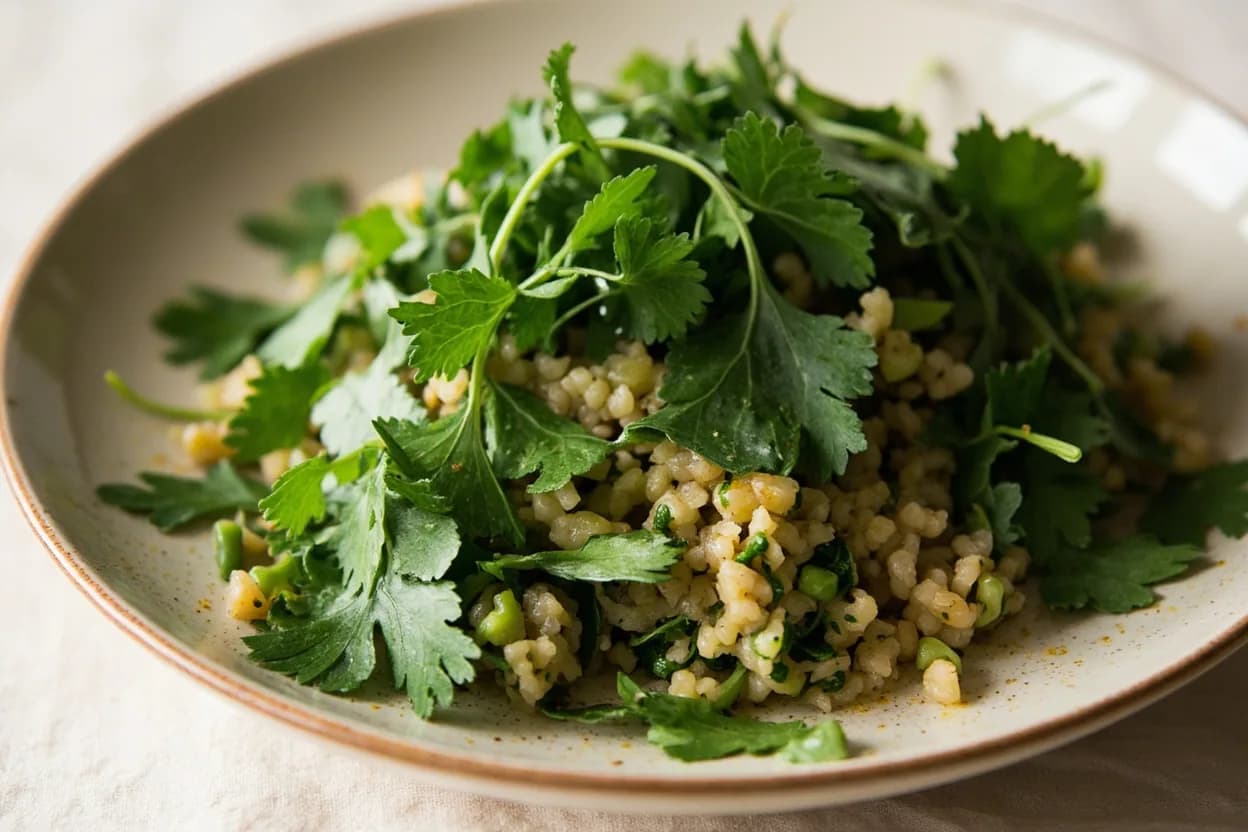
Tabbouleh herb preparation involves a fundamental choice: chiffonade (stacking leaves, rolling tight, and slicing crosswise into 1–2 mm ribbons) versus a rough chop (a two-handed rocking motion over loosely gathered leaves producing 3–5 mm irregular pieces). While chiffonade produces visually uniform fine shreds, the rolling compresses and bruises the leaf cells, releasing chlorophyll-laden liquid that pools in the salad, dilutes the lemon dressing, and creates a soggy texture. The rough chop uses minimal compression, leaves cell walls more intact, and is the cut used across Lebanon, Syria, and Palestine for authentic tabbouleh.
In photos

Where it comes from
Flat-leaf Italian parsley (Petroselinum crispum var. neapolitanum). Curly parsley is a poor substitute for tabbouleh — its tight frilly surface traps dressing rather than releasing it cleanly, and its flavor is coarser. Flat-leaf leaves should be fully dry (spun and patted) before cutting.
Best for
How to cook it
- 1Wash parsley in a basin of cold water, agitating to dislodge grit. Lift out — do not pour through a strainer, which forces grit back through the leaves.
- 2Spin in a salad spinner until dry, then spread on a clean kitchen towel and pat firmly. Moisture is the enemy: wet leaves bruise at the knife and release liquid immediately.
- 3Strip leaves from stems. Tender upper stems (top third) can remain in tabbouleh; woody lower stems are too fibrous.
- 4FOR ROUGH CHOP (tabbouleh standard): Gather a loose pile of leaves — do not press or compact them. Place one hand lightly on the flat of the blade tip, use the other to grip the handle. Rock forward and sweep side-to-side with minimal downward pressure. Gather and re-chop once or twice until pieces are 3–5 mm. Stop early — over-chopping reintroduces bruising.
- 5FOR CHIFFONADE (garnish or immediate use only): Stack 6–8 leaves, roll them tightly lengthwise into a compact cigar. Slice crosswise in 1–2 mm passes. Unroll immediately and do not press; use within 5 minutes before browning sets in.
- 6For tabbouleh: toss chopped parsley with diced tomato and sliced scallion first, then add soaked-and-squeezed fine bulgur. Dress with lemon juice and olive oil last, and serve within 20–30 minutes — the salad cannot sit overnight without the parsley oxidizing and the bulgur absorbing all liquid.
Prep & butchery
- Completely dry leaves are non-negotiable: a single paper towel pass is not enough. Spin, then towel-blot, then let air-dry on the board for 2 minutes if needed.
- Never chop parsley over a wet cutting board — the surface moisture wicks into the cut ends immediately.
- Rough chop: the pile should be loose and high, not compressed flat. The knife is clearing the pile, not crushing it.
- If chiffonade is required (plating garnish), roll gently and slice in a single forward stroke per ribbon — do not saw.
- For high-volume tabbouleh, a mezzaluna (half-moon blade in a wooden bowl) is the traditional Levantine tool; it chops without compressing better than a rocking chef's knife.
Substitutes
- Flat-leaf parsley + fresh mint (Lebanese blend)
Traditional tabbouleh uses a minority of fresh mint torn by hand — roughly 1 part mint to 5–6 parts parsley
- Cilantro rough chop
Bruises similarly to parsley; same rough-chop logic applies; used in Mexican and Middle Eastern fusion salads
- Curly parsley rough chop
Acceptable in a pinch but coarser flavor; avoid chiffonade as the tight frills trap dressing
Related cuts
- Basil chiffonade
Same technique; basil bruises even faster than parsley and turns black within minutes — finish and use immediately
- Mint hand-torn
Used in tabbouleh and fattoush; hand-tearing avoids any blade pressure and is the most cell-preserving method
- Herb fine brunoise
Very fine dice of herbs (chervil, tarragon) for compound butters and classical French garnish; compression issue minimal because leaves are small and stiff
Appears in
References
- 1.Zaitoun: Recipes from the Palestinian Kitchen — Yasmin Khan (W. W. Norton, 2018)
- 2.Jerusalem — Yotam Ottolenghi & Sami Tamimi (Ten Speed Press, 2012)
- 3.The Arabesque Table — Reem Kassis (Phaidon, 2021)
- 4.On Food and Cooking — Harold McGee (Scribner, 2004)
Confidence: high
Notes
Why chiffonade fails in tabbouleh
Rolling the leaves tightly before slicing compresses fragile cell walls. When the knife passes through the compressed roll, each cell releases its liquid instantly — chlorophyll, water, and volatile aroma compounds flood the board. This produces a salad that is wet before the dressing is even added, with a murky dark-green pool forming around the herb pile. In contrast, loose rough-chopped leaves experience only the shock of the blade edge — minimal rolling pressure — so cells on the cut face release liquid, but the interior cells of each piece remain intact and the herb stays dry.
Levantine ratios
Authentic Lebanese tabbouleh reverses the Western ratio: the dish is primarily parsley with a small amount of bulgur, not a bulgur salad with some herbs. A traditional portion uses a large bunch of parsley (approximately 200 g trimmed) to only 2–3 tablespoons of fine bulgur (soaked and squeezed dry, not cooked). Western restaurant tabbouleh — heavy on grain, light on herb — is a diaspora adaptation.
Timing and oxidation
Even perfectly rough-chopped parsley begins to oxidize (turn khaki-green) within 30–45 minutes once cut and dressed with acid. Traditional tabbouleh is dressed and served within that window, not prepared ahead. If advance prep is needed, keep the chopped parsley dry in a sealed container in the refrigerator and dress at the table.