Regional Meat Cuts
Peruvian Asado de Tira (Short Rib Cross-Cut)
Also: asado de tira, tira de asado, flanken-style short rib, cross-cut short rib, costillas cruzadas
A flanken-style cross-cut through 3–4 short rib bones that yields a long, thin strip of marbled beef ideal for the screaming heat of a South American grill or a slow braise in Peruvian chifa-influenced sauces.
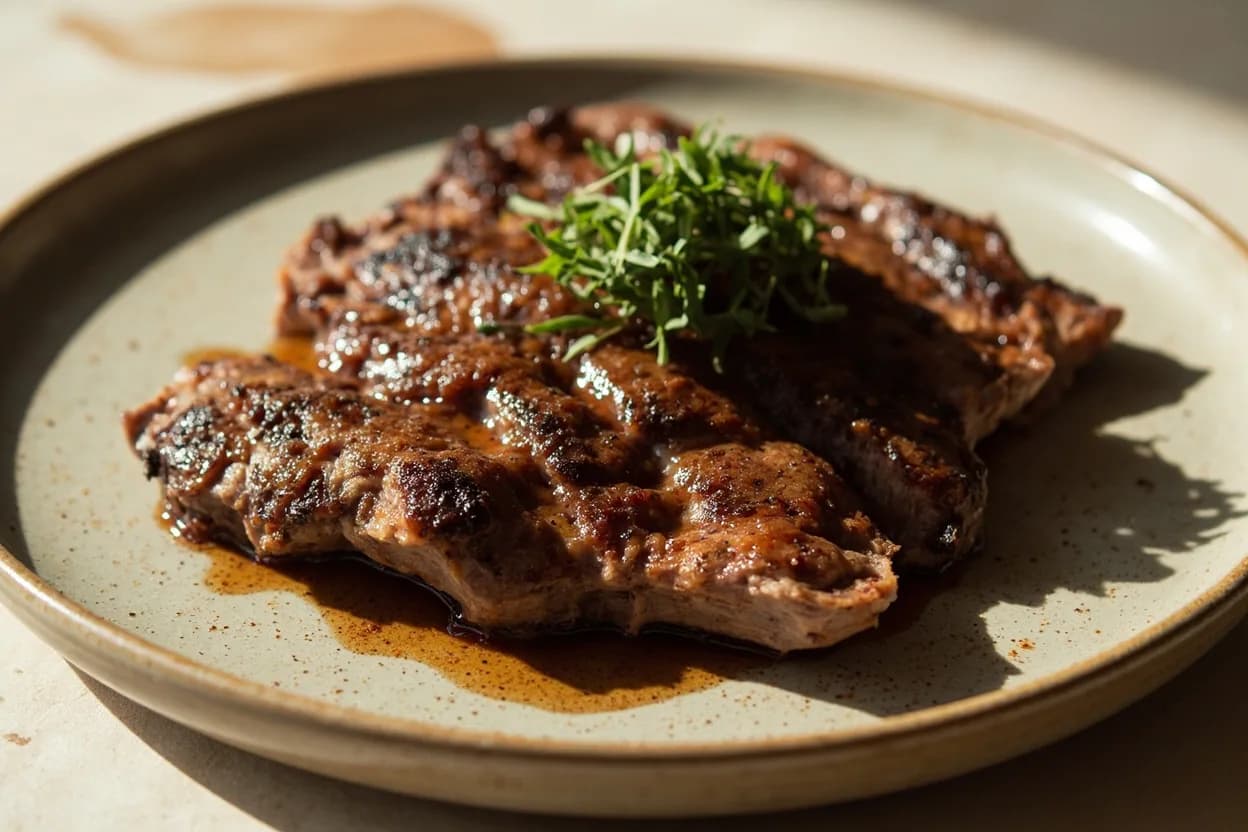
Asado de tira is a cross-cut taken perpendicular to the rib bones through the short rib plate (costillas), producing strips typically 1–2 cm thick, 20–35 cm long, each containing cross-sections of 3–4 rib bones. Unlike the English-style short rib (cut between bones, yielding a thick single-bone block), the tira is flanken-style — the saw or band saw runs parallel to the length of the ribs and perpendicular to the bone long axis. The result is a thin, multi-bone strip with high surface area, abundant intramuscular fat, and rapid grill penetration. It is among the most popular cuts for the Argentine and Peruvian parrilla and is the default short rib cut sold at butchers across both countries.
In photos


Where it comes from
The short rib plate (plate and chuck rib sections), specifically ribs 6–10. The tira cut can be taken from the thicker chuck end (more fat, more flavour) or the thinner plate end (leaner, quicker cooking). Peruvian versions often specify the lower chuck ribs for their marbling.
Best for
How to cook it
- 1GRILL METHOD: Bring to room temperature, season aggressively with coarse salt (and optionally ground cumin — standard in Peru). Build a hot two-zone fire; tira needs direct, very high heat. Grill 3–5 minutes per side for 1.5 cm strips — the goal is a deeply charred crust while the thin profile keeps the interior medium to medium-rare. Rest 3–4 minutes before cutting between bones for serving.
- 2MARINADE OPTION: Peruvian parrilla often marinates tira overnight in a paste of ají panca, garlic, cumin, red wine vinegar, and oil. The acid tenderises the connective tissue and the ají panca smoke flavour complements charcoal char.
- 3BRAISE METHOD: Sear strips hard in batches in a Dutch oven. Remove. Sauté onion, garlic, ají amarillo paste. Deglaze with chicha de jora or red wine. Return ribs, submerge in stock, cover and braise at 150 °C for 2.5–3 hours until intercostal tissue dissolves. Reduce braising liquid to glaze.
- 4CHIFA STYLE: Marinate in soy sauce, ginger, oyster sauce, five-spice, sesame oil for 4 hours. Grill or roast at high heat, then glaze with reduced marinade in final 5 minutes.
- 5Do not attempt to cook tira rare — the collagen adjacent to the bone cross-sections requires at minimum medium internal temperature to soften, even on a grill.
Prep & butchery
- Ask the butcher to cut at 1.5 cm (not thinner — thinner strips dry out before the connective tissue softens; not much thicker or grill time exceeds the window for crust without overcooking)
- Score through the connective tissue between bone cross-sections before marinating to allow flavour penetration around the bone
- Pat completely dry before grilling — moisture on the surface delays Maillard reaction by 1–2 minutes, effectively overcooking the strip
- Let cut strips come to room temperature for 30–45 minutes before hitting the grill — cold strips cook unevenly, with charred exterior and cold centre near the bone
Substitutes
- English-style short rib (bone-in block)
Same primal, different geometry — requires much longer braising (3+ hours) to achieve similar tenderness; not suitable for direct grilling
- Flanken short ribs (Korean galbi cut)
Nearly identical cross-cut but typically thinner (0.5–1 cm) and often scored — the Korean galbi cut is the closest functional equivalent
- Beef plate / hanger steak
Comparable fat content and grill character; single muscle without bone; misses the collagen contribution of the tira
Related cuts
- Korean galbi (flanken short rib)
Identical primal cut, thinner (0.5–1 cm), scored and marinated in soy-sugar rather than dry-rubbed — the closest cross-cultural equivalent
- English short rib
Between-bone cut from the same primal; thick single-bone block for braises, not grilling
- Beef plate (vacio)
Neighbouring primal on the same side of the animal; similar fat profile, popular in the same parrilla tradition
Appears in
References
- 1.Seven Fires: Grilling the Argentine Way — Francis Mallmann (2009)
- 2.The Art of South American Cooking — Felipe Rojas-Lombardi (1991)
- 3.Parrilla: The Art of Argentine Barbecue — Various authors, Argentine Meat Institute (IPCVA)
- 4.The Professional Meat Buyer's Guide — NAMP (North American Meat Processors, Item 123 Short Ribs)
Confidence: high
Notes
Argentine vs. Peruvian usage
In Argentina, tira de asado is THE iconic parrilla cut — often placed on the grill bone-side down over moderate heat for 15–20 minutes before flipping, a slow approach that renders fat through the bone cavities before crisping the meat face. Peruvian parrilleros tend to prefer higher direct heat and shorter cooking times, typically using marinades to compensate for the reduced cook time's lower collagen breakdown. Chifa (Peruvian-Chinese) versions braise rather than grill, reflecting the Chinese immigrant influence that permeates Peruvian cuisine.
Why the thin cross-cut beats English style for grilling
A thick English short rib block (4–6 cm) requires indirect heat and 45+ minutes to achieve tenderness — by which point it's essentially a braise-on-the-grill. The tira's 1.5 cm profile means the fat nearest the bone can render in the same time the crust forms on the outer face: roughly 3–4 minutes per side. The trade-off is that you can't target the doneness precision of a solid steak — tira is inherently a medium cook.