Knife Cuts — Regional & Global
Rajas (Roasted Chile Strips)
Also: rajas, rajas de chile, chile strips, chile poblano strips, poblano rajas
Roasted, peeled, and stripped chile peppers — a Mexican cut-and-prep technique that transforms raw heat into sweet, smoky depth.
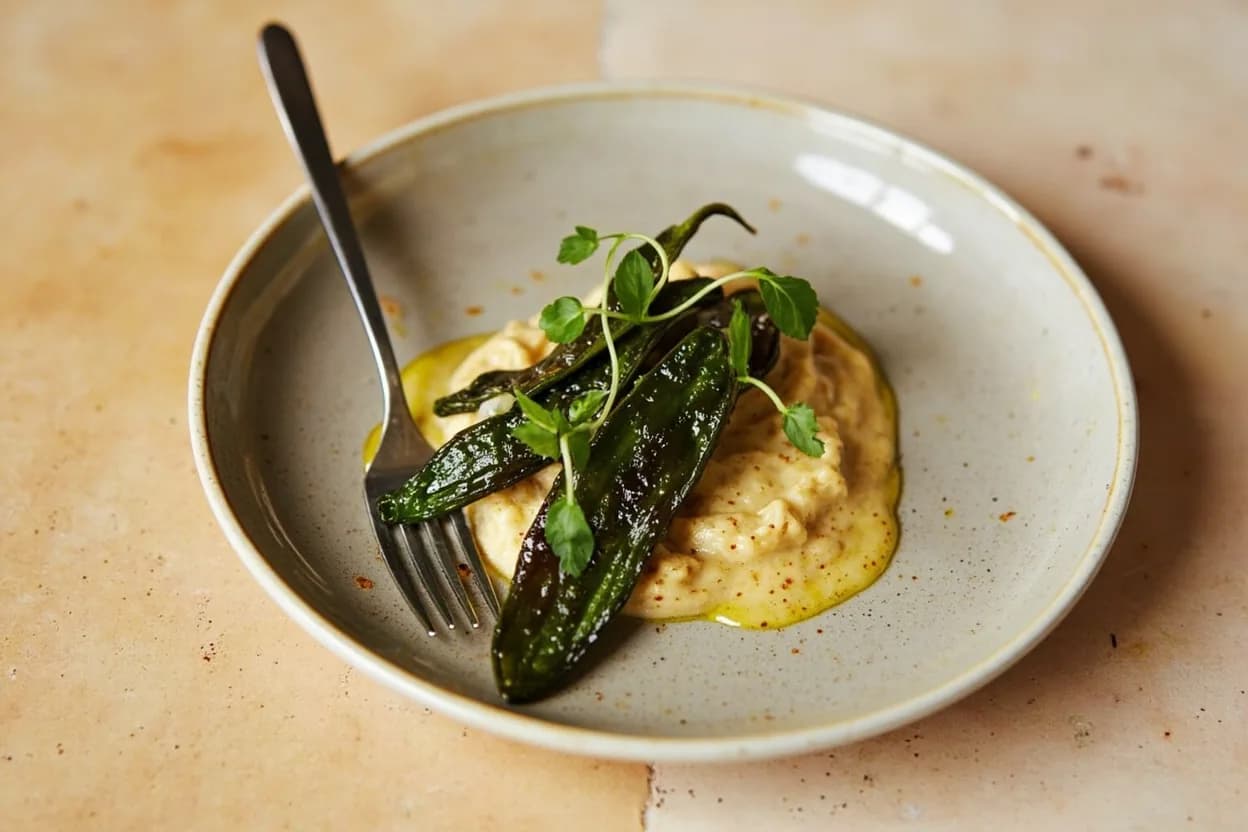
Rajas (from the Spanish verb rajar, to split) are strips of roasted and peeled chile peppers, most commonly poblano, cut approximately 5–8 mm wide and 5–7 cm long. The technique is both a knife cut and a preparatory method: the chile is charred over an open flame or under a broiler, sweated in a sealed bag to loosen the skin, peeled, seeded, and then cut into strips. The roasting fundamentally changes the chile's flavor — raw poblano is grassy and mildly bitter; rajas are sweet, smoky, and silky, with concentrated capsaicin that reads as warmth rather than sharpness.
In photos
Where it comes from
Applied to fresh chiles, most commonly poblano (Capsicum annuum 'Poblano'), but also Anaheim, Hatch, guajillo (less commonly — they are typically dried), and occasionally chile de agua or chile morrón. The poblano is the canonical raja chile: its thick walls survive roasting without disintegrating, its broad flat shape peels cleanly, and its mild-to-medium heat (1,000–2,000 Scoville) makes the finished rajas broadly edible.
Best for
How to cook it
- 1Char the whole chile directly over a gas burner on high, turning with tongs every 30–45 seconds, until the skin is blackened on all sides — roughly 4–6 minutes total. Alternatively, broil 10 cm from the element, turning once.
- 2Immediately transfer to a zip-lock bag or a bowl sealed tightly with plastic wrap. Let steam 10–15 minutes — the steam loosens the charred skin from the flesh.
- 3Open the bag and peel off the blackened skin with your fingers or a paper towel. Do not rinse under water — rinsing washes away roasted flavor. Tolerate small patches of remaining char; attempting 100% peeling tears the flesh.
- 4Slit the chile lengthwise from stem to tip. Open it flat and remove the seed cluster and inner veins with a spoon or knife tip. If heat tolerance is a concern, remove all veins; for more fire, leave some.
- 5Cut the peeled, cleaned chile lengthwise into strips approximately 5–8 mm wide and 5–7 cm long, following the natural planes of the flesh.
- 6Use immediately or store refrigerated up to 3 days. Rajas freeze well — freeze flat on a sheet pan before bagging for easy portioning.
Prep & butchery
- Wear gloves if sensitive to capsaicin — the oils concentrate on your fingertips during peeling and can transfer to eyes
- Tongs are essential for open-flame charring; never use a fork which punctures the flesh and allows juice loss
- If working in volume (chiles en nogada for a party), use a broiler and char 6–8 chiles simultaneously on a rack
- A dry, rough-textured paper towel grabs charred skin better than fingers alone
- Cut against the natural ribs of the chile interior — the flesh has directional grain from the shoulder to the tip
Substitutes
- Hatch green chile strips
Direct functional substitute with higher heat; same roast-peel-strip technique; seasonal (August–September) and regional (New Mexico)
- Anaheim chile rajas
Milder than poblano; thinner walls mean more careful roasting to avoid complete charring through to flesh; acceptable substitute in cream sauces
- Jarred roasted red peppers (pimientos)
No char flavor, no heat — a pantry emergency substitute that retains the silky-strip texture but loses the smoky depth entirely
Related cuts
- Tiras anchas
Wider strips (10–12 mm) used in some northern Mexican preparations where the chile strip is a focal ingredient rather than a component
- Chiffonade of chile
Very fine strips of raw or roasted chile used as garnish — the fine end of the raja spectrum
- Chile relleno whole
The same roasted-and-peeled poblano left whole and stuffed — rajas are the strip version of the same base prep
Appears in
References
- 1.Mexican Everyday — Rick Bayless
- 2.Authentic Mexican — Rick Bayless
- 3.My Mexico — Diana Kennedy
- 4.The Art of Mexican Cooking — Diana Kennedy
Confidence: high
Notes
The chemistry of roasting
Roasting a poblano over open flame achieves two simultaneous goals. First, the Maillard reaction on the skin produces hundreds of new flavor compounds — the same reaction responsible for seared meat flavor — in a vegetable context. Second, the heat collapses the pectin crosslinks in the chile's cell walls, converting the firm raw flesh to a silky, yielding texture that no amount of sautéing raw chile achieves. The skin itself is indigestible when charred and must be removed, but its flavor migrates into the flesh during the steam-sweat phase.
Poblano vs. pasilla confusion
In Mexico City and central Mexico, the fresh dark-green chile used for rajas is universally called poblano. In many parts of the US and in some northern Mexican states, this same chile is sold as 'pasilla.' True pasilla (chile pasilla negro) is a dried chile — long, dark, wrinkled, with a different flavor profile entirely. When buying for rajas, look for the large, triangular, dark green fresh chile regardless of the label.