Poultry — Breakdown & Cuts
Rabbit Segmentation
Also: rabbit breakdown, lapin en morceaux, rabbit fabrication, tu rou fen ge, whole rabbit butchery
The whole-rabbit breakdown into saddle, forelegs, hind legs, and rib section — each cut demanding different cooking times and methods, with offal (liver, kidney) reserved for high-heat preparations.
Rabbit segmentation divides a whole dressed rabbit (1.2–1.8 kg) into its anatomically distinct sections: the two hind legs (cuisse arrière — the meatiest and most valued cuts), the saddle (râble — the long loin section running between the last rib and the pelvis), the two forelegs (épaule), the rib cage section (poitrine/côtes), and often the head and liver/kidney as separate components. Because a rabbit's hind legs are powerful, well-exercised muscles while the saddle contains the most tender, fast-twitch fibers, each section requires a different cooking method and time — unlike chicken, where all parts can be cooked together by adjusting timing alone.
In photos
Where it comes from
The whole domestic rabbit (Oryctolagus cuniculus domesticus), typically sold dressed (skinned and gutted) with head optional. The hind legs attach to the pelvis at a ball-and-socket joint identical in anatomy to a chicken's hip. The saddle runs along both sides of the lumbar spine. The forelegs lack a ball-and-socket joint and are attached only by muscle — they can be removed by following the natural seam without cutting bone. The liver and kidneys are typically left in the carcass by the butcher and removed first during breakdown.
Best for
How to cook it
- 1Remove offal first: reach into the body cavity and remove the liver, kidneys (in their fat jackets), heart, and lungs; season and reserve separately — the liver will be sautéed in butter for 2 minutes; kidneys roasted in their fat.
- 2Separate hind legs at the pelvis: bend each leg outward to expose the ball-and-socket joint; cut through the joint cleanly, then trim away the flap of belly flap attached.
- 3Remove forelegs: the foreleg has no ball-and-socket joint — simply cut through the muscle seam where the foreleg meets the rib cage, working from the inside out along the natural seam.
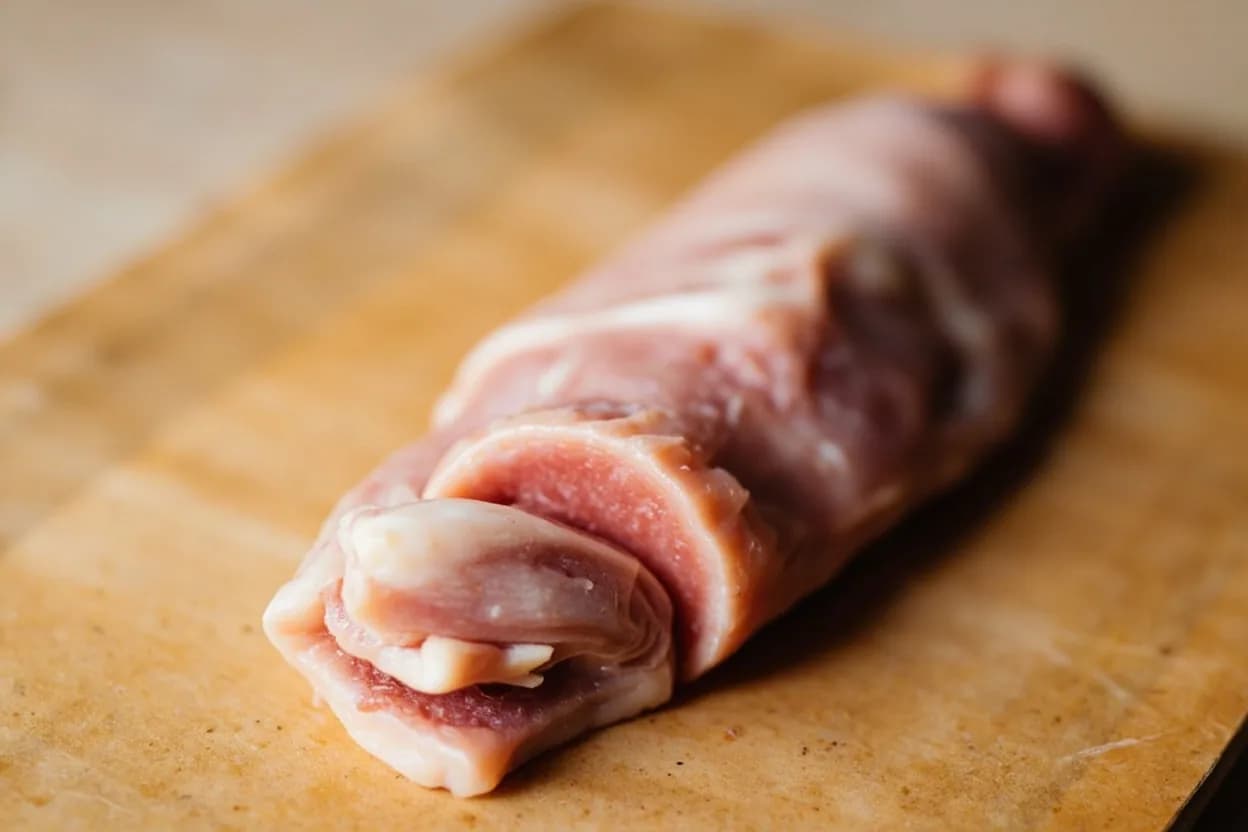
- 4Isolate the saddle: identify the last rib by pressing down the spine; cut just forward of the last rib (toward the head) to separate saddle from rib section; cut across the pelvis at the posterior end to free the saddle from the hip remnant. The result is a long 'barrel' of loin meat on the bone.
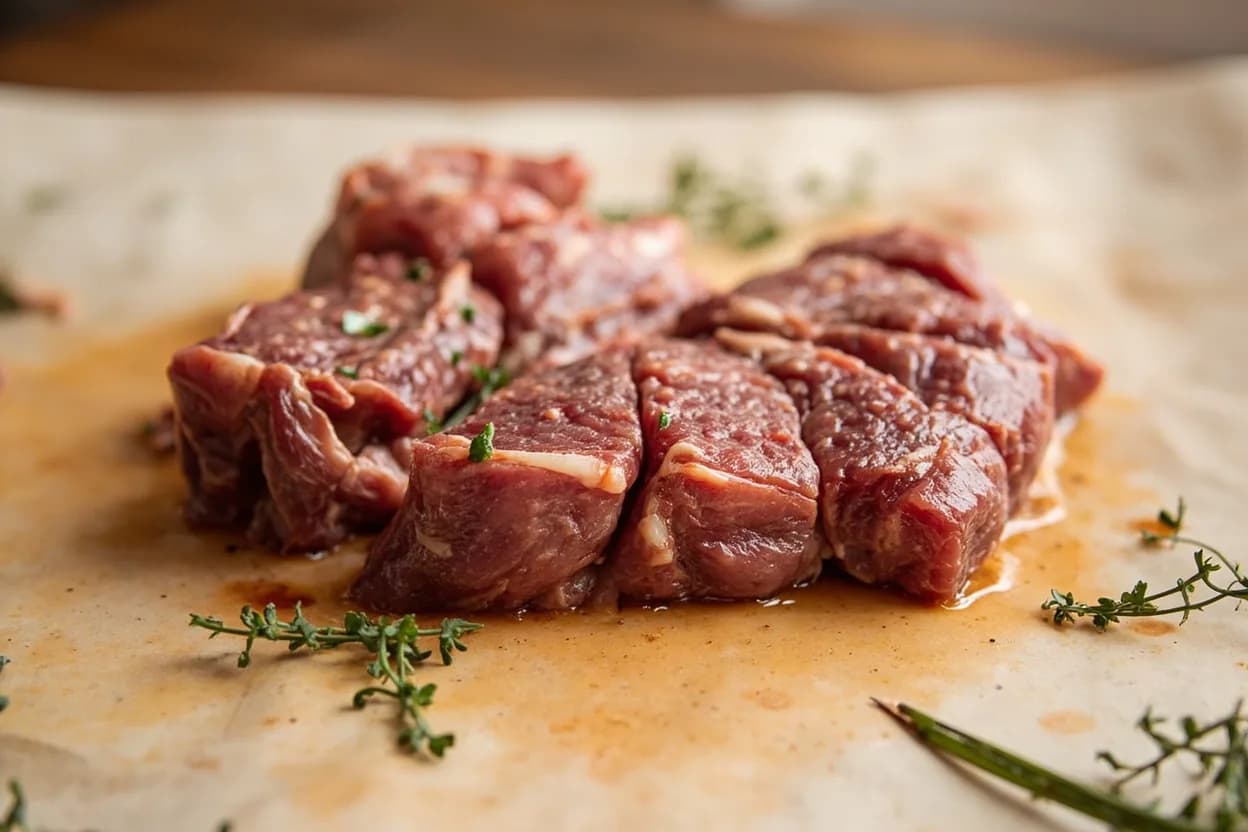
- 5For Sichuan red-braised rabbit: chop hind legs and saddle into 4 cm pieces across the bone; par-boil 3 minutes; braise in doubanjiang, Shaoxing wine, Sichuan peppercorns, dried chili, star anise, and soy for 45 minutes.
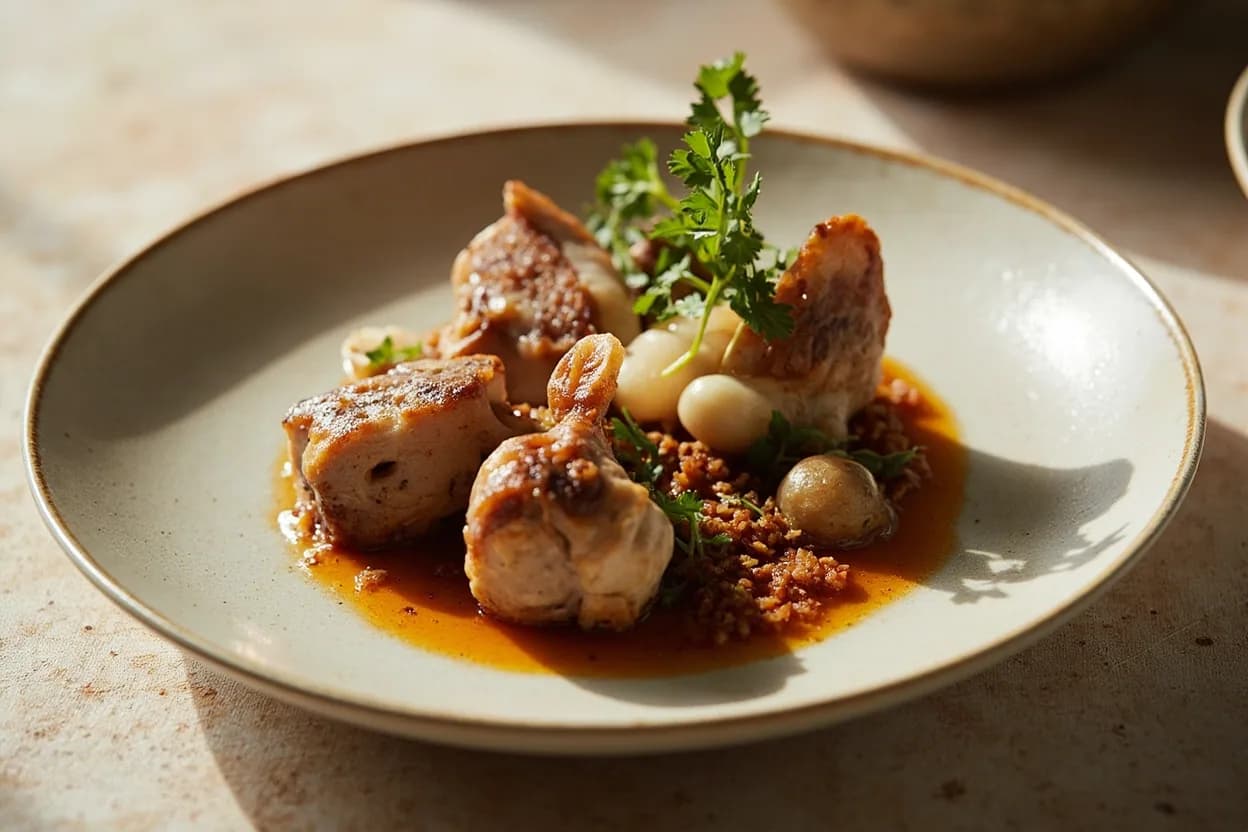
- 6For French lapin à la moutarde: sear hind legs in butter until golden; deglaze with white wine and crème fraîche blended with Dijon mustard; braise covered for 35–40 minutes; fold in more mustard off heat.
Prep & butchery
- Work on a large board — a whole rabbit, even dressed, is longer than most people expect (typically 50–60 cm from nose to tail base).
- Remove kidneys and liver first, while the carcass is intact — reaching in with one hand to locate and pull the offal is easier before the carcass is opened up by leg removal.
- For hind legs: use a boning knife to locate the hip socket by feel; the ball joint pops free cleanly if the knife tip is inserted at the correct angle — no bone-saw needed.
- For Sichuan applications: once the four primary cuts are made, chop all bone-in pieces across the bone into 3–4 cm chunks using a heavy Chinese cleaver. Rinse under cold water to remove bone fragments, then par-boil.
- Chill the saddle to 1–2°C before roasting: cold saddle meat contracts less rapidly, giving a wider window between rare-tender and dry-overcooked.
- Truss the saddle if roasting whole: fold the flaps of belly meat under the saddle and tie with butcher's twine every 3 cm — this creates a uniform cylinder that browns evenly.
Substitutes
- Chicken leg quarters
Similar anatomy for the hind leg application; fattier and more forgiving of overcooking — a reliable substitute in braised dishes
- Hare leg (lièvre)
Gamier and tougher; requires longer braising and benefits from marination; more appropriate for civet de lièvre than mild mustard preparations
- Veal loin
Comparable texture and leanness to the rabbit saddle — can substitute in stuffed-roulade applications
- Guinea fowl (pintade)
Similar lean, gamey profile; whole bird breakdown comparable in concept though anatomically different
Related cuts
- Rabbit Saddle (Râble de Lapin)
The premium loin section isolated from the full breakdown
- Rabbit Leg (Cuisse de Lapin)
The hind leg cut — the single most versatile and meaty rabbit portion
- Chicken Leg Quarter
Closest chicken analog to the rabbit hind leg in braised applications
- Veal Loin
Textural analog to the rabbit saddle — similar lean, fine-grained structure
Appears in
References
- 1.Charcuterie: The Craft of Salting, Smoking, and Curing — Michael Ruhlman and Brian Polcyn
- 2.The French Laundry Cookbook — Thomas Keller
- 3.Land of Plenty — Fuchsia Dunlop
- 4.The River Cottage Meat Book — Hugh Fearnley-Whittingstall
Confidence: high
Notes
The leanness problem
Rabbit is one of the leanest domesticated meats — roughly 3–5% fat, compared to 15–20% for chicken thigh. This leanness, celebrated nutritionally, is the cook's central challenge: the saddle in particular goes from perfectly cooked to dry and chalky within 2–3 minutes of overcooking. French cuisine addresses this by larding the saddle (threading strips of pork fatback through the loin with a larding needle) or by wrapping it in caul fat or pancetta before roasting. Italian cacciatore relies on braising liquid to compensate. Sichuan red-braising uses the chopped bone-in method, which keeps the meat in contact with fat-carrying liquid throughout the long cook.
Sichuan rabbit culture
Sichuan province has the highest per-capita rabbit consumption in China by a significant margin — rabbit is embedded in Chengdu street food culture in a way that has no direct parallel in the rest of the country. The most common preparation is cold-dressed rabbit (fuqi feipian-adjacent dishes with numbing-spicy sauces) and hong shao braised rabbit. The key Sichuan technique for the breakdown is chopping all bone-in pieces fine (3–4 cm across the bone) rather than the French separation of whole leg/saddle — this maximizes sauce surface area and produces the characteristic sticky, heavily spiced coating that defines Sichuan red-braised rabbit.