Pasta & Grain Doneness
Congee & Juk Starch Breakdown Stage
Also: jook, zhou, rice porridge dissolution stage, grain burst stage, congee gelatinization
The point at which rice grains fully burst and their starch gelatinizes into a silky, cohesive porridge — the defining doneness of congee.
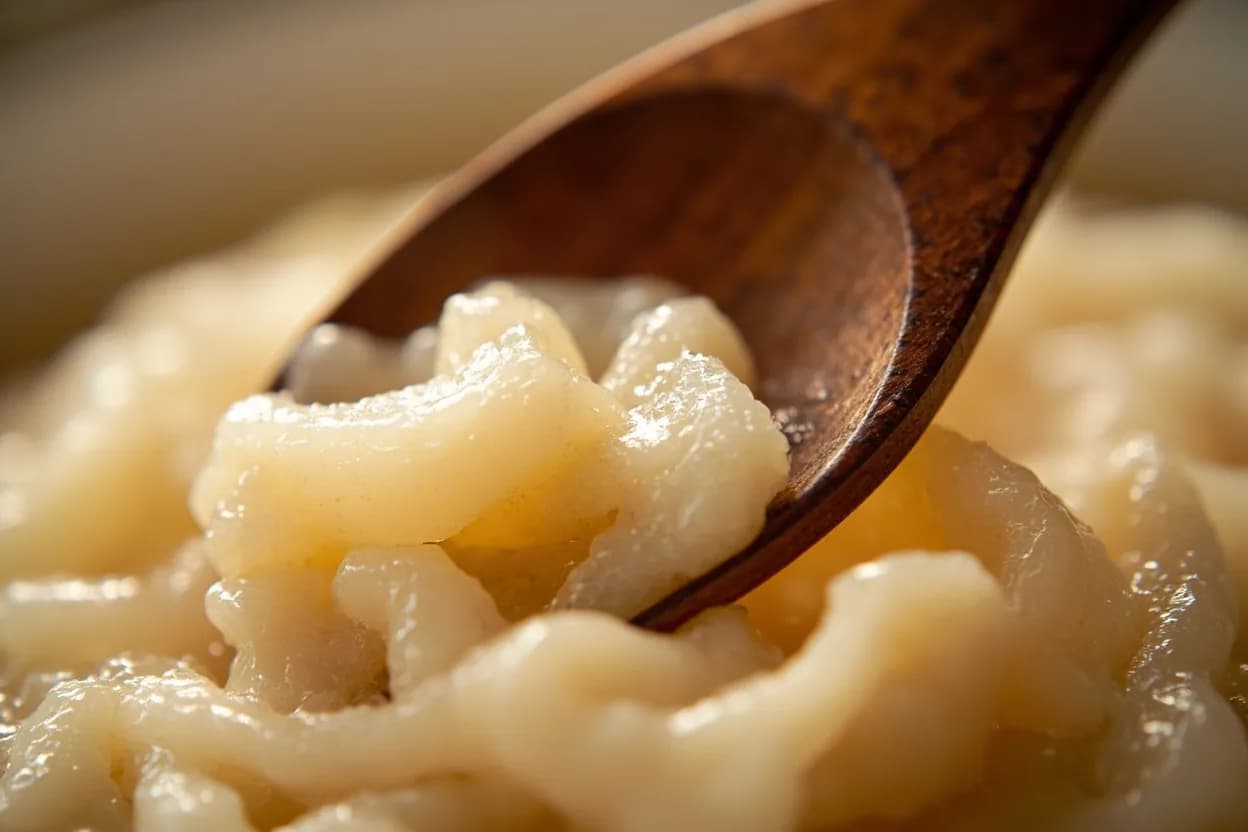
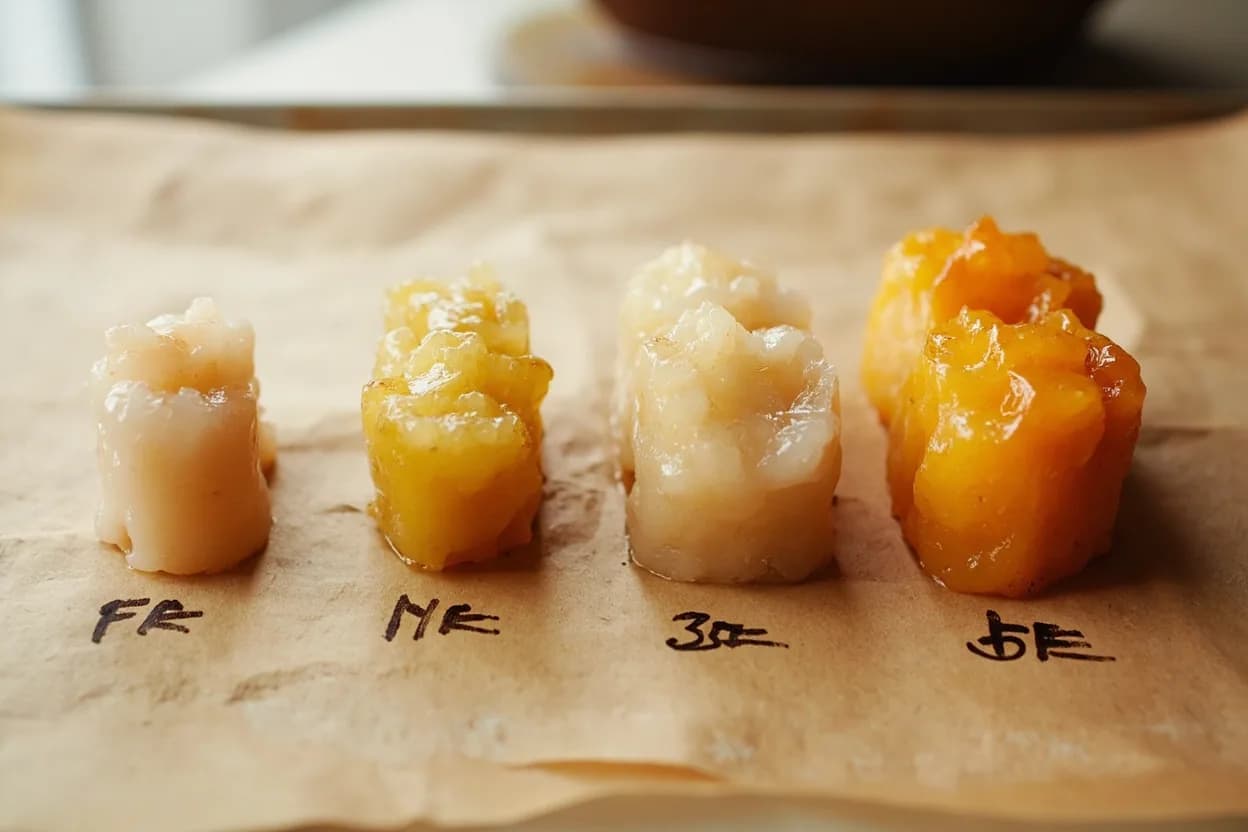
Congee (Cantonese: juk; Mandarin: zhōu; Japanese: kayu; Korean: juk) achieves its characteristic texture through an extended simmer — typically 45–90 minutes at a low boil — that carries rice far beyond conventional doneness. The starch breakdown stage has two sub-phases: first, grains soften and swell as starch granules absorb water and gelatinize; then, continued heat and agitation ruptures the grain structure entirely, releasing amylose and amylopectin chains into the cooking liquid. These polymers cross-link loosely, thickening the water into a homogeneous, creamy suspension with a glossy surface and a spoonable, coating consistency. At this stage no discrete grain texture remains — only a smooth or finely particulate mass depending on rice variety and ratio.
In photos
What happens
Starch gelatinization begins around 60–70°C as water penetrates the crystalline regions of starch granules, swelling them. By 100°C, granules have fully swollen. Continued agitation at a low boil physically shears the swollen granules, releasing soluble amylose into the water column and leaving amylopectin-rich ghost cells dispersed throughout. This biopolymer matrix traps water in a gel-like network, producing viscosity without gelatin. The longer the cook, the more starch dissolves, until the texture crosses from 'broken rice in thick broth' to a fully unified, almost velvety paste. Fat (lard, sesame oil, scallion oil) emulsifies into the matrix during finishing, adding gloss and lubricity.
What to look for
- No distinct grain boundaries visible — the surface appears smooth and unified, not lumpy
- A wooden spoon dragged through the pot leaves a slow-closing channel — the mixture coats the spoon without dripping
- Texture is silky and uniform; grains should offer no resistance when a small amount is pressed between thumb and forefinger
- The surface has a glossy sheen and small, lazily bursting bubbles (not a rolling boil)
- Aroma is deeply savory and cereal-sweet, without any raw or chalky note
- Color is ivory to pale cream; long-cooked batches over high heat may show light caramelization at the pot walls
How to check
- Spoon test: lift a spoonful and let it fall back — it should ribbon off the spoon in a slow, cohesive sheet, not splash
- Pinch test: press a small amount between fingers — no hard core, no granular grit, just uniform soft paste
- Plate drag: spoon a small pool onto a cold plate and tilt — it should flow slowly and hold a mounded shape at the center
- Stir resistance: a well-done congee resists the spoon with a gentle, even drag; undercooked congee has a waterier resistance with grain lumps
The science behind it
The hydration and swelling of starch granules when heated with water; the first phase of congee development
On cooling, amylose chains re-crystallize, causing leftover congee to thicken further and develop a gummy skin — reheat with added water
- Risotto Mantecatura
Analogous starch-release technique in Italian cooking: agitation frees amylopectin from Arborio rice to create a creamy sauce
- Rice-to-Water Ratio
Congee ratios range from 1:8 (thick Cantonese juk) to 1:14 (thin Japanese okayu); ratio determines final viscosity and cook time
- Bone Broth Base
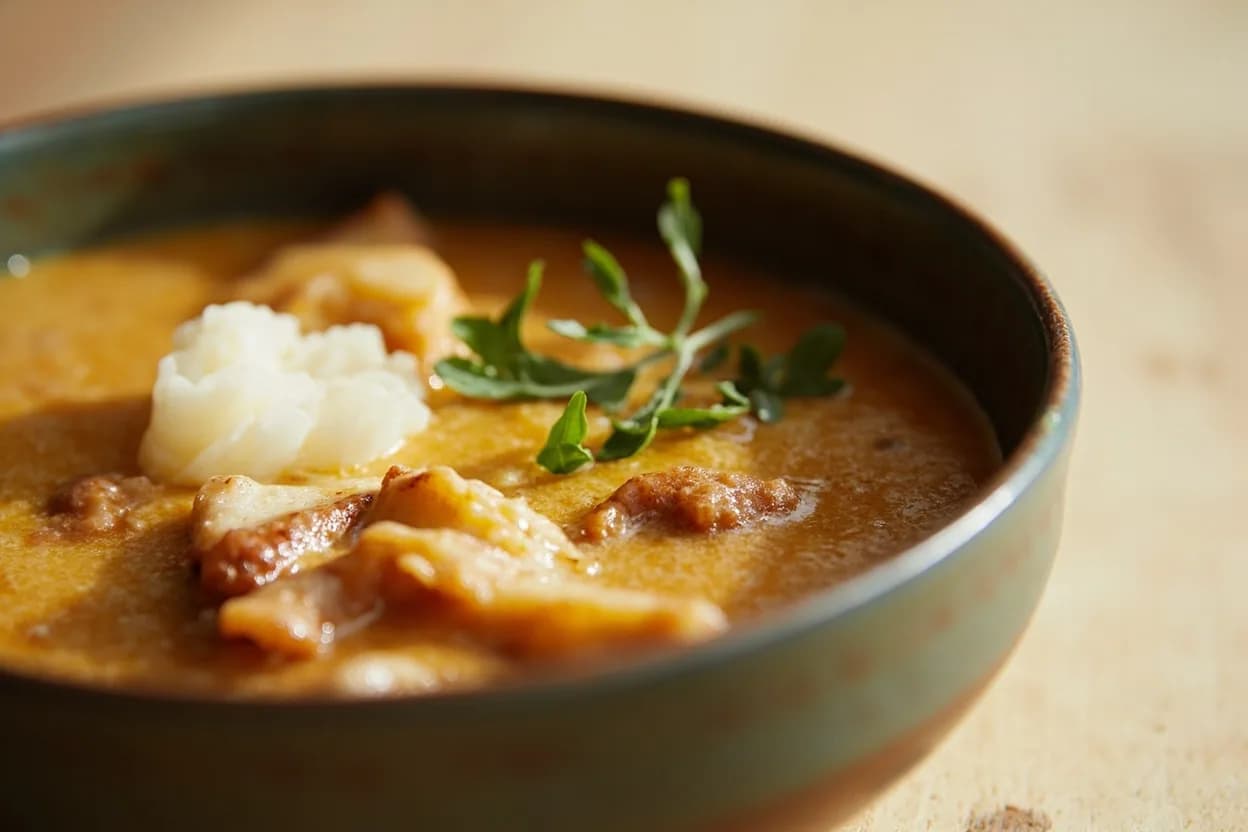
Many congee traditions simmer rice in rich bone broth rather than water, adding collagen that reinforces the gel structure
- Century Egg (Pidan)
Classic Cantonese congee topping; the alkaline gel of the egg contrasts with the soft, neutral starch matrix
Appears in
References
- 1.On Food and Cooking — Harold McGee (Scribner, 2004)
- 2.The Wok — J. Kenji López-Alt (W. W. Norton, 2022)
- 3.Land of Fish and Rice — Fuchsia Dunlop (W. W. Norton, 2016)
- 4.Modernist Cuisine — Nathan Myhrvold et al. (The Cooking Lab, 2011)
Confidence: high
Notes
Variety selection changes breakdown time
Broken jasmine rice (sold in Southeast Asian markets) reaches the starch breakdown stage in 30–40 minutes because pre-fractured grains absorb water faster. Short-grain Japanese rice (Koshihikari) produces a finer, stickier gel due to higher amylopectin content. Long-grain indica rice (Thai jasmine, basmati) takes longer and yields a looser, less cohesive result. Using a small percentage of glutinous rice (10–20%) dramatically accelerates creaminess.
Overnight and slow cooker methods
Both exploit the time-dependence of starch breakdown. An overnight slow-cooker congee (low, 8 hours) often exceeds the texture of a stovetop version, producing a remarkably silky result because the sustained low heat prevents evaporation while maximizing gelatinization without scorching. The trade-off is that flavoring agents like ginger and scallion must be refreshed at serving.