Fish & Seafood Doneness
Crab: Shell Color Change & Internal Temperature
Also: crab doneness, crab shell color, cooked crab temperature
Crab is fully cooked when the shell shifts from blue-grey to vivid orange-red via astaxanthin liberation — confirmed safe at 74°C internal temperature in the body cavity.
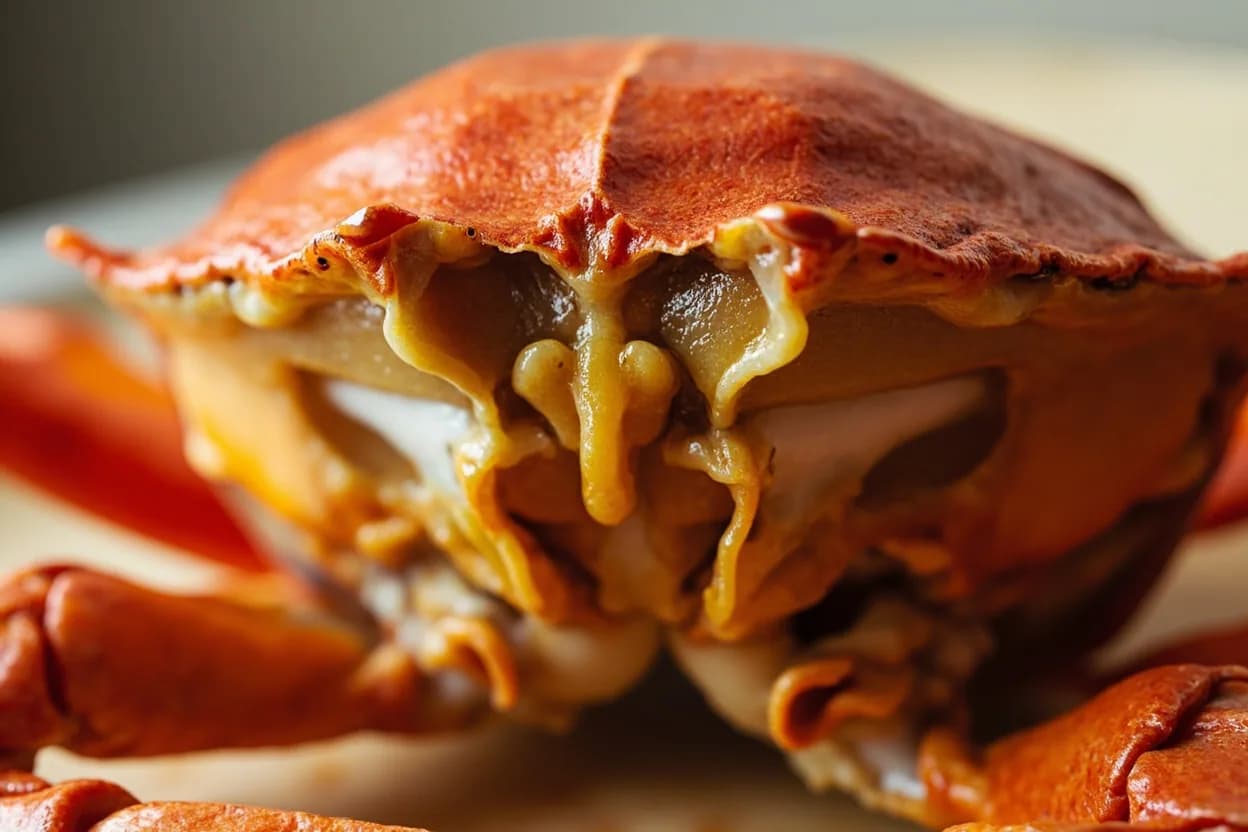
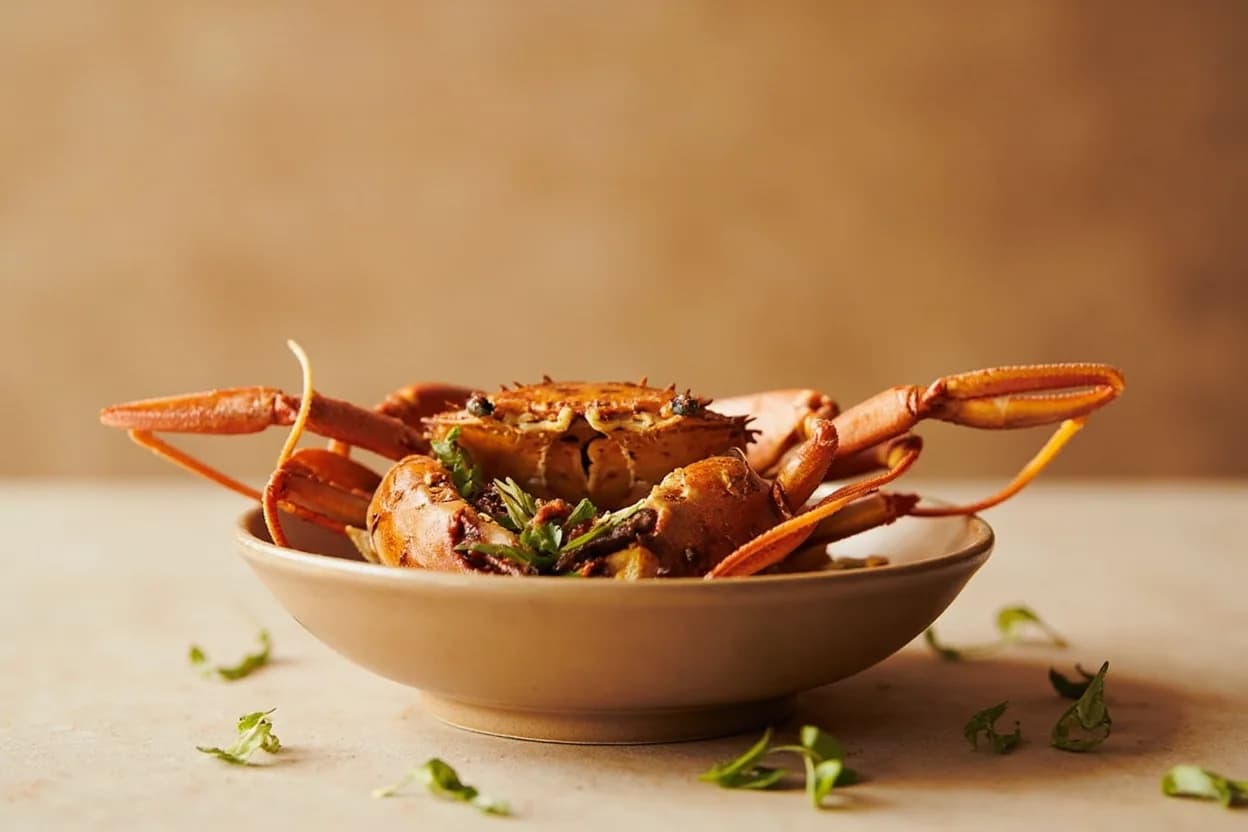
Live and freshly killed crabs display shells ranging from blue-grey (Dungeness, blue crab) to green-brown (mud crab) to speckled brick (king crab), depending on species. This coloration comes from astaxanthin, a carotenoid pigment protein-bound in a complex called crustacyanin. At approximately 40°C, the crustacyanin complex begins to denature and release free astaxanthin, which absorbs light maximally at around 490 nm — giving the characteristic vivid orange-red color. The color change is therefore not a doneness indicator for the meat per se, but a reliable signal that the crab has been heated throughout. For food safety, USDA and FDA guidance specifies 74°C (165°F) as the minimum internal temperature for crab — significantly higher than for most other seafood — due to the dense body cavity and the risk of pathogens in the hepatopancreas (mustard/tomalley).
In photos

What happens
The color shift begins early (around 40°C) as crustacyanin loosens its grip on astaxanthin. By 60°C the shell is fully orange-red and the exterior provides no further temperature information about the interior. The crab's muscle proteins (primarily in the claws and leg meat) denature from 55°C onward, transitioning from translucent grey-white to opaque white. The hepatopancreas ('mustard' or 'tomalley') in the body shifts from grey-green to yellow to firm and slightly granular. At 74°C, the dense muscle in the large claws and body is fully set: the meat pulls cleanly away from the shell walls and segments easily. Overcooking above 80°C leads to dry, stringy leg meat and a rubbery claw texture.
What to look for
- Shell achieves full, uniform orange-red color across all surfaces — no remaining grey-blue patches
- Claw meat visible through translucent claw segments turns opaque white
- The hepatopancreas (body cavity 'mustard') firms from runny grey-green to set yellow
- Leg and body joints feel firm rather than limp when flex-tested
- Aroma becomes fully cooked — rich, briny, and sweet — losing the raw sea smell
How to check
- Insert a thin probe thermometer through a soft joint or an eye socket into the body cavity; target 74°C
- Twist off a walking leg — if the meat at the break point is opaque white with no grey translucency, the crab is done
- For steamed whole crab, pull one leg tip: if it detaches cleanly, the crab is cooked through
- Check that the abdominal flap (apron) is firm and no longer flexible
Food safety
Carryover & resting
Whole crab carries over 3–5°C due to the dense shell acting as a heat sink. Remove from boiling water or steam when the thickest body cavity point reaches 70–71°C and allow a 2-minute rest to let carryover bring it to 74°C. Immediate plunging in ice water halts carryover for species like Dungeness where the sweet, delicate leg meat can quickly overcook.
The science behind it
- Astaxanthin and crustacyanin
The protein-bound carotenoid complex responsible for the universal crustacean color-change signal across lobster, shrimp, and crab
- Hepatopancreas (crab mustard)
The digestive gland that sets at 65–70°C, used as a secondary doneness cue; also a prized delicacy in many cuisines
- Species-specific cooking times
Dungeness (~1.5 kg): 15–18 min boil; blue crab (~350g): 8–10 min steam; king crab legs (pre-cooked): 5–7 min steam to 63°C
- Carryover in shellfish
Dense crustacean shells create a meaningful carryover effect unlike thin-shelled bivalves
- Soft-shell crab doneness
Soft-shell blue crabs (freshly molted) are cooked in the entirety — shell included — and checked by internal temperature and flesh opacity, not shell color
Appears in
References
- 1.FDA Food Code 2022, §3-401.11 (Crustacean Shellfish Minimum Temperatures).
- 2.McGee, Harold. On Food and Cooking: The Science and Lore of the Kitchen. Scribner, 2004.
- 3.Myhrvold, Nathan, et al. Modernist Cuisine: The Art and Science of Cooking. The Cooking Lab, 2011.
- 4.Rae, A.E. and Cooksey, C.J. 'Astaxanthin and the Colour of Cooked Crustaceans.' Pigment & Resin Technology, 2001.
Confidence: high
Notes
The color change is not enough
The orange-red color shift occurs long before the body cavity reaches 74°C. A crab pulled from boiling water the moment it turns red may be 50–55°C internally — enough to kill the surface bacteria but not the pathogens potentially harbored in the body cavity. For large Dungeness and mud crabs especially, cook time (not color) must drive the process, with probe confirmation.
Pre-cooked crab
The majority of commercially sold crab legs (king crab, snow crab) are cooked and flash-frozen on the processing vessel immediately after harvest. These only need to be reheated to 63°C for safe service. The 74°C standard applies to raw live or raw-frozen whole crab.