Technique-Specific Doneness
Gyoza & Jeon Crisp-Bottom Doneness
Also: potsticker crust, jiaozi golden crust, pajeon crisp base, dumpling crust doneness, steam-fry finish
The moment the bottom crust of a pan-fried dumpling or Korean pancake turns deep golden-brown, releases cleanly from the pan, and sounds hollow when tapped.
Crisp-bottom doneness in the steam-then-fry method describes the precise endpoint at which the starch-and-fat crust formed on the base of gyoza, jiaozi, mandu, or jeon has dehydrated and undergone sufficient Maillard browning to produce a rigid, audibly crisp shell that separates from the pan without tearing. It is achieved after the lid is removed and residual steam is driven off, exposing the crust to direct dry pan-contact heat. The crust temperature at this moment is typically 160–180°C (320–356°F) at the contact surface, while the filling interior reads 74–80°C (165–176°F) for meat-filled dumplings.
In photos
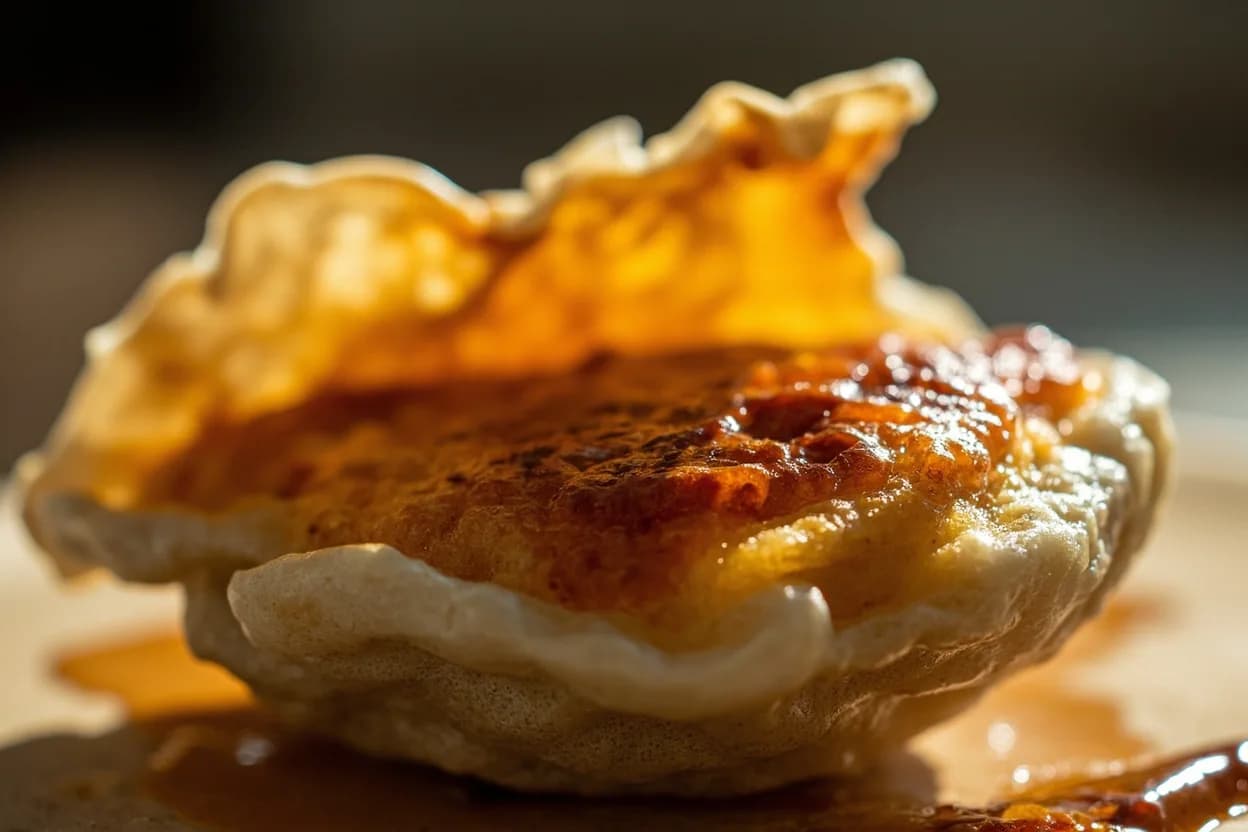


What happens
During the initial steam phase, moisture migrates into the dough or batter, gelatinising the starches and cooking the filling through. Once the lid is removed and the remaining liquid evaporates, the pan temperature recovers sharply. The thin film of oil or starch slurry (hana — a water-cornstarch mixture used in yakigyoza) crisps into a translucent lacework through rapid dehydration. Maillard reactions between amino acids in the dough and reducing sugars produce the characteristic golden-brown colour and nutty aroma. Simultaneously, steam from the filling no longer softens the dough from below, allowing the shell to set rigid. For jeon (Korean pancakes), the egg-and-flour batter undergoes the same protein coagulation and starch dextrinisation, creating a cohesive, lacy crust that releases as a single intact sheet.
What to look for
- Colour shifts from pale gold to deep amber-brown across the full bottom surface
- Sizzling sound becomes quieter and drier as free water evaporates from the pan
- Edges of the crust visibly curl or pull away fractionally from the pan wall
- A gentle shake of the pan slides the dumplings or pancake freely — the sticking phase has ended
- Tapping the underside with a spatula produces a hollow, crackling resonance rather than a soft thud
- For hana-style gyoza, the starch lattice turns translucent and glassy with brown specks
- A faint nutty, caramelised aroma (not acrid) rises from the pan
How to check
- Lift-and-peek test: slide a thin flexible spatula under one dumpling edge — it should release with zero resistance; if it tears or sticks, return to heat
- Shake test: grasp the pan handle and swirl gently; fully crisped dumplings slide as a mass, not individually, indicating the crust is set
- Tap test (jeon): press the centre of the pancake with a fingertip — it should spring back and sound firm, not soggy or hollow in a wet way
- Invert a single gyoza onto a plate and inspect the base: aim for an even, unbroken amber crust with no pale or wet patches
- For filling safety, insert an instant-read thermometer through the side pleat of one dumpling — meat fillings must read ≥74°C (165°F) at the centre
- Visual edge check: the pleated folds just above the crust line should be set and slightly leathery, not doughy or translucent
Food safety
Carryover & resting
Residual pan heat continues to brown the crust for 15–20 seconds after removal from the burner. For very dark pans or cast iron, pull slightly early (when the crust is pale gold at the edges) and allow carryover to reach the target amber. Jeon pancakes hold their crisp well for 2–3 minutes off heat if placed cut-side-up on a rack; stacking traps steam and softens the crust rapidly.
The science behind it
- Steam-fry method
The two-phase technique (steam with lid, then uncover to crisp) that defines gyoza and mandu cookery — crisp-bottom doneness is its terminal state
The non-enzymatic browning reaction between amino acids and reducing sugars responsible for the golden crust colour and nutty flavour
- Hana (starch lattice)
A water-flour or water-cornstarch slurry added to the pan before lidding in Japanese yakigyoza; it sets into a crisp, lacy skirt that visually marks doneness
- Starch gelatinisation
Occurs during the steam phase, transforming raw dough into a pliable, cooked wrapper; a prerequisite for the crust to set crisply
- Pan release
The physical signal most cooks rely on: a properly crisped base de-adheres from the pan as the moisture layer between crust and metal evaporates completely
- Jeon batter doneness
Korean pancake batter (egg, flour, water) sets by protein coagulation and starch dextrinisation — the same mechanism as the dumpling crust but across a larger surface area
Appears in
References
- 1.The Food Lab — J. Kenji López-Alt (W. W. Norton, 2015)
- 2.Japanese Farm Food — Nancy Singleton Hachisu (Andrews McMeel, 2012)
- 3.Korean Home Cooking — Sohui Kim (Abrams, 2018)
- 4.On Food and Cooking: The Science and Lore of the Kitchen — Harold McGee (Scribner, 2004)
- 5.USDA Food Safety and Inspection Service: Safe Minimum Internal Temperature Chart (FSIS, 2023)
Confidence: high
Notes
The hana lattice as a doneness indicator
Many Japanese gyoza recipes call for a hana slurry — 1 part flour or cornstarch dissolved in 8–10 parts water — poured into the hot pan just before lidding. As steam escapes and the lid comes off, this slurry dries into a translucent, lacy skirt connecting each dumpling. The transition from opaque white to glassy amber-brown is one of the most reliable visual signals that the bottom crust is fully set. Home cooks who master reading the hana rarely need to perform the lift-and-peek test.
Why jeon releases differently from dumplings
Korean pancakes present a larger surface area and a thinner mass, so the release dynamic differs: you are waiting for the entire underside to release simultaneously rather than individual dumpling bases. The correct technique is to press gently on the centre of the pancake — if the centre bounces back and the edges have visibly browned and pulled away from the pan wall, flip in one decisive motion. Hesitation causes tearing. A well-seasoned cast-iron skillet or carbon-steel pan is strongly preferred; non-stick pans inhibit the high-heat Maillard browning that defines authentic jeon texture.