Fish & Seafood Doneness
Octopus Tenderness Test (Skewer Resistance)
Also: octopus doneness, polpo tenderness, skewer test octopus, knife test octopus
Octopus is tender when a skewer or knife tip pierces the thickest tentacle arm with no spring-back resistance — the result of extended collagen hydrolysis at 80–85°C.
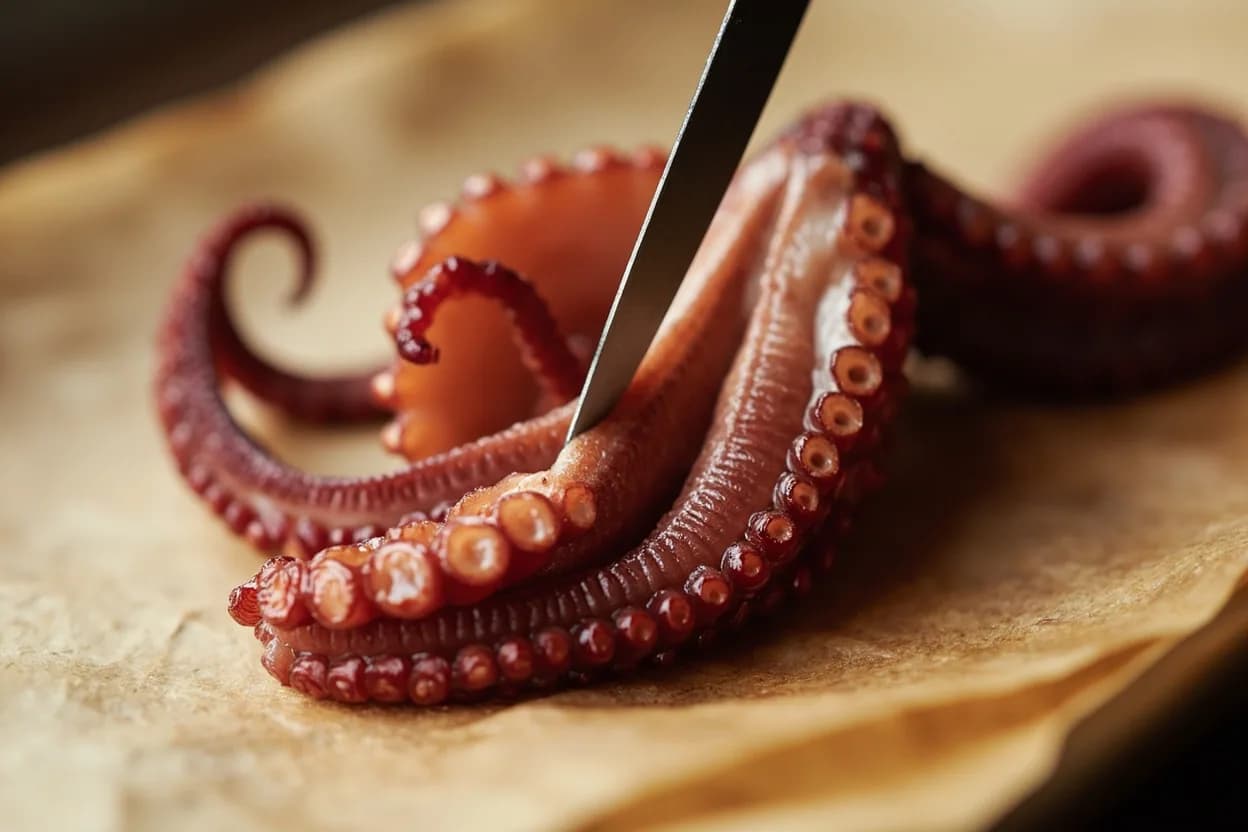
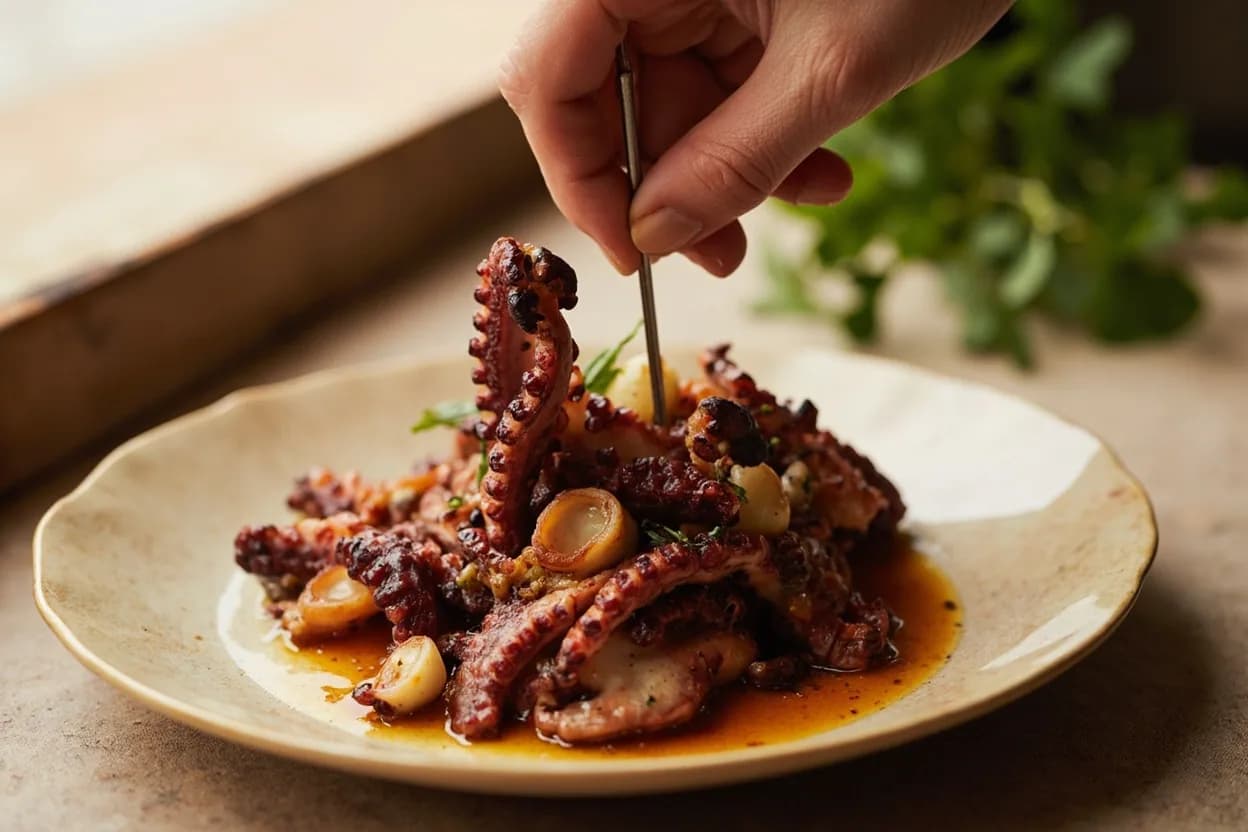
Octopus is one of the most collagen-dense marine animals: its tentacle arms contain roughly three times the connective tissue of comparable finfish muscle. Unlike fish, which become tender from myosin denaturation alone (55–65°C), octopus only achieves a pleasant, giving texture when the dense collagen network throughout the muscle hydrolyzes into gelatin. This requires holding the tissue at 80–85°C for an extended period — typically 45–90 minutes depending on species and specimen size. The skewer test, universal across Mediterranean and East Asian kitchens, is the definitive doneness check: push a thin metal skewer or paring knife tip into the fattest section of the longest tentacle. When done, it slides in and withdraws with no rubbery spring-back resistance. Any tug or elastic push-back means the collagen network is still intact and the octopus needs more time.
In photos

What happens
Octopus muscle passes through two textural phases during cooking. In the first phase (55–65°C), myosin and actin denature and the muscle firms dramatically — the tentacles become rigid and rubbery, resembling a rubber band. This is the failure state for undercooked octopus. In the second phase (80–85°C sustained), the abundant intramuscular collagen (primarily Type I and V) undergoes hydrolysis: the triple-helix collagen fibers break down into shorter gelatin chains that lubricate the muscle fibers rather than binding them tightly. The tentacle transforms from fibrous and chewy to tender with a slight give. The skin — a collagen-rich dermis — softens simultaneously, typically pulling away from the suckers in loosely separated sheets. At temperatures above 90°C (aggressive boiling), the muscle fibers over-contract and expel moisture faster than gelatin can compensate, producing a stringy, dry result. The optimal window is a gentle simmer, not a rolling boil.
What to look for
- Skewer or knife tip penetrates the thickest tentacle arm with no resistance and withdraws cleanly
- Skin along the tentacles separates loosely from the sucker pads and appears wrinkled rather than taut
- Tentacle arms droop and sway fluidly when lifted — no rigid curl or stiffness
- Cross-section of a sliced tentacle shows a uniform, opaque, slightly gelatinous texture with no raw grey core
- Broth or cooking liquid has taken on a deep amber color and a silky, lightly gelatinous body from dissolved collagen
How to check
- Insert a thin metal skewer (or the tip of a paring knife) at a 90° angle into the fattest section of the longest tentacle; it should slide in with zero elastic resistance
- Lift the octopus from the cooking liquid — the arms should hang limply with no rigid structure
- Slice a tentacle cross-section: interior should be uniformly opaque with no translucent grey center
- Test every 15 minutes once the initial 45-minute mark is reached, as size variation is significant
Food safety
Carryover & resting
Octopus benefits from resting in its cooking liquid as it cools, which allows residual heat to continue softening any remaining tough collagen. This passive rest (often called 'relaxing') is standard in Greek, Italian, and Japanese preparations. The tentacles continue to tenderize by 3–5°C equivalent effect during the rest period. Cutting immediately after cooking results in a tougher texture than allowing a 15–20 minute rest off the heat.
The science behind it
- Collagen hydrolysis
The conversion of intramuscular collagen to gelatin is the rate-limiting step in octopus tenderness, requiring sustained heat over time
- Two-phase texture transformation
Octopus passes through a firm-rubbery phase (55–65°C) before reaching tenderness — the 'rubber band' phase is often misread as doneness
- Gentle simmer vs. boiling
80–85°C (a gentle simmer) is optimal; a rolling boil at 100°C over-contracts muscle fibers and produces dry, stringy texture
- Species variation in octopus
Common octopus (Octopus vulgaris) and Pacific giant octopus (Enteroctopus dofleini) differ significantly in collagen density and required cooking time
- Freezing as a tenderizing pre-treatment
Freezing octopus before cooking ruptures cell membranes and partially disrupts the collagen matrix, reducing required cooking time by 20–30%
Appears in
References
- 1.McGee, Harold. On Food and Cooking: The Science and Lore of the Kitchen. Scribner, 2004.
- 2.Myhrvold, Nathan, et al. Modernist Cuisine: The Art and Science of Cooking. The Cooking Lab, 2011.
- 3.Keller, Thomas. Under Pressure: Cooking Sous Vide. Artisan, 2008.
- 4.Davidson, Alan. The Oxford Companion to Food, 3rd ed. Oxford University Press, 2014.
- 5.Bourdain, Anthony. Mediterranean Journal: Spain, Greece, Turkey. Travel + Leisure, 2002. (Popular documentation of the skewer test in Greek preparation)
Confidence: high
Notes
The freezing question
Many Mediterranean fishmongers and home cooks freeze octopus before cooking, citing tenderization. This is well-founded: ice crystals rupture muscle cells and mechanically disrupt collagen structure, reducing required cooking time noticeably. Frozen-then-thawed octopus often reaches tenderness in 45 minutes; a never-frozen specimen of the same size may need 75–90 minutes. It is also worth noting that most octopus sold in markets outside the Mediterranean has been frozen at sea — so 'fresh' octopus at an inland fishmonger is usually thawed.
Sous vide parameters
Sous vide cooking of octopus at 77°C for 5–6 hours achieves excellent tenderness by sustaining the collagen hydrolysis temperature precisely without any risk of over-boiling. Some chefs use 85°C for 2.5–3 hours for a more traditional-textured result. The skewer test remains applicable through the bag — piercing the bag at the tentacle to check resistance is a legitimate technique in professional kitchens.
Species timing guide
Octopus vulgaris (common octopus, 800g–1.5kg): 45–75 min simmered. Enteroctopus dofleini (Pacific giant, 2kg+): 90–120 min. Baby octopus (Octopus macropus, 100–200g each): 20–30 min. Always verify with the skewer regardless of time — individual variation is significant.