Offal & Specialty Cuts
Offal Safe Cooking Temperatures
Also: organ meat safe temps, variety meat minimum temperatures, offal food safety
USDA and international food-safety minimums for kidney, heart, liver, tripe, and other organ meats.
Organ meats carry a higher pathogen load than skeletal muscle because blood, lymph, and metabolic waste pass through them continuously during the animal's life. Safe cooking temperatures for offal reflect this elevated risk: most organs must reach a verified internal temperature that neutralizes Salmonella, E. coli O157:H7, Campylobacter, and, for pork offal, Trichinella spiralis. Minimums range from 63°C (145°F) for some muscle-adjacent organs to 77°C (170°F) for poultry livers.
In photos

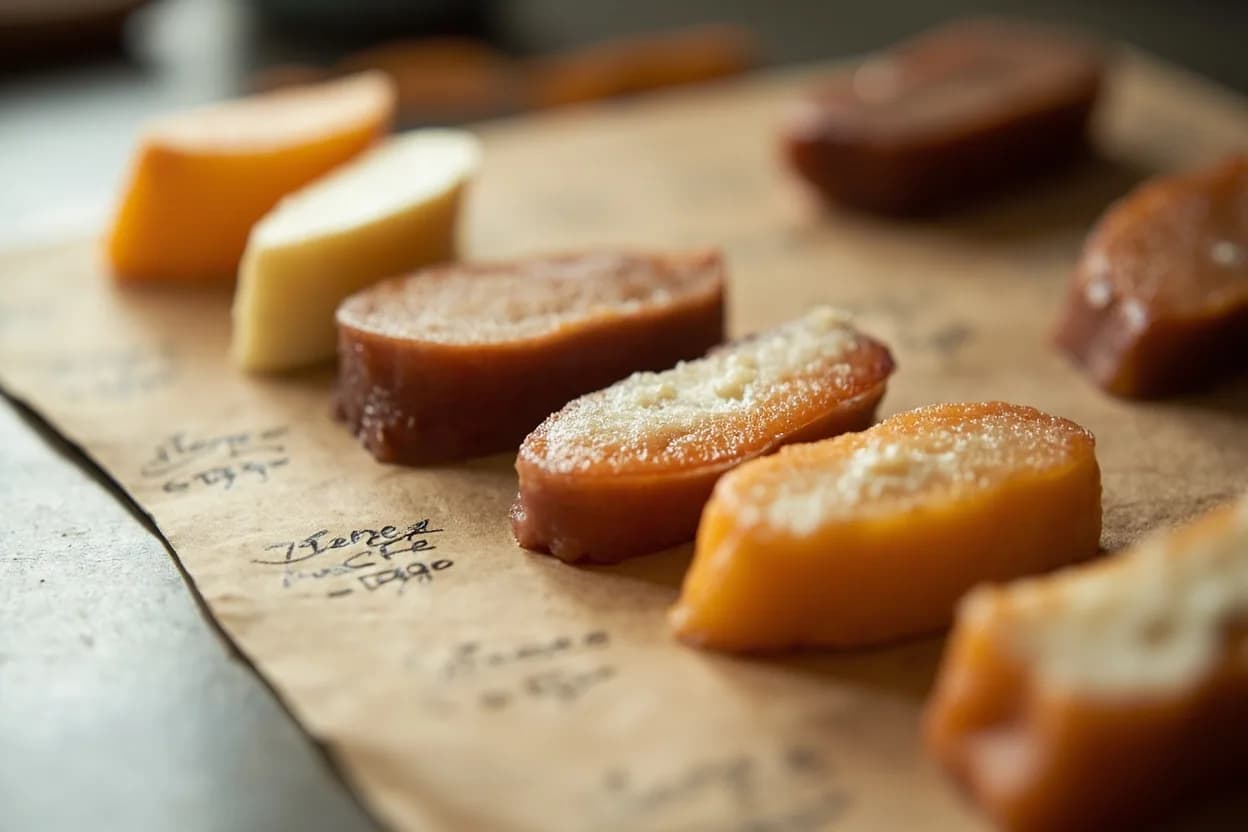
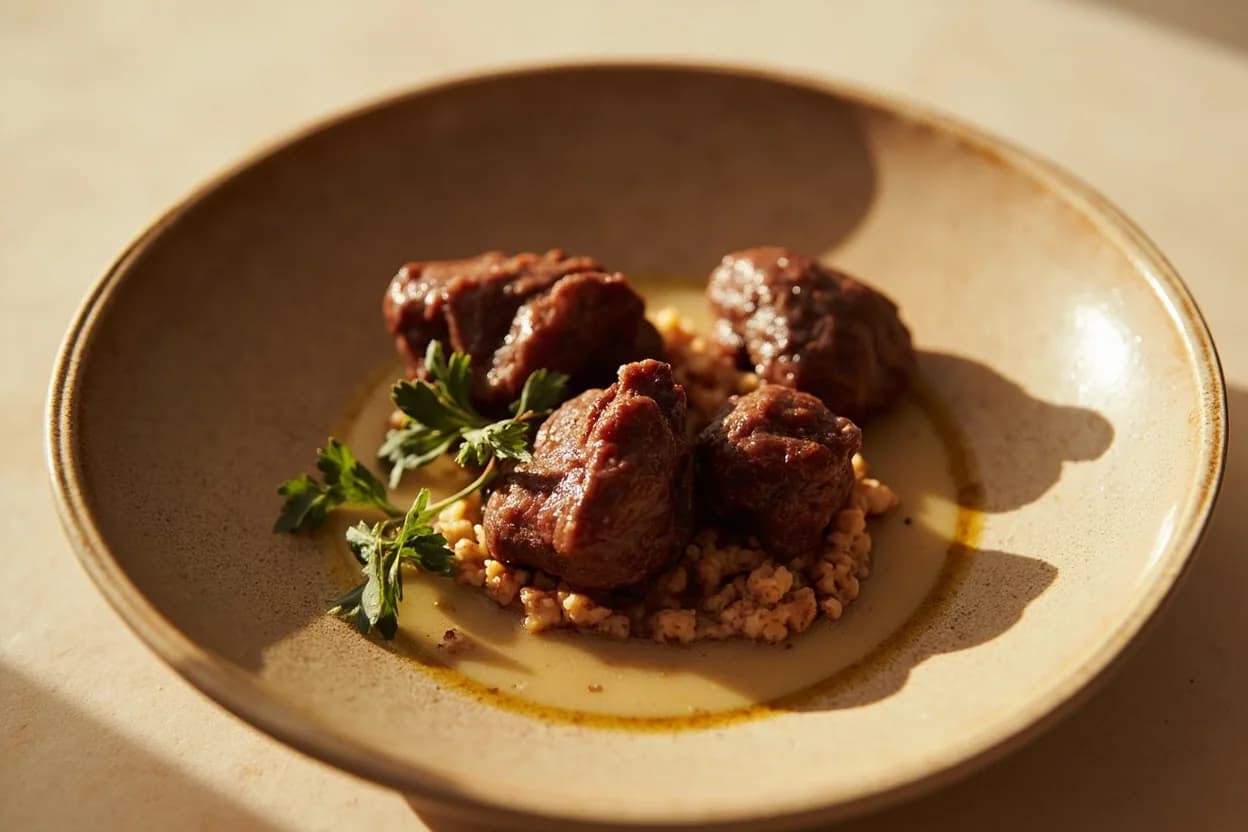
What happens
At 63°C (145°F) the z-value for most enteric pathogens is reached with a 3-minute rest, destroying Salmonella and E. coli populations to a 7-log reduction. At 71°C (160°F) the lethal dose is near-instantaneous. Myoglobin in liver and heart denatures above 65°C, shifting colour from deep burgundy to pale tan-grey. Collagen in tripe and tendon begins partial conversion to gelatin at 70°C but full softening requires extended time above 90°C — a separate culinary target distinct from safety.
What to look for
- Liver: interior should show no glossy, translucent burgundy centre; fully cooked is pale tan-grey throughout (though many chefs prefer a just-pink 65–68°C for tenderness)
- Heart: juices run clear when pierced at the thickest point; firm spring-back rather than raw give
- Kidney: chalky-white or tan interior, no glassy translucent core remaining
- Tripe: fully opaque white to cream; no slippery raw surface on cut edges
- Sweetbreads (thymus/pancreas): creamy-white and firm-set, not gelatinous-raw in the centre
How to check
- Insert a thin-probe instant-read thermometer into the geometric centre of the organ or its thickest cut section
- For sliced liver, probe through the side of the slice, not the flat face, to reach the true centre
- For whole kidneys, insert at the thickest lobe, avoiding the central fat column which reads lower
- For tripe, a temperature check confirms pasteurisation but texture doneness requires time — both criteria must be met
- Rest organ meats 3 minutes at target temperature before cutting to complete pathogen kill
Food safety
Carryover & resting
Dense offal (whole calf liver, whole heart) carries over 2–4°C after resting due to residual thermal mass. Pull 2–3°C before target and rest loosely tented. Thin-sliced liver (under 1.5 cm) has negligible carryover and should be pulled at target temperature directly.
The science behind it
- Pathogen Kill Curves
Time-at-temperature tables (USDA FSIS Appendix A) govern how long each temperature must be held to achieve 7-log reduction
- Trichinella spiralis
Pork-associated parasite destroyed at 137°F (58°C) for 2 minutes or 145°F (63°C) instantly; freezing at -15°C for 20 days also effective
- Campylobacter in Poultry Liver
Responsible for documented UK and US outbreaks from pink-centre chicken liver parfait; requires 74°C to eliminate
- Carryover Cooking
Residual heat in dense organs continues pasteurisation after removal from heat
- Collagen Melt Temperature
Tenderness target for tripe/tendon (90°C+) is separate from and higher than the safety minimum
Appears in
References
- 1.USDA FSIS Safe Minimum Internal Temperature Chart (FSIS, 2023)
- 2.On Food and Cooking — Harold McGee (Scribner, 2004)
- 3.The Food Lab — J. Kenji López-Alt (W. W. Norton, 2015)
- 4.USDA FSIS Appendix A: Compliance Guidelines for Meeting Lethality Performance Standards for Certain Meat and Poultry Products (FSIS, 1999, rev. 2017)
- 5.Public Health England: Campylobacter in Chicken Liver — Outbreak Investigation (PHE, 2016)
Confidence: high
Notes
The Pink Liver Problem
Many classic recipes — French chicken liver mousse, Scottish haggis filling, Venetian fegato alla veneziana — are intentionally served with a pink or just-set centre for optimal texture and flavour. This creates genuine tension with food-safety guidance. Professional kitchens that serve pink liver should use consumer advisories and source from high-welfare, inspected suppliers. The 65°C 'pasteurising pink' zone (where Salmonella is killed over 1–2 minutes) offers a partial middle ground but is not endorsed by USDA for vulnerable populations.
Species and Organ Matrix
Beef and lamb kidney, heart, liver: 71°C (160°F). Pork kidney, heart, liver: 71°C (160°F) minimum; some regulatory bodies accept 63°C/3-min for whole pork kidney. Poultry liver (chicken, duck): 74°C (165°F). Tripe (bovine rumen/stomach): 74°C (165°F) or pre-blanched safe; extended braising to 90°C+ for texture. Sweetbreads (thymus): 71°C (160°F). Blood (morcilla, black pudding): ensure casings reach 74°C throughout.