Pork Doneness
Whole Pig & Whole Hog Roast Core Temperature
Also: whole hog doneness, spit-roast pig temperature, lechon core temp, whole pig internal temperature
A whole pig is done when its deepest joint — the hip or shoulder — reaches a minimum of 74°C (165°F) internally, with most of the carcass ideally at 82–90°C (180–195°F) for full collagen conversion.
Cooking a whole pig presents a fundamental thermal gradient challenge: the outer thin cuts (belly skin, flanks, ears) reach safe temperatures and begin to overcook or char while the deepest muscle masses — the shoulder joint and hip socket — may still be dangerously undercooked. The governing rule is that the deepest, most thermally remote point must clear the safe minimum: 74°C (165°F) for whole poultry is often applied to whole pig as a conservative margin (USDA minimum for whole pork is 63°C / 145°F with a rest, but whole-animal roasts are typically held to the higher threshold for safety assurance). In practice, experienced pitmasters aim for 82–90°C (180–195°F) in the thick shoulder and hip muscles so that collagen converts and the meat shreds or carves cleanly — not merely safe, but texturally finished.
In photos
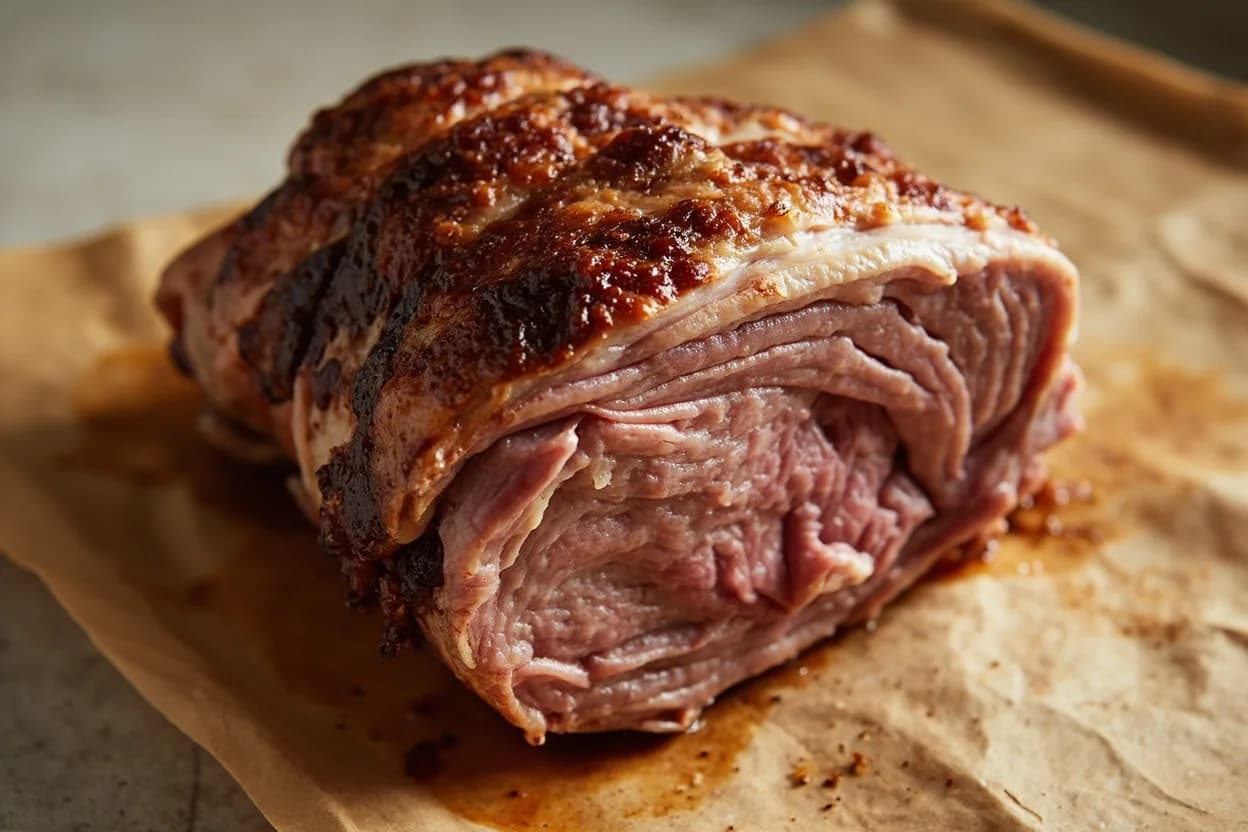

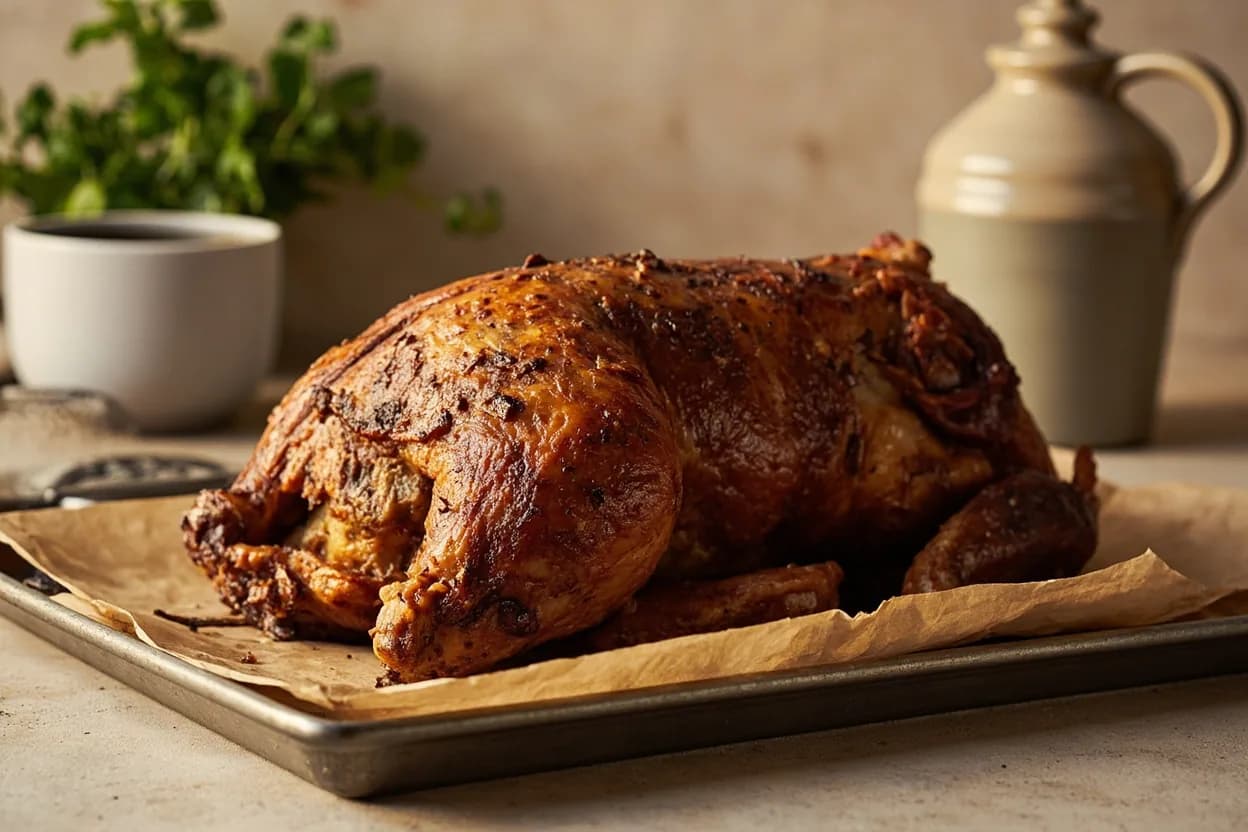
What happens
A whole pig's carcass is a mosaic of different thicknesses: the loin over the ribcage may be 2–3 cm from surface to bone, while the Boston butt muscle mass may be 15–20 cm deep. Heat penetrates by conduction and convection at different rates across these geometries. During a spit roast or pit roast lasting 8–20 hours (depending on pig size), the belly, ribs, and flanks reach collagen-conversion temperatures early, while the shoulder and ham joints lag by 1–3 hours. Surface Maillard browning and crackling formation on the skin happen at 160°C+ at the skin surface while the deep muscles are still at 70°C. When the hip joint finally reaches 74–85°C, the cartilage around the ball joint has softened, the gluteal muscles are fully cooked, and the entire carcass can be considered done.
What to look for
- The hip joint (where femur meets pelvis) rotates freely or the femur can be pulled partially free without tearing meat
- The shoulder blade (scapula) wiggles and lifts away with gentle pressure
- Juices run clear (not pink) when the thickest thigh muscle is deeply pierced with a skewer
- The skin across the entire pig is uniformly golden-brown and crackling-crisp, not patchy raw or raw-colored
- The flanks and belly have a slight char at the thin edges — an acceptable indicator that the thick joints have had enough heat exposure
- The ears, if wrapped in foil early, unravel to show fully rendered cartilage with no rubbery resistance
How to check
- Insert a long-probe instant-read thermometer into the thickest part of the shoulder, angling toward the center of the muscle mass and avoiding the bone — target 74°C (165°F) minimum, 82°C (180°F) for easy carving
- Probe the ham (inside of the thigh near the hip socket) — this is typically the coldest point in the entire pig
- Check at least two sites: shoulder AND ham; both must meet the minimum
- Perform the joint-wiggle test: grip the hind leg and rotate the hip joint — it should rotate 30–45 degrees freely if the hip cartilage has softened
- For whole pit-roast (underground Hawaiian imu or Philippine lechon pit), use a long-stem probe through a gap in the wrapping before uncovering
Food safety
Carryover & resting
A whole pig carries over 5–10°F at the thickest joints due to its enormous thermal mass. Pull from heat when deepest probes read 160–165°F (71–74°C) if targeting a 165–175°F finish after resting. Rest the entire pig tented with foil for 20–45 minutes before carving; the equalization period also allows the skin to crisp further as steam dissipates.
The science behind it
- Thermal gradient in large roasts
The fundamental challenge of whole-animal cooking — outer and inner temperatures differ by 30–50°C during most of the cook
The target process in the shoulder and hip joints that determines eating quality
- Crackling formation
High surface temperature process happening simultaneously on the skin while deep joints are still coming to temperature
- Spit-rotation physics
Rotating spit distributes radiant heat evenly and prevents one side from overcooking before the deep joints are done
- Pit temperature management
Underground pit roasts (imu, pibil) rely on retained stone heat; managing total BTU input determines whether deep joints reach target temperature
Appears in
References
- 1.Whole Hog BBQ: The Regional Variations of an American Classic — Sam Jones & Daniel Vaughn (Ten Speed Press, 2019)
- 2.USDA FSIS Fresh Pork from Farm to Table — USDA Food Safety and Inspection Service
- 3.Meathead: The Science of Great Barbecue and Grilling — Blonder & Goldman (Rux Martin/Houghton Mifflin Harcourt, 2016)
Confidence: high
Notes
Size determines strategy
A 15 kg suckling pig (lechon de leche) may roast in 3–4 hours at 180°C and reach 74°C in the hip easily. A 90 kg whole hog on a traditional pit may need 18–24 hours at 110–135°C to achieve the same result. Scaling up requires proportionally more time, not simply more heat — higher heat chars the exterior before the deep joints receive enough thermal energy.
The hip-socket as the control point
Professional pitmasters universally treat the hip socket — where the femur head seats into the acetabulum — as the single most reliable control point for whole-pig doneness. The joint is surrounded by dense bone and thick gluteal muscle, and heat reaches it last. When the hip reads 74°C, no other part of the pig can be undercooked.