Cheese & Dairy Doneness
Whey Draining Temperature for Ricotta
Also: ricotta cooking temperature, albumin precipitation temperature, whey cheese temperature
At 85–90°C, denatured whey proteins — chiefly albumin — precipitate from solution and rise as delicate white clouds that are skimmed to make ricotta.
Ricotta ('recooked' in Italian) is traditionally a whey cheese made by reheating the whey left from cheesemaking to 85–90°C (185–195°F) and acidifying it slightly (with vinegar, citric acid, or lactic acid) to precipitate the remaining albumin and globulin proteins. These whey proteins, unlike casein, are not coagulated by rennet — they survive the primary cheesemaking step intact and are only recovered by this high-heat, high-acid secondary cooking. The resulting curd is gossamer-light and mild, forming soft, moist clouds that are ladled into basket molds to drain. Modern 'whole-milk ricotta' uses fresh milk or a blend of milk and whey but follows the same heat-and-acid precipitation principle at the same temperatures.
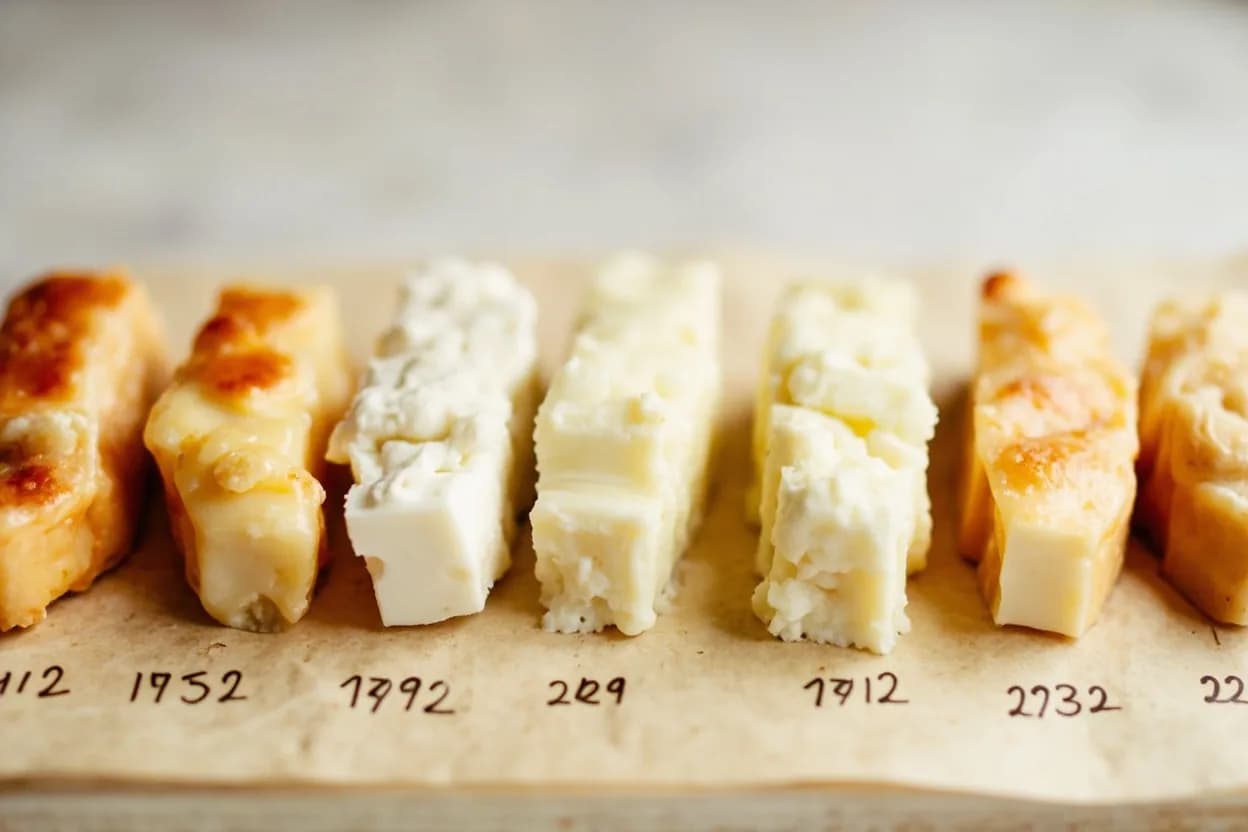
In photos


What happens
At 85–90°C, beta-lactoglobulin (the most abundant whey protein and the primary heat-sensitive fraction) denatures irreversibly: its normally globular structure unfolds, exposing hydrophobic interior surfaces that aggregate with other denatured proteins. Alpha-lactalbumin denatures at a slightly lower temperature and is already precipitating before the vat reaches 90°C. Added acid (pH drop to ~5.9–6.1) reduces electrostatic repulsion between protein molecules, facilitating flocculation and coagulation into curd particles fine enough to be collected by a fine-mesh ladle or cheesecloth. The process is rapid — once 88–90°C is reached and acid is added, curd forms within 5–10 minutes. Overheating (above 95°C) causes excessive casein-whey protein interaction and can produce a coarser, slightly rubbery texture.
What to look for
- Fluffy, white protein clouds rising slowly to the surface of the heated whey signal that precipitation is underway
- The liquid beneath the floating curd transitions from milky-yellow to increasingly clear and greenish-yellow as proteins are removed
- Gently stirring reveals the clouds consolidating into larger, floatable masses
- A sweet, cooked-milk aroma develops at the correct temperature; scorching or an eggy smell indicates too high a heat or overlong cooking
How to check
- Use a probe thermometer or continuous-read clip thermometer to hold the whey at 85–90°C without exceeding 92°C
- Add acid (white wine vinegar, citric acid, or lemon juice) once the target temperature is reached and wait for cloud formation before stirring
- Test clarity: ladle the whey around the floating curd — when the liquid below is pale yellow-green rather than milky, precipitation is largely complete
- Allow 10–15 minutes undisturbed once curd forms; excessive stirring breaks the delicate curd into particles too small to collect
Food safety
The science behind it
- Beta-lactoglobulin denaturation
The primary whey protein that precipitates at 85–90°C; absent in human milk, present in cow and sheep milk
- Albumin
Collective term for the heat-sensitive whey proteins (beta-lactoglobulin, alpha-lactalbumin, serum albumin) that form ricotta curd
- Scotta
The residual liquid after ricotta is skimmed — used in some Italian communities to make drinks, bread, or feed animals
- Urda / Anthotyros
Greek and Balkan whey cheeses made by the same heat-and-acid method; regional ricotta analogues
- Ziger / Sérac
Alpine whey cheeses (Swiss and French) made from heated whey; the same mechanism, pressed into firmer forms
Appears in
References
- 1.Dairy Science and Technology — P. Walstra, J.T.M. Wouters & T.J. Geurts (2nd ed., 2006)
- 2.Cheese and Fermented Milk Foods — Frank Kosikowski & Vikram Mistry (3rd ed., 1997)
- 3.On Food and Cooking — Harold McGee (revised ed., 2004)
Confidence: high
Notes
Sheep vs. cow whey
Traditional southern Italian and Sardinian ricotta is made from sheep's milk whey (the byproduct of pecorino production), which is richer in fat and protein than cow's milk whey. Sheep-milk ricotta produced at 88–90°C is creamier and has a more pronounced sweet, lanolin-touched flavor than the cow-milk product sold in most supermarkets.
Whole-milk ricotta shortcut
Restaurant and home recipes often substitute whole milk (or a 50/50 milk-and-cream blend) for whey, since pure cheesemaking whey is not typically available to home cooks. The same temperature range and acid addition produce a similarly textured ricotta, though the protein composition differs and the yield is higher due to fat co-precipitation.