Herbs
Lovage
Also: Levisticum officinale, love parsley, sea parsley, Maggikraut (German), ligusticum
Celery's wild, overpowering older cousin — the cold-kitchen's secret weapon for terrines, stocks, and salads that need deep, roasted-vegetable umami without an ounce of actual celery.
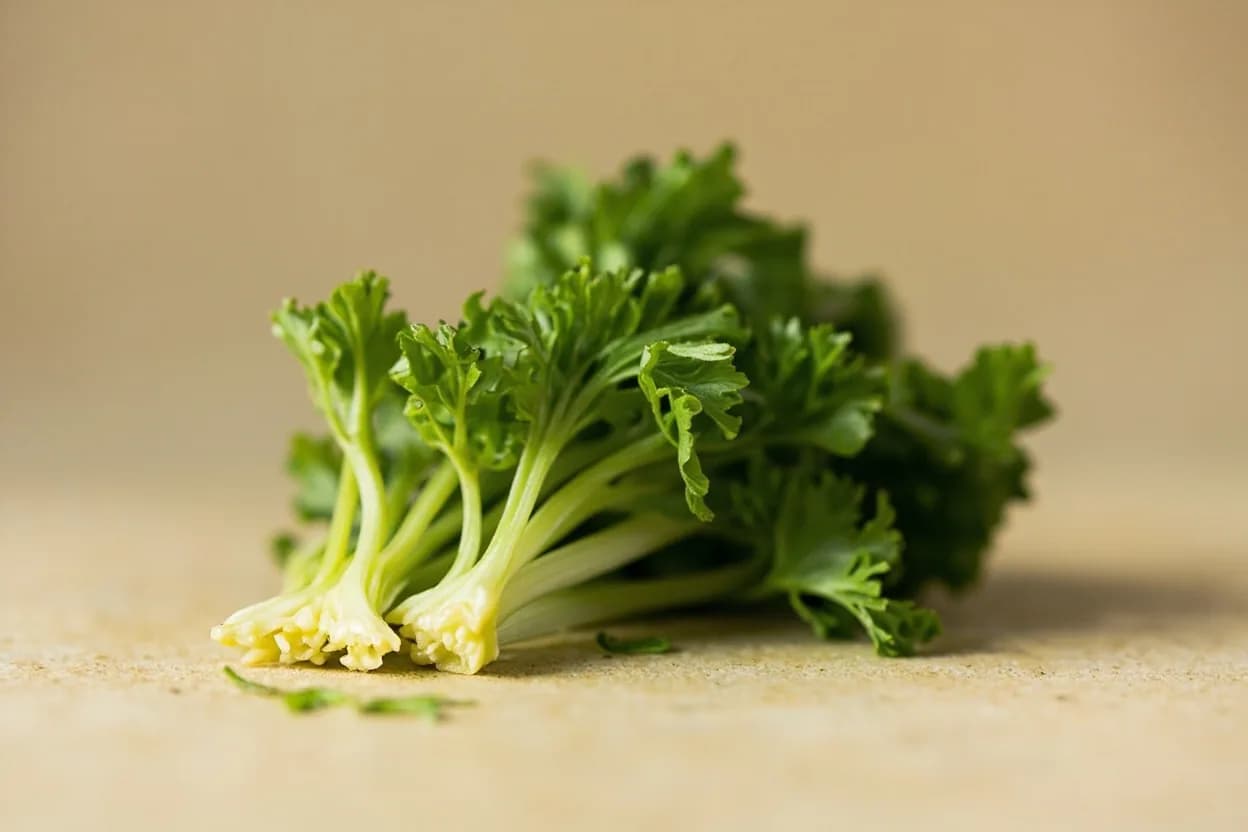
Lovage (Levisticum officinale) is a tall perennial herb of the carrot family with large, dark-green, deeply lobed leaves that carry an intense, celery-like aroma amplified by notes of parsley, anise, curry-leaf warmth, and a faint musty earthiness. It is used sparingly — a single leaf can season a whole pot of soup. In German-speaking countries it is called Maggikraut because its flavour resembles Maggi seasoning liquid, which historically replicated it. In English cold-kitchen tradition, lovage is prized in terrines, charcuterie, potted meats, and pickled salads where its strong, persistent flavour survives without heat degradation.
In photos
Flavour profile
Classic pairings
- potatoBritish, German
Lovage soup — potato and lovage — is a British and German classic: the starch absorbs and mellows lovage's intensity while the herb deepens the soup's savory base.
- pork (terrine and charcuterie)French, British
Lovage's persistent celery-umami character survives fat and salt in pork rillettes, terrines, and country pâtés — it integrates where delicate herbs would disappear.
- chicken stockBritish, Central European
A few lovage leaves in a slow stock add a celery depth that surpasses celery itself — the flavour extracts deeply and evenly from the large leaf surface.
- celeriacFrench, Central European
Lovage amplifies celeriac's celery register without adding sweetness; together in a remoulade or gratin they form an intense, vegetable-umami pairing.
- eggBritish
Lovage chopped finely into egg salad or quiche cuts through richness with its bitter-herbal edge — a single leaf is usually enough per 4 eggs.
- tomatoBritish, Italian
Lovage and tomato — in a salad, soup, or sauce — is a late-summer pairing; the herb's savory depth pulls forward tomato's own glutamates.
- lentils and pulsesGerman, Levantine
In Central European and Middle Eastern cooking, lovage added during lentil cooking provides a celery-onion depth without additional vegetables.
Adventurous pairings
- oyster and clam
Lovage's sea-parsley character (it is sometimes called 'sea parsley') bridges beautifully with briny shellfish; finely minced in a mignonette or shellfish butter it adds savory depth without sweetness.
- Bloody Mary cocktail
Lovage syrup or a lovage-infused vodka replaces celery salt in a Bloody Mary with dramatic effect — more complex, less one-dimensional than plain celery.
- aged hard cheese (Gruyère, Comté)
The herb's warm curry-anise undertone plays interestingly against the caramel-nutty notes of aged Alpine cheese in a cheese sauce or gratin.
- fermented cream (crème fraîche, labneh)
Lovage's bitterness is tamed by fermented dairy's lactic tang; the combination makes an excellent dip for raw vegetables or spread for bread.
- walnut
Both have an earthy, slightly bitter quality; together in a salad dressing or over roasted beets they build a complex, autumnal savory plate.
Tread carefully
- delicate fish (sole, plaice, raw scallop)avoid
Lovage overwhelms subtle fish — its intensity is calibrated for long-cooked meat dishes and robust stocks, not for proteins whose appeal is oceanic delicacy.
- desserts and sweet preparationsavoid
The herb's curry-musky depth turns medicinal in sweet contexts; it has no culinary role in pastry.
- large quantities in fresh saladsavoid
Unlike parsley or dill, a handful of lovage leaves will dominate an entire salad unpleasantly — use maximum 1–2 leaves finely shredded per serving.
How to use it
- Use sparingly — one or two leaves will season a 4-person pot; more risks a medicinal, overpowering result
- Add to stocks, braises, and soups in the first 30 minutes — its robust compounds extract slowly and evenly
- Finely chiffonade fresh leaves for salads, egg dishes, or finishing sauces where more control is needed
- Dry lovage stems and leaves: the dried form is milder and easier to dose in spice rubs and herb blends
- Blanch briefly and blend into herb oils for a striking dark-green, intensely savory oil
- Seeds can be used like celery seeds in pickling brines and bread doughs
Appears in
Related flavours
- Celery
The milder, more watery counterpart — lovage can replace it when a more intense, less watery herb character is desired
- Celeriac
Root vegetable that shares lovage's celery-anise register; the two amplify each other rather than competing
- Angelica
Another large carrot-family herb with a similar role in old European cold-kitchen cooking; sweeter and more anise-forward than lovage
References
- 1.Jekka's Complete Herb Book — Jekka McVicar (Kyle Books, 2009)
- 2.Nose to Tail Eating — Fergus Henderson (Bloomsbury, 1999)
- 3.Vegetables from Amaranth to Zucchini — Elizabeth Schneider (William Morrow, 2001)
- 4.The Oxford Companion to Food — Alan Davidson (Oxford University Press, 3rd ed., 2014)
Confidence: high
Notes
The Maggi connection
Lovage's German common name, Maggikraut ('Maggi herb'), reflects a genuine historical relationship: Maggi seasoning, invented by Julius Maggi in 1886 as a cheap nutritional supplement for industrial workers, was formulated to approximate the flavour of lovage-enhanced broths. The herb's dominant compound, phthalides (shared with celery but in higher concentrations), combined with pyrazines that generate roasted, umami-savory notes, is what Maggi's factory chemists were trying to bottle. Today Maggi still contains no actual lovage, but the flavour association in Central European kitchens remains — to many German cooks, the herb smells like their grandmother's soup.
A cold-kitchen herb above all
Lovage's strongest culinary identity is as a cold-kitchen herb — meaning terrines, pâtés, potted meats, pickled preparations, and anything where its intensity can be modulated through proportion and long integration rather than the violence of high heat. It performs particularly well in the charcuterie tradition because its strong bittering compounds balance fatty cuts in ways fresh parsley or thyme cannot match.