Storage & Containers
Bakery Box
Folding paperboard box for transporting and presenting cakes, pastries, and baked goods.
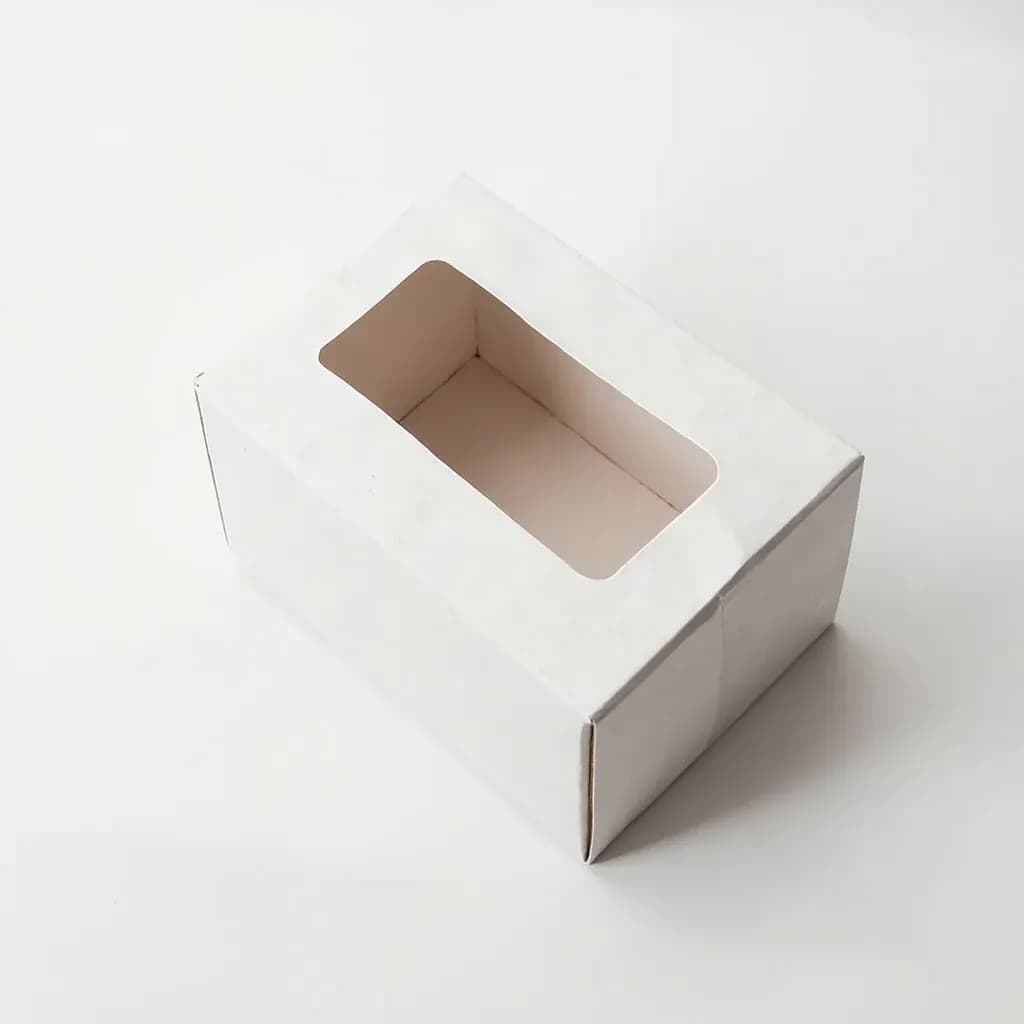
A bakery box is a sturdy folding carton, usually white or kraft paperboard, designed to hold cakes, cupcakes, cookies, and pastries without crushing them. Bakeries and home bakers use them to transport finished goods and present them attractively, often with a window panel or tuck-top lid. They come flat and fold up quickly, and grease-resistant interiors help with buttery items.
A bakery box is the folding paperboard carton with a hinged lid and four locking corners that sits on every pastry counter and under every birthday cake. The standard form is a one-piece die-cut of clay-coated solid bleached sulfate (SBS) board, pre-creased so a flat sheet folds into a rigid, self-locking tray in seconds. This is the same basic silhouette — flat lid, low walls, snug-fitting cover — that bakeries have used since folding cartons were patented in 1890, because it stacks efficiently, costs almost nothing per unit, and protects frosting without crushing the work beneath it.
The board is what makes the box behave as it does. At roughly 18 to 24 point caliper, paperboard is rigid enough to support the weight of a two-layer frosted cake yet flexible enough to fold cleanly along its score lines. SBS board takes ink for printed logos and resists grease for short spans, while natural kraft board offers a more rustic presentation and composts easily. Windowed versions replace a cutout with a clear PLA or PET panel so the contents become their own display, and rigid clear plastic boxes (PET or polystyrene) serve as the reusable workhorse for tiered and wedding cakes.
Used correctly, a bakery box solves three problems at once: it shields decoration from contact damage, contains drips and crumbs during transport, and presents the product to the buyer. Used carelessly — closed on a warm cake, reused after its lock corners have crushed, or loaded past its crush rating — the same box can deliver a cake to the party in pieces. Picking the right size and board, then loading it properly, is what separates a tidy arrival from a reconstruction project.
Alternatives
Types & varieties
Tall square or round box, 5–6" interior height, for two- or three-layer frosted cakes; the classic white SBS style.
Rectangular, shallow or tall, sized to quarter-, half-, or full-sheet pans (9x13 to 16x24).
Shallow (2–2.5") with side vent holes to release steam; sized to 8" or 10" pie pans.
Long, shallow kraft box, often with a cellophane or PLA window; half-dozen, dozen, and two-dozen counts.
Small single-serve box for a slice of cake, éclair, or sandwich; sometimes called a pâtisserie box.
Holds 1, 2, 4, 6, or 12 cupcakes with a slotted corrugated or molded pulp insert; tall lid accommodates frosting swirls.
Compact box or tray with a fitted insert, typically 6, 12, or 24 count; standard for patisseries.
Long, narrow kraft box sized to a standard 9x5 or 8.5x4.5 loaf pan.
Any of the above with a cutout covered by clear PLA or PET film for retail visibility.
Rigid PET or polystyrene box with locking tabs; reusable, the standard for tall decorated and wedding cakes.
Unbleached brown board; rustic look, widely compostable, popular with artisan bakeries.
Choosing the Right Box for the Job
Match the box to the cake, the route, and the camera. White SBS projects a clean patisserie look and photographs brightly; kraft signals artisan and composts curbside. Both behave the same in transport, so the choice is largely aesthetic unless you are working in a jurisdiction with composting requirements. For anything beyond a modest two-layer cake, upgrade the structure rather than the look: a double-wall corrugated cake box of the same footprint will carry stacked or fondant-covered work that a single-wall box would crush.
Sizing is the most common error. Measure the cake on its circle or drum, then add at least 1" of clearance on every side and 1.5–2" of headroom for swirls, flowers, or toppers. A tight box crowds the decoration against the lid; an oversized box lets the cake slide and shifts weight onto the corners. For tiered cakes, order one box per tier, not one box for the whole stack.
- Choose SBS (white) for presentation and photography; choose kraft for a rustic look and easier composting.
- Step up to double-wall corrugated for cakes over ~7 lb, fondant work, or anything with tall decorations.
- Size up: leave 1" of side clearance and 1.5–2" of headroom so the lid never touches the decoration.
- Buy one box per tier for stacked cakes; never try to enclose a tiered cake in a single oversized box.
The Clear Plastic Cake Box
For tiered, wedding, and competition cakes, the rigid clear PET or polystyrene box is worth its higher price. The deep lid provides headroom above tall decorations, the transparent walls let the cake be admired without opening, and the same box can be wiped clean and reused dozens of times. Locking tabs at the corners secure the tall lid to the base so it cannot shift onto the work beneath. Professional bakers often keep a small fleet in graduated sizes for 6", 8", 10", and 12" tiers, plus a deep "tall cake" variant for stacked and fondant work where headroom matters more than footprint.
The trade-off is storage: a stack of rigid boxes takes far more shelf space than a flat of fold-flat paperboard cartons, and the plastic will not compost. For most home and small-bakery work, paperboard remains the right tool; reach for clear plastic when the cake is too tall, too heavy, or too valuable to risk a lid touching the buttercream.
- Use clear PET for tiered, wedding, and competition cakes where height and visibility matter.
- Wipe clean with a damp cloth and mild soap; avoid abrasives that haze the plastic over time.
- Store stacked flat to save shelf space; unlike paperboard, the rigid box does not fold down.
- For very heavy tiered cakes, pair the clear box with a separate cake drum and carry base.
Common uses
Tips & pitfalls
- Chill a frosted cake in the refrigerator until the buttercream, ganache, or glaze is firm (15–30 minutes) before boxing; a tacky surface will stick to the lid and pull off decorations.
- Always place a cake circle, drum, or parchment round on the bottom of the box so the cake lifts out cleanly and grease never reaches the board.
- Cut a piece of non-slip shelf liner or a parchment round to fit the box floor; a sliding cake is the single most common delivery disaster.
- Drape a sheet of parchment over the top of a decorated cake before closing the lid so the board never touches the frosting, even if the box is jostled.
- For tiered cakes, box and transport each tier separately and stack on site; never stack filled cake boxes on top of one another.
- Use vented pie boxes for fruit and lattice pies, and solid boxes for cream, custard, and meringue pies to control moisture.
- Avoid boxes with metalized foil stamping, glitter inks, or strong dyes on food-contact surfaces; choose FDA-compliant food-grade board.
- Recycle plain, food-free paperboard boxes curbside; tear off any plastic windows and compost or trash grease-soiled sections.
- Inspect reused boxes at the lock corners — a crushed or stretched corner will fail under the weight of a heavy cake and is not worth the savings.
- In warm weather, transport the box on a flat, non-slip surface in the trunk or footwell, not on a slanted car seat where the cake will lean into the lid.
Good to know
- Material
- Folding paperboard (folding carton board), typically 18–24 pt caliper; clay-coated SBS (white) or unbleached kraft (brown).
- Standard construction
- One-piece die-cut with hinged lid and four lock (tuck) corners; some styles are two-piece base-and-lid.
- Common sizes (round cake)
- 6", 8", 10", 12", 14" diameter; ~5" interior height to clear a two-layer 8" cake with frosting.
- Sheet cake sizes
- 9x13 (quarter), 12x18 (half), 16x24 (full sheet); ~5" tall to accommodate frosted sheet cakes.
- Origin
- Pre-cut, pre-creased folding paperboard box invented by Robert Gair in Brooklyn, NY in 1890.
- Load rating
- A standard 10x10x5 paperboard cake box supports roughly 5–7 lb of decorated cake on a cake circle; heavier loads need a double-wall corrugated box or a cake drum.
- Microwave and freezer
- Not microwave-safe (board absorbs moisture; metalized inks or windows can spark). Freezer-safe when dry, but wrap contents first because condensation weakens the board.
- Compostability
- Plain kraft boxes are curbside compostable; coated or PLA-windowed boxes are industrially compostable where facilities exist.
Also called
Pastry / Bakery Box · pastry box · cake box · patisserie box
Related

Freezer Bags
Thick, sealable bags built to fight freezer burn

Storage Bags
Resealable bags for fridge storage and marinating

Storage Container
Lidded container for leftovers, prep, and meal kits

Glass Container
Oven-to-fridge glass that won't stain or hold odors

Plastic Container
Lightweight, stackable storage for everyday leftovers

Vacuum Sealer Bags
Airtight bags for long freezing and sous-vide

Reusable Bags
Washable silicone bags that replace single-use plastic

Mason Jar
Sealed glass jar for preserves, pickles, and storage