Wraps & Liners
Bamboo Leaf Wrapper
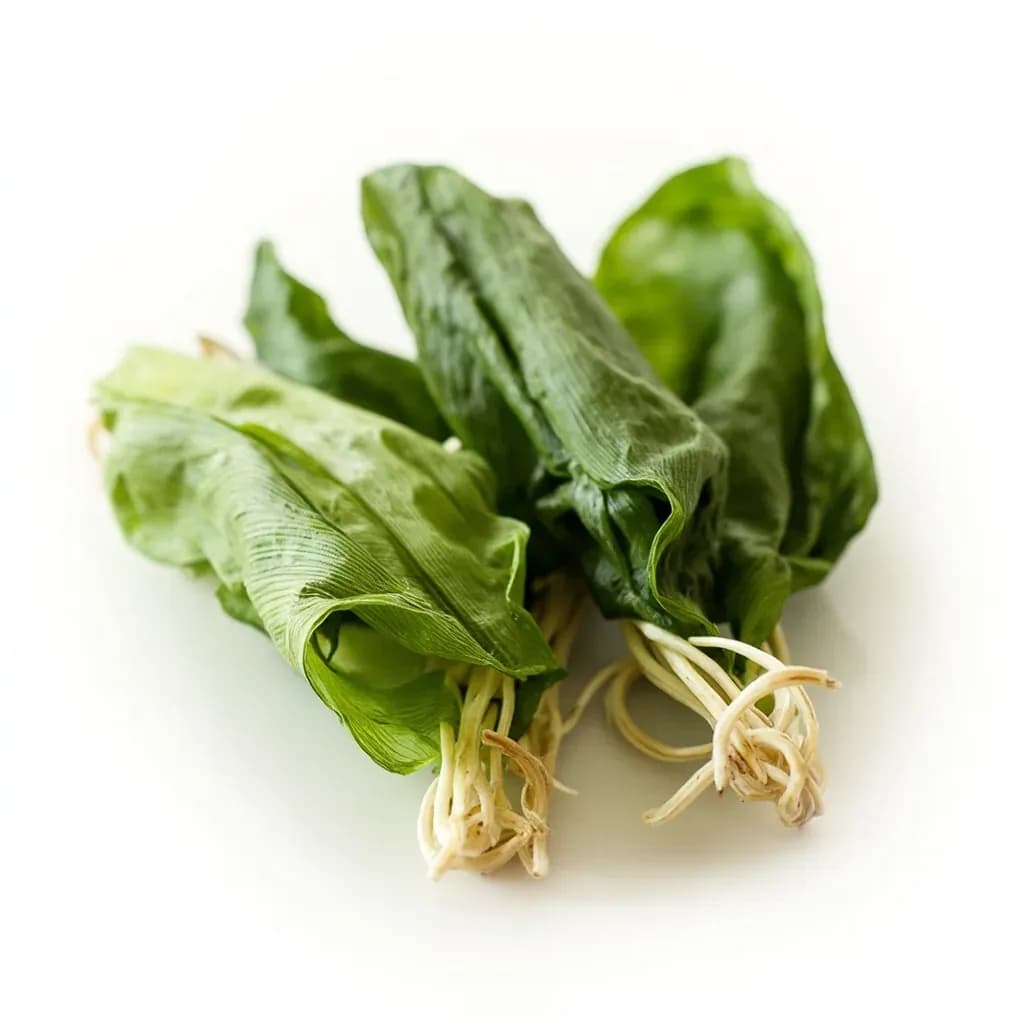
Long dried bamboo leaf used to wrap zongzi and steamed parcels, lending a green tea-like aroma.
A bamboo leaf wrapper is a long, narrow dried bamboo leaf, soaked and softened before use, for wrapping food to be steamed or boiled. It is essential for forming zongzi, the glutinous-rice parcels of Chinese cuisine, and is also used to line steamers and wrap fish and rice. The leaf seals in moisture and imparts a fresh, grassy, green-tea-like fragrance, and is removed before eating.
The bamboo leaf is the workhorse wrapper of East Asian sticky-rice cookery: a long, dried leaf that, after soaking, becomes pliable enough to fold around seasoned glutinous rice and hold its shape through hours of boiling or steaming. In the kitchen it plays two roles at once—a structural one, keeping delicate fillings contained, and an aromatic one, lending a faint grassy, tea-like note that is more delicate than the earthy perfume of lotus leaf. The leaf itself is not eaten; it is a single-use vessel, valued precisely because it flavors what is inside without competing with it.
Two species dominate the market. The broad Indocalamus leaf (粽叶, also written 箬叶) is the standard southern Chinese zongzi wrapper, prized for its size and forgiving flexibility. The narrower Moso leaf (竹叶, from Phyllostachys edulis), common in Zhejiang, Jiangsu, and northern China, is more aromatic but trickier to fold and more prone to splitting along its midrib. In Japan, smaller sasa leaves (熊笹) wrap delicate sweets like sakura mochi and chimaki and are used singly rather than layered. All behave the same way in principle—rigid and brittle when dry, pliable and leathery after a long soak—but their dimensions and strengths shape the geometry of the parcels they can build.
For most home cooks, the practical question is not which species but how to handle the leaf: how long to soak, how to fold without tearing, and how to coax the most aroma out of it during the long cook. Dried bamboo leaves are unusually forgiving in storage, keep their flexibility for a year or two, and are inexpensive by the bundle, which is why they have remained the default wrapper for zongzi and similar parcels for centuries.
Alternatives
Types & varieties
Broad, paddle-shaped leaf from Indocalamus tessellatus; the standard southern Chinese zongzi wrapper, large enough to fold a tetrahedral parcel with a single leaf or two crossed leaves
Narrower, more pointed leaf from Phyllostachys edulis; common in Zhejiang, Jiangsu, and northern China, more aromatic than Indocalamus but more prone to splitting along the midrib
Small, soft Japanese bamboo leaf used to wrap sakura mochi and chimaki; delicate enough to use singly and fold around sweet rice cakes without tearing
Traditional in some regions and dishes: a broad bamboo leaf for the body of the parcel with a narrower bamboo or reed leaf as a tie, inner liner, or flavor layer
Choosing Between Species
The species choice is mostly about parcel size and folding confidence rather than flavor. A broad Indocalamus leaf is the easiest for beginners because its surface covers a fistful of rice with minimal overlap; the fold lines are short and forgiving. Moso leaves demand a steadier hand—wrap them with the midrib running along the fold rather than across it, or the leaf will crack mid-cook. Sasa leaves, being small and soft, are essentially single-use for sweets and tear easily if forced.
- Indocalamus (粽叶): best for tetrahedral zongzi, large steamed rice parcels, and any fold that needs to hold 100 g or more of filling
- Moso (竹叶): best when you want a stronger grassy note and the parcel is small—sticky rice balls, individual sticky rice portions, or congee-bound rice steamed in leaf cups
- Sasa (熊笹): best for Japanese sweets, single-layer folds, and parcels under 50 g; do not substitute for zongzi work
- Mixed-leaf wrapping: useful when Indocalamus is unavailable—pair one broad leaf with a narrower Moso or reed leaf for added aroma and a more secure tie
The Aromatic Contribution
Bamboo leaf is sometimes dismissed as a flavorless wrapper, but it does contribute—quietly. The aroma is volatile, water-soluble, and driven largely into the soaking liquid and the cooking liquid rather than into the rice itself. A long boil or steam (an hour or more for a tightly wrapped parcel) is what releases it; quick-steamed parcels taste mostly of the filling. Treat the leaf as a delivery system for its own soaking water: the same tea-like note ends up in the rice whether it travels by steam or by direct contact.
- The aroma is closer to green tea than to lotus—mild, slightly tannic, and grassy
- Reserve the soaking water and use it as part of the cooking liquid for the rice; this deepens the flavor far more than wrapping alone
- Blanching the soaked leaves in boiling water for 30–60 seconds before wrapping intensifies the green color and removes any dusty aftertaste from drying
- A single leaf added to a pot of stock or congee during the last 20 minutes gives a faint hay-and-green-tea note without making the dish taste 'wrapped'
- Do not expect bamboo leaf to perfume a dish the way lotus leaf perfumes lo mai gai; it is a whisper, not a statement
Storage and Spent Leaves
Dried bamboo leaves are among the most forgiving wrappers in a kitchen: kept dry and dark, they hold their pliability for a year or two and only become brittle if stored in humid conditions or in direct sunlight. Once a parcel has been cooked and unwrapped, the spent leaf is structurally spent but not useless. Its aroma lingers, and cooks have long reused the leaves as aromatic liners in rice jars and grain storage.
- Store dried leaves in an airtight container away from light and humidity; a paper bag inside a sealed tin works well
- If leaves have dried out and cracked, a longer soak (6–8 hours in cool water, or 3 hours in hot) will usually restore flexibility
- Reuse spent leaves as a liner in rice or grain storage jars for a faint grassy scent; replace every few months
- Spent leaves are fully compostable and break down quickly in a home compost bin
- Never reuse a spent leaf as a wrapper for a second cook—the fibers have softened beyond usefulness and will tear during folding
Common uses
Tips & pitfalls
- Soak dried leaves in hot water for at least 2 hours, or overnight in cool water; under-soaked leaves crack and split the moment you try to fold them
- Pat both sides of the soaked leaf dry with a kitchen towel before wrapping—wet leaves slip against the rice and the parcel will not hold its pyramid or cone shape
- Use two leaves per zongzi, with the second rotated so its midrib offsets the first; one layer almost always tears during a long boil
- Place the smoother, shinier side of the leaf outward for a tidier finished parcel and easier unwrapping at the table
- Tie with cotton kitchen twine, never nylon or other synthetic string; synthetic materials can leach flavor into the rice during long boils and aren't food-safe
- Blanch the soaked leaves in boiling water for 30–60 seconds before wrapping for the deepest green color and a cleaner aroma
- Reserve the soaking water and use it as part of the liquid for cooking the rice—it carries the same tea-like note and noticeably deepens the flavor
- Do not eat the leaf; it is fibrous, the surface can carry residues from sun-drying, and it adds nothing pleasant to the mouthfeel of the rice
Good to know
- Material
- Dried leaves of bamboo species, primarily Indocalamus tessellatus (broad-leaf) and Phyllostachys edulis / Moso (narrow-leaf); Sasa species in Japan
- Typical length
- 20–45 cm, with broad Indocalamus leaves the largest and Sasa leaves the smallest
- Color when prepared
- Olive to deep forest green after soaking and a long steam or boil
- Soaking time
- 2–4 hours in hot water, or overnight in cool water, until fully pliable
- Aroma
- Subtle, grassy, faintly tannic—reminiscent of green tea and fresh hay, much milder than lotus leaf
- Storage
- Cool, dry, dark place in an airtight container; dried leaves keep 1–2 years without becoming brittle
- Edible?
- No; the leaf is fibrous and not meant to be eaten
- Sold as
- Tied bundles of dried leaves, vacuum-packed fresh leaves, and occasionally frozen leaves in Asian markets
Also called
dried bamboo leaf · zongzi leaf · bamboo wrapper · zhu ye
Related

Aluminum Foil
Wraps, covers, and tents food for the oven and grill

Parchment Paper
Nonstick liner for clean, even baking and easy release

Wax Paper
Moisture-resistant sheet for wrapping and counter prep

Plastic Wrap
Clings tight to cover bowls and wrap leftovers

Silicone Baking Mat
Reusable nonstick liner that replaces parchment

Cheesecloth
Loose-woven cloth for straining stock and bundling herbs

Beeswax Food Wrap
Reusable wax wrap that molds around bowls and produce

Piping Tips
Shaped nozzles that turn frosting into stars and rosettes