Wraps & Liners
Banana Leaf (Wrapping)
Large pliable leaf used to wrap, steam, grill, and serve food with a subtle green aroma.
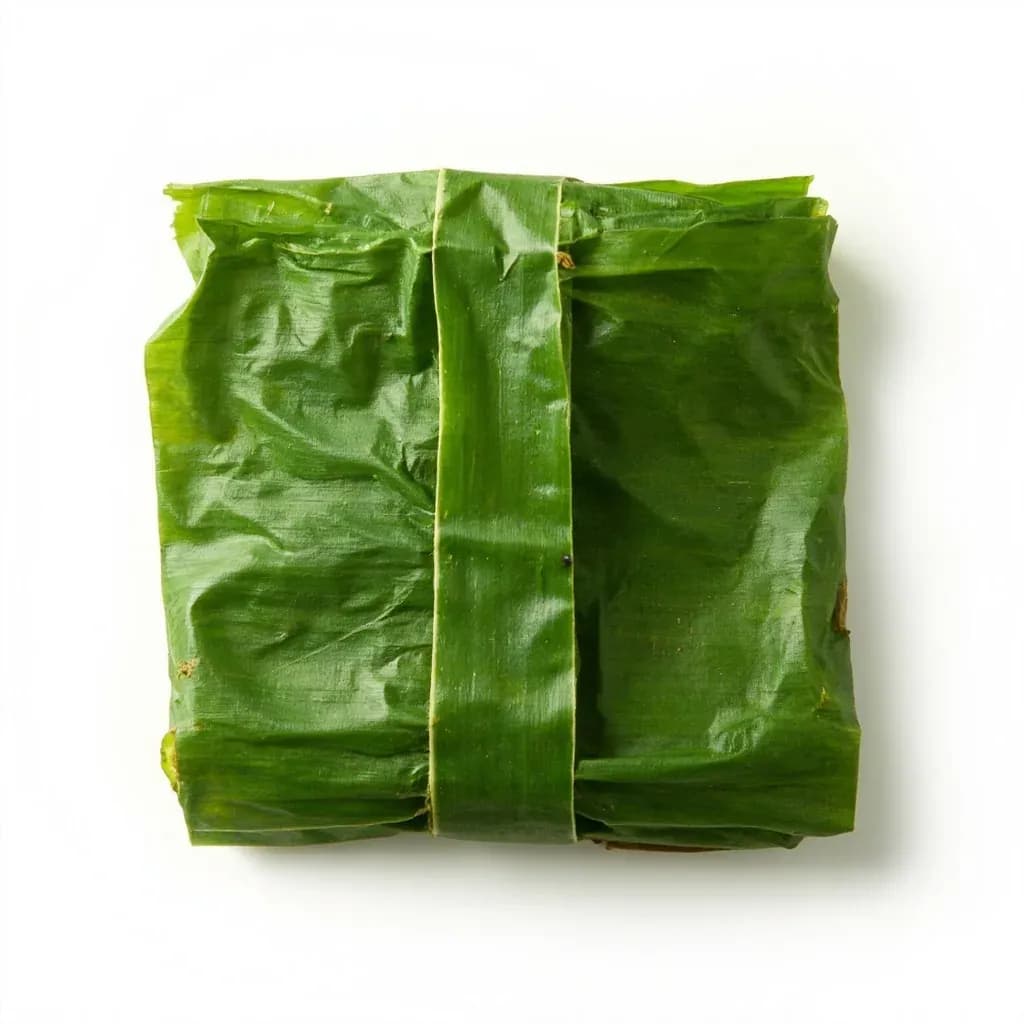
Banana leaf is a large, pliable green leaf used across South and Southeast Asian, African, and Latin American cooking to wrap food for steaming, grilling, and roasting. It seals in moisture and imparts a gentle grassy aroma to rice, fish, tamales, and dishes like moi-moi. Cooks usually pass the leaf briefly over a flame or hot water to wilt it so it folds without cracking.
Banana leaves are the large, lustrous foliage of Musa species—herbaceous plants often mistaken for palms—harvested at maturity for their impressive size and waxy resilience. A single mature leaf can span two to three feet in length with a natural waterproof coating that makes them uniquely suited to contain moisture, steam, and fats during cooking. Unlike synthetic wraps, banana leaves owe their hygienic reputation to the antimicrobial properties of their protective wax, which inhibits bacterial growth on the leaf surface itself.
The leaf's appeal extends beyond pure function. When heated, banana leaves release a subtle grassy, herbal aroma that complements rather than dominates the foods they envelop—think of the faint green fragrance in a perfectly steamed fish or the fragrant notes threading through a Hawaiian laulau. This flavor contribution is delicate enough to work with both savory and sweet preparations. The leaves also serve as traditional serving vessels, lending an elegant, rustic presentation that is fully compostable after use.
In Southeast Asian, Indian, Malay, and Latin American traditions, cooking in banana leaves is deeply rooted in culture and ceremony, not merely technique. The practice spread from its origins across the Pacific to Hawaii, throughout Mexico and the Caribbean, and into parts of Africa. Today, fresh, frozen, and dried banana leaves are increasingly available in mainstream supermarkets alongside specialty Asian and Latin markets, making this ancient cooking method accessible to any kitchen willing to explore it.
Alternatives
Types & varieties
Preferred for cooking; most pliable, strongest aroma, best results for steaming and grilling
Widely available; nearly equivalent to fresh when thawed; convenient for most uses
Used in traditional tamales and pasteles; must be rehydrated; more brittle, harder to fold neatly
Young inner leaves are more tender and pliable; outer mature leaves are larger but stiffer
Selecting Quality Leaves
Choose deep green leaves with a slight gloss—these retain moisture and pliability. Avoid leaves with yellowing, brown spots, or dried-out edges, as they tear easily during folding and impart off-flavors. The waxy surface should feel intact and smooth to the touch.
- Deep green color indicates freshness and pliability
- Yellowing or browning signals age and potential bitterness
- Glossy surface means the waterproof coating is intact
- Avoid any leaves with holes or torn edges for wrapping purposes
Storage
Fresh leaves keep 7–10 days refrigerated, wrapped in damp towels and placed in a plastic bag. For longer storage, cut leaves into usable pieces, stack them, and roll before freezing—this saves freezer space and allows you to thaw only what you need. Frozen leaves keep up to 6 months. Dried leaves store indefinitely in an airtight container in a cool, dark place.
- Refrigerate fresh leaves wrapped in damp towels, up to 7–10 days
- Freeze cut and stacked leaves for up to 6 months
- Thaw frozen leaves completely before use to restore pliability
- Dried leaves require rehydration in warm water before folding
Common uses
Tips & pitfalls
- Wipe leaves clean with a damp cloth—do not scrub or peel the waxy coating, which is essential for waterproofing
- Briefly pass fresh leaves over an open flame or through boiling water for 30–60 seconds to make them more pliable and easier to fold without tearing
- Cut out the tough central rib before folding, especially for decorative or tightly wrapped presentations
- Use two layers when grilling or pit-roasting for structural integrity; steam cooking typically needs only one layer
- Secure folds with wooden toothpicks, kitchen twine, or stainless pandan clips—avoid plastic in high-heat applications
- Place wrapped bundles seam-side down when steaming to prevent unraveling from rising steam pressure
- For grilling, place leaf-wrapped food away from direct flame or on a perforated pan to prevent burning through the leaf
- Do not eat banana leaves—they are discarded after cooking, though they are fully compostable
Good to know
- Source
- Musa species (banana plant) leaves, harvested from palm-like herbaceous plants
- Typical Size
- 1–3 feet long, 6–18 inches wide depending on plant maturity
- Color
- Deep green when fresh; darkens with age or wilting
- Texture
- Waxy, smooth, pliable when fresh; brittle when dried or over-mature
- Flavor Impact
- Subtle grassy, herbal aroma; imparts faint green note to foods
- Primary Property
- Waterproof waxy coating contains moisture, steam, and fats during cooking
- Cuisine Origins
- Southeast Asia, Indian subcontinent; spread to Hawaii, Mexico, Central/South America, Africa
- Availability
- Fresh in Asian/Latin markets; frozen in many supermarkets; dried in specialty shops
- Storage (Fresh)
- Refrigerate wrapped in damp towels, up to 7–10 days
- Storage (Frozen)
- Up to 6 months in freezer; thaw before use
- Equipment Needed
- Scissors or sharp knife; kitchen twine, toothpicks, or pandan clips for securing
Also called
banana-leaf-liner · banana-leaf-wrap · banana-leaf-wrapper · banana-leaves · moi-moi-leaf
Related

Aluminum Foil
Wraps, covers, and tents food for the oven and grill

Parchment Paper
Nonstick liner for clean, even baking and easy release

Wax Paper
Moisture-resistant sheet for wrapping and counter prep

Plastic Wrap
Clings tight to cover bowls and wrap leftovers

Silicone Baking Mat
Reusable nonstick liner that replaces parchment

Cheesecloth
Loose-woven cloth for straining stock and bundling herbs

Beeswax Food Wrap
Reusable wax wrap that molds around bowls and produce

Piping Tips
Shaped nozzles that turn frosting into stars and rosettes