Wraps & Liners
Banana Stump (Imu Layer)
Sections of banana trunk layered in earth ovens to steam and protect food.
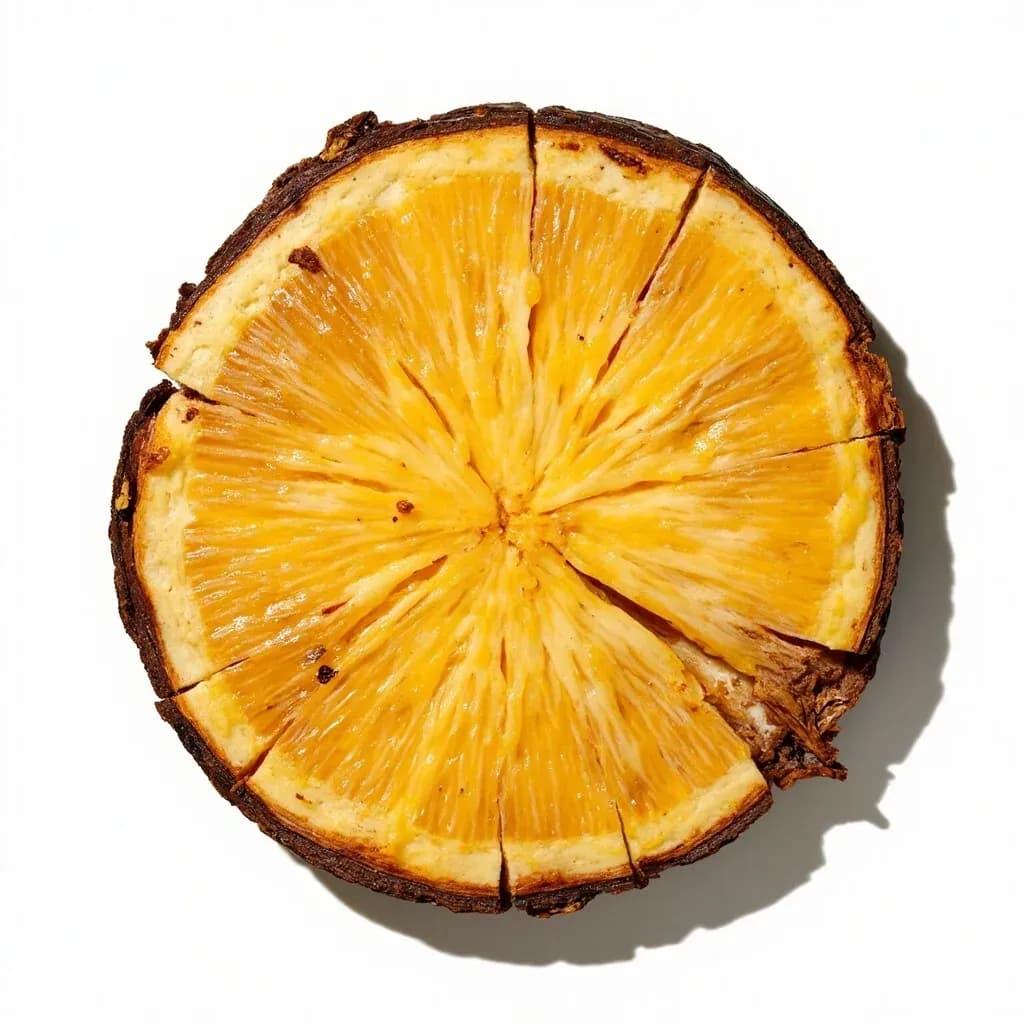
The banana stump or trunk is the fleshy stem of the banana plant, cut into pieces and packed into earth ovens like the Hawaiian imu. Its high water content releases steam over the hot rocks, gently cooking food while the layer shields it from direct heat and ash. The trunk also adds moisture that keeps roasted meats and roots tender.
The banana 'stump' used in Pacific earth ovens is not a stump at all in the botanical sense — it is the pseudostem, that trunk-like column of tightly furled leaf sheaths that rises from a banana plant's underground corm. Cooks across Hawaii, Samoa, Tonga, Fiji, and Aotearoa New Zealand cut this column into thick rounds or split it lengthwise and lay it directly over the heated stones of an imu, umu, 'umu, lovo, or hāngi. There it performs the work of a steam battery: it absorbs radiant heat from the rocks, sweats a steady flow of moisture back up through the food, and holds a thermal buffer between embers and ingredients.
What makes the pseudostem irreplaceable in a traditional pit oven is its water content, well above 90 percent when fresh. As the stones underneath give up their stored heat, the stump slowly releases that water as steam, which rises through the food and gently cooks it while preventing scorching and drying. A properly laid stump layer can keep a whole pig, a heap of taro, or a butterflied fish moist for several hours without ever touching flame. It also insulates, slowing heat loss so the oven stays in a workable range even as the rocks cool.
This is a supply in the literal sense of the word — a structural element of the cooking setup, not an ingredient anyone eats. It is almost always single-use; after a cook the inner layers are reduced to fibrous, charred pulp. The tougher outer sheaths may survive one more firing if peeled off intact, but the working rule is to cut fresh for each oven.
Alternatives
Types & varieties
Pseudostem rounds from common cooking bananas such as Mai'a 'Iholena or Mai'a Kaualau; the standard imu base layer in luau cooking
Sections from short-cycle cooking bananas; often split lengthwise and laid flesh-side up as a steaming mat over the stones
Thick cross-cut rounds of the pseudostem used to cradle whole fish or root crops and hold drip moisture
Sturdier, thicker-walled pseudostems from cooking plantains; handled the same way and slightly more tolerant of prolonged heat
A pseudostem halved lengthwise and laid as a continuous bed; the go-to form when a single round is too tall for the pit
How it behaves in the oven
Think of the stump as a slow-release steam generator bolted to the bottom of the cook. The hot stones beneath it can run several hundred degrees; the waterlogged pulp of the stump will not, because evaporating moisture holds its surface near 100 °C (212 °F) for as long as liquid remains. Food resting on top of the stump, or on a rack just above it, is bathed in this steam rather than in dry radiant heat, which is why pit-roasted pork comes out moist and why taro and breadfruit steam to a soft, even texture without a crust of char.
The outer green-to-yellow skin of the pseudostem matters more than it looks. It is drier and tougher than the creamy inner pulp, and it slows the rate at which the stump surrenders its water to the fire. Removing it before cooking is a common mistake: the stump then chars through quickly and the steam runs out before the food is done. Leaving the skin on noticeably extends the stump's working life in the oven and helps the round hold its shape under the weight of a whole pig or a stack of root crops.
Sourcing and preparation
A usable stump is cut from a mature plant, ideally one that has fruited or is about to fruit; younger suckers are generally too thin to make a practical base layer. After the fruiting stalk is cut, the remaining column is felled with a machete and trimmed of any dried outer leaves. Each round is then cross-cut to length and either used whole, halved, or quartered depending on the pit and the dish.
- Fell a mature pseudostem the same morning the oven is lit; cut stumps lose internal moisture within hours, especially in sun and wind.
- Keep the cut rounds wrapped in damp cloth or a wet tarp until they go into the pit if there is any delay.
- Leave the tough outer skin on the side that contacts the stones; it slows charring and keeps the softer pulp from collapsing.
- Score the top surface lightly with a machete so steam vents form predictably, rather than letting pressure build and burst the round.
- If a stump has wilted, soak it whole in water for 20–30 minutes to recover some of its steam capacity before laying it.
Common uses
Tips & pitfalls
- Cut the pseudostem the same day you light the oven; cut stumps lose internal moisture within hours and dried-out stumps will ignite and taint the food with bitter smoke.
- Leave the tough outer skin on the bottom face — it slows charring and is what separates a working steam layer from one that burns through before the food is done.
- Score the top of each round lightly with a knife or machete so steam vents form; an unscored round can burst and dump the food into the coals.
- Stand rounds upright around the perimeter of the pit to bank the heat, or lay them flat as a continuous mat when you need a broad steaming bed — match the layout to the shape of the food.
- Do not cook directly on a stump layer for more than 3 hours; past that point switch to a banana-leaf-and-stone setup or set a wire rack above the stumps so food does not sit on collapsing, charred pulp.
- Avoid dried, papery stumps at all costs — they smolder rather than steam and will give everything above them an acrid, ashy flavor.
- If fresh stumps are unavailable, thick bundles of fresh banana leaves can stand in as a steaming layer, but expect far less moisture and watch them closely for burn-through.
- Save the toughest outer sheaths pulled off after a cook; they can sometimes be reused once more as a secondary steaming bed in a smaller pit.
Good to know
- Material
- Banana pseudostem — tightly rolled leaf sheaths, not a true woody stem
- Typical cut size
- Rounds 20–60 cm (8–24 in) long, matched to the pit depth and food being cooked
- Moisture content
- Roughly 90%+ water when freshly cut; this is what makes it steam
- Primary function
- Steam reservoir and insulating layer placed directly over hot stones
- Cultures
- Hawaiian (imu), Samoan (umu), Tongan ('umu), Fijian (lovo), Māori (hāngi)
- Freshness rule
- Must be cut the same day; dried stumps crack, lose moisture, and burn through
- Reusability
- Single use is standard; only the tougher outer sheaths may be salvaged for a second firing
- Heat tolerance
- Best as a 1–3 hour steam layer; not suited to long roasting as the sole barrier
Also called
Banana Trunk · Imu Banana Stump
Related

Aluminum Foil
Wraps, covers, and tents food for the oven and grill

Parchment Paper
Nonstick liner for clean, even baking and easy release

Wax Paper
Moisture-resistant sheet for wrapping and counter prep

Plastic Wrap
Clings tight to cover bowls and wrap leftovers

Silicone Baking Mat
Reusable nonstick liner that replaces parchment

Cheesecloth
Loose-woven cloth for straining stock and bundling herbs

Beeswax Food Wrap
Reusable wax wrap that molds around bowls and produce

Piping Tips
Shaped nozzles that turn frosting into stars and rosettes