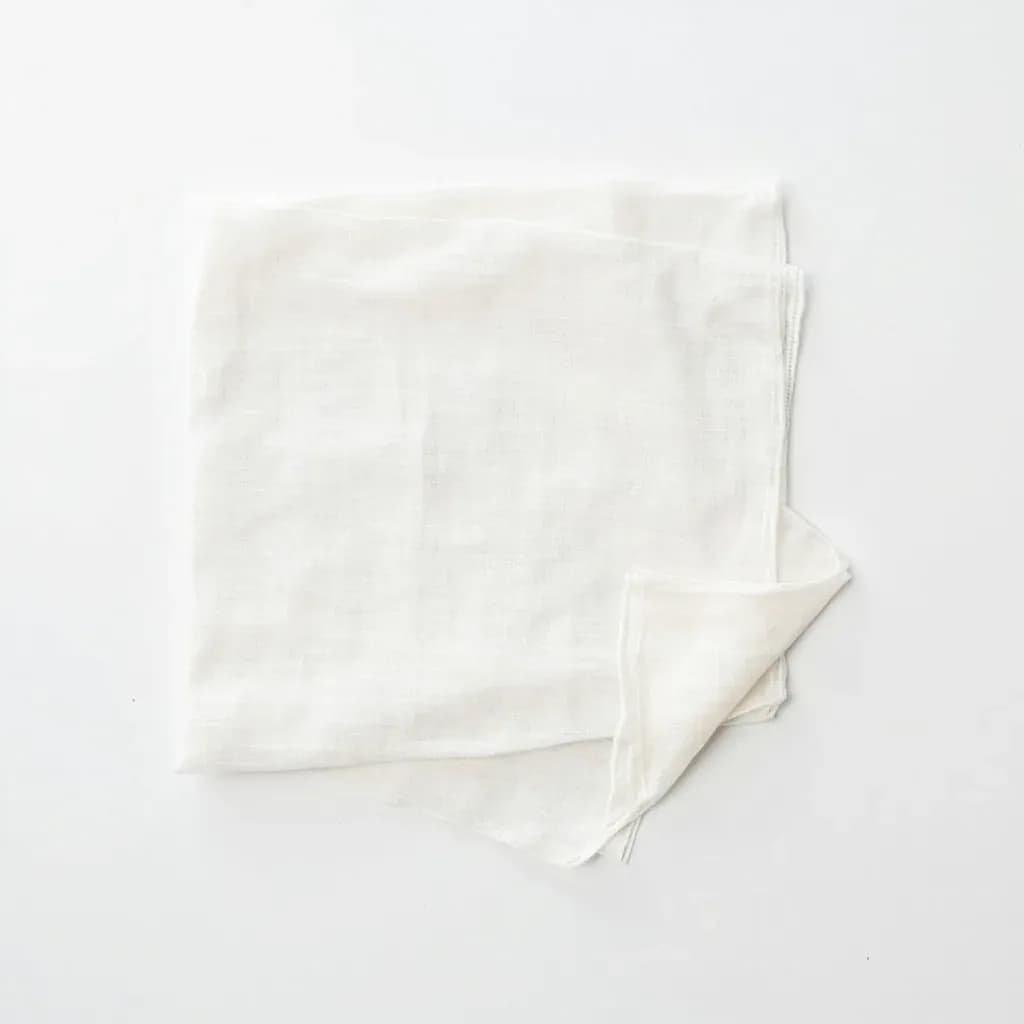
Wraps & Liners
Nylon Bolting Cloth
Precision fine-mesh nylon fabric used to strain, sift, and filter purees, stocks, and dry ingredients.
Nylon bolting cloth is a strong, precisely woven mesh fabric used for fine straining and sifting. Cooks line a sieve or chinois with it to filter stocks, fruit purees, and infusions to a silky texture, or to bolt flour to an exact particle size. Its uniform aperture and chemical resistance make it more durable and consistent than cheesecloth, and it rinses clean for reuse.
Nylon bolting cloth is a tightly woven textile made from single continuous filaments of nylon arranged in a square grid, producing apertures of a precise, reproducible size. Unlike cheesecloth — an open, gauzy cotton scrim with a loose, irregular weave — or a standard metal kitchen sieve, whose wire-mesh openings are uniform but far coarser, this cloth gives the cook exact control over what passes through, because you choose a mesh rating, expressed in microns or threads per inch, and the cloth holds the line.
The material comes from industrial flour milling, where "bolting" originally meant sifting milled grain through fine cloth to separate pure flour from bran. Professional kitchens adopted it in the twentieth century as cooks chased silken purées and crystal-clear consommés, and it has since become a quiet staple of the prep station. Its particular gift is finishing — taking a purée, stock, or milk that is almost right and pushing it across the last threshold into something glossy, smooth, or brilliantly clear.
In use, bolting cloth is a fabric, not a rigid screen, so it must always be supported by a frame: a conical chinois is the classic partner, but a bowl-shaped sieve, a colander, or a pot rim will do. The cloth handles boiling liquids without trouble, softens only under direct dry heat well above cooking temperatures, and cleans easily if rinsed the moment you finish. A single medium-grade square covers most home jobs; a finer cloth for stock clarification is the first upgrade a serious cook adds.
Alternatives
Types & varieties
Pre-cut round cloth that drops into a conical chinois; the classic pro-kitchen setup for clarifying stocks and finishing purées
Unfinished fabric to cut to size for draping over bowls, lining sieves, or folding into ad-hoc bags for nut milks and rinses
Sewn bag, often with a drawstring; used for hanging infusions, cold-brew coffee, and large-batch straining without any frame
Same product in different apertures — finer for clarity, coarser for yield and faster flow
Choosing the right grade
Mesh rating is the decision that matters most, because the cloth does only one thing — control what passes through. Think in terms of the result you want, then pick the cloth that gets you there without over-filtering.
- ~25 µm: consommé and crystal-clear stocks; slow, but produces a glassy finish. Use with a chinois and change the cloth partway through a large batch.
- ~50–80 µm: the sweet spot for purées. A vegetable or legume purée pushed through here loses the last visible fibers and turns silken without losing body.
- ~100–150 µm: general straining. The everyday workhorse for stocks that don't need to be consommé, for tomato and fruit coulis, and for nut milks.
- 200 µm and up: dry sifting — flour, powdered sugar, cocoa, almond meal, spice powders. Coarser openings move volume quickly and do not clog on dry goods.
The chinois-and-cloth combination
A conical chinois is the frame that bolting cloth was made for. The cone speeds flow under gravity, the cloth catches what metal mesh cannot, and the whole rig stands over a bowl or a stockpot with no hands required. This is the configuration to reach for when a recipe says "strain through a fine sieve" and you actually want it to look like the photograph.
- Wet the cloth with cold water first so the purée slides rather than grabs.
- Set the chinois over a deep container; the cone's depth gives you headroom for large batches and lets gravity pull liquid steadily through the cloth.
- Resist the urge to press. A ladle resting gently against the surface speeds flow without forcing solids through; a spoon used to scrape the cone wall will clog the cloth fast.
- For maximum clarity on a large batch, finish with a second pass through a fresh cloth — once the first cloth loads with particles, flow slows and clarity drops, so swapping in a clean one restores the polish.
Common uses
Tips & pitfalls
- Pre-wet the cloth with cold water before adding food — a dry cloth grabs purée and can tear under the resistance.
- Always support the cloth in a chinois, sieve, or colander; never let it sag unsupported, or the weave will stretch and the apertures will distort.
- Let gravity do most of the work and press only gently with a ladle — wringing or twisting stretches the monofilament and ruins the grade.
- For maximum clarity on a consommé, swap in a fresh cloth partway through; once the mesh loads with particles, flow slows and clarity drops sharply.
- Rinse the cloth the instant you finish — starches and purées that dry into the mesh are extremely hard to remove.
- Keep the cloth away from direct flame, stovetop burners, and hot ovens; the nylon will distort or melt well below the temperatures cooks sometimes assume.
- Turmeric, saffron, and dark berries will permanently stain the cloth — once it is colored, retire it to a non-staining task or replace it, since it cannot be whitened back to neutral.
- Label cloths by micron size with a tag or permanent marker; once they all look gray in the drawer, you cannot tell the grades apart.
Good to know
- Material
- Woven monofilament nylon — single-strand threads in a uniform square grid
- Mesh measurement
- Stated in microns (opening size) or mesh count (threads per inch); kitchen cloths run roughly 10–500 µm
- Common kitchen grades
- ~25 µm for consommé, ~50–80 µm for fine purées, ~100–150 µm for general straining, 200+ µm for dry sifting
- Heat tolerance
- Safe for boiling liquids; softens near 170 °C / 338 °F and melts near 220 °C / 428 °F — keep away from direct flame or dry oven heat
- Forms sold in
- Cut-to-size squares or bolts, pre-cut cone liners for a chinois, or sewn straining bags with drawstrings
- Cleaning
- Rinse immediately under running water; wash with mild soap and a soft brush; air-dry flat; do not wring
- Color coding
- Some makers dye cloth by grade, but no universal standard — always check the stamped micron or mesh rating
- Typical cost
- Modest; a yard of cloth or a single cone liner is inexpensive relative to a fine-mesh metal strainer
Also called
nylon straining mesh · bolting silk · sifting mesh
Related

Aluminum Foil
Wraps, covers, and tents food for the oven and grill

Parchment Paper
Nonstick liner for clean, even baking and easy release

Wax Paper
Moisture-resistant sheet for wrapping and counter prep

Plastic Wrap
Clings tight to cover bowls and wrap leftovers

Silicone Baking Mat
Reusable nonstick liner that replaces parchment

Cheesecloth
Loose-woven cloth for straining stock and bundling herbs

Beeswax Food Wrap
Reusable wax wrap that molds around bowls and produce

Piping Tips
Shaped nozzles that turn frosting into stars and rosettes