Wraps & Liners
Breadfruit Leaf (Wrapping)
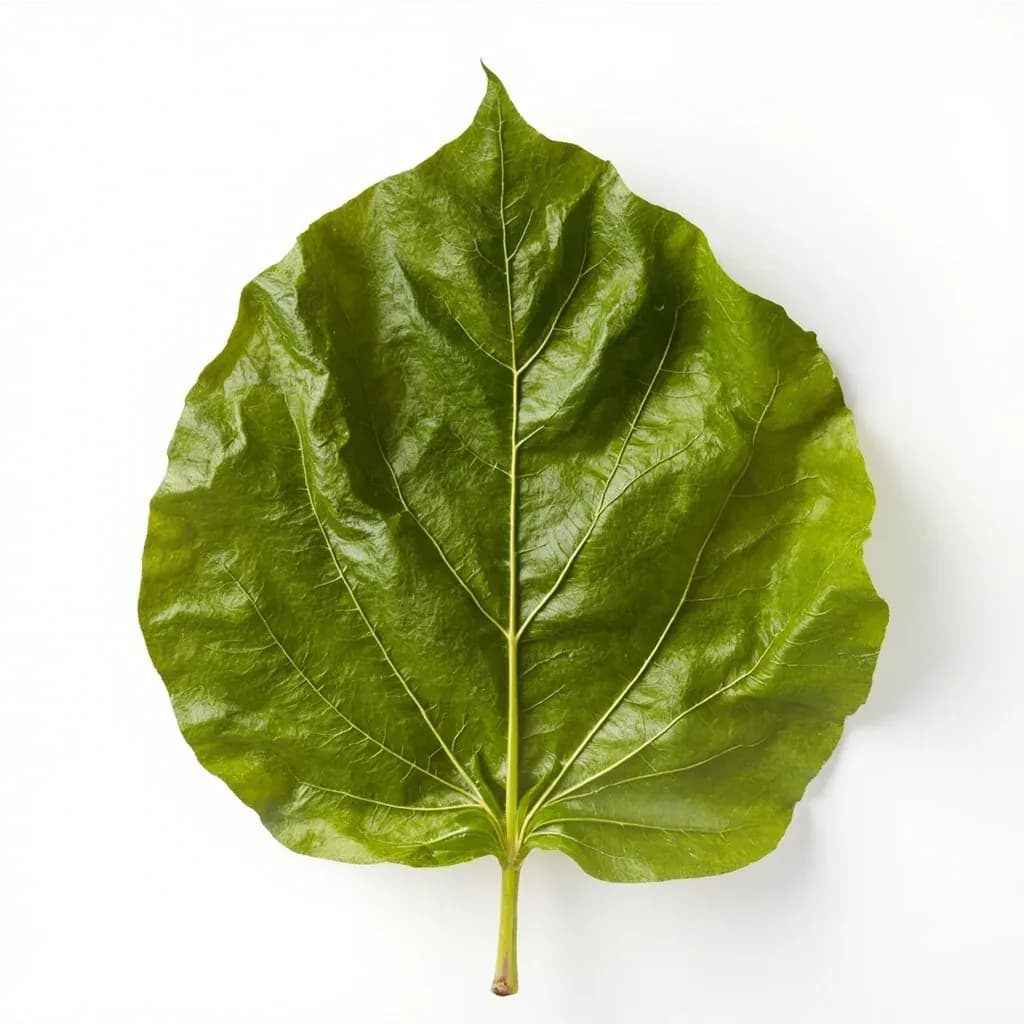
Large lobed breadfruit leaves used to line earth ovens and wrap food for steaming.
Breadfruit leaves are broad, deeply lobed leaves used across the Pacific and Caribbean as natural food wrappers and oven liners. Cooks layer them in earth ovens or wrap parcels of fish, root vegetables, and starches for steaming and roasting. The thick leaf shields food from direct heat and ash while holding in moisture.
Breadfruit leaves are the broad, deeply lobed foliage of Artocarpus altilis, the same Moraceae tree that bears the starchy fruit. They are among the largest leaves a cook is likely to handle — typically 30–90 cm long and 20–50 cm wide, with pointed, leathery segments, a glossy upper face, and a paler matte underside. Across Polynesia, Melanesia, and the wider Pacific they form the working floor of the earth oven — the umu, lovo, imu, and kālua — and serve as the principal wrap for whole pigs, fish, and root crops buried in heated stones.
What sets them apart from banana leaf, their closest cousin in the tropical pantry, is thickness and rigidity. Breadfruit leaves are heavier, less permeable, and more resistant to tearing when wet, which makes them the wrap of choice for heavy, juicy parcels and for lining an oven bed that must endure direct stone heat. Their flavor is faint — a slightly nutty, vegetal whisper — so they contribute less aroma than banana or ti leaves, but they lock in moisture and steam so effectively that meats emerge exceptionally tender. The matte underside is traditionally laid against the food for a smoother contact surface and cleaner release after cooking.
Outside Oceania and parts of the Caribbean, fresh breadfruit leaves are difficult to source, and most cooks will encounter them only through Pacific Island restaurants, specialty grocers, or gardeners who cultivate the tree. When available, they reward a little preparation: a brief pass over a flame makes them pliable, and they freeze remarkably well, so surplus leaves can be stockpiled for ceremonial feasts and Sunday lovos alike.
Alternatives
Types & varieties
Deeply cut, glossy, leathery; the standard wrap throughout Polynesia
From compact cultivars grown in Samoa and Tonga; exceptionally broad and leathery, preferred for lining lovo ovens
Larger, more heavily lobed leaf of the seeded ancestor; used identically in Guam, parts of Melanesia, and the Philippines
Some seedless Polynesian cultivars (such as those in the Hawaiian 'ma'afala' group) have shallower lobes but behave the same in the oven
Preparing leaves for the oven or grill
Fresh breadfruit leaves are stiff and will crack if folded cold. A few seconds of heat relaxes the cuticle and the fibers without actually cooking the leaf, and a quick trim of the midrib allows the leaf to lie flat under a tied parcel.
- Wipe the leaf clean with a damp cloth; do not soak, as prolonged water makes it soggy.
- Hold each leaf 10–15 cm above a gas flame or pile of glowing coals for 2–5 seconds, until it darkens slightly and feels pliable.
- Work one leaf at a time over a kettle of boiling water if no open flame is available — the steam relaxes the leaf almost as well.
- Trim the thick central midrib flush with a sharp knife so the leaf folds flat and the rib does not punch through when tied.
- Lay the matte underside against the food; the smoother surface releases cleanly after cooking.
Breadfruit leaf vs. banana leaf
The two are often interchangeable in Pacific cookery, but they behave differently under heat, weight, and moisture, and experienced cooks choose between them deliberately rather than by default.
- Breadfruit leaves are thicker and more rigid; banana leaves drape and conform, making them better for delicate parcels and tamale-style folds.
- Breadfruit leaves are less permeable, so they hold steam inside heavy, wet bundles (whole pig, fish in coconut cream) more reliably.
- Banana leaves contribute more aroma and a greener, hay-like scent; breadfruit leaves are almost neutral, letting the food speak.
- For oven lining, breadfruit wins because it tolerates direct contact with hot stones without scorching through.
- When both are available, layer them: banana leaf against the food for aroma, breadfruit on the outside for structure.
Common uses
Tips & pitfalls
- Pass the leaf over an open flame for 2–5 seconds until it darkens and softens; an un-wilted leaf will snap and leak juices.
- Lay the matte underside against the food so sap contact is minimized and release is clean after cooking.
- Trim the thick central midrib flat with a knife so the leaf folds evenly and does not punch through when tied.
- Overlap two leaves at the seam of a parcel to create a leak-proof wrap for very wet foods like fish baked in coconut cream.
- Tie parcels with coconut-husk sennit, pandanus strip, or banana-fiber twine; kitchen twine works but lacks the traditional aroma.
- Avoid young, light-green leaves: they weep milky latex and blacken badly in contact with heat.
- Discard leaves that are dry, brittle, or already browned; they will scorch and turn bitter.
- For grilling, double-wrap (leaf–food–leaf) so the outer layer shields the inner one from direct flame char.
- Blanch leaves briefly in boiling water before freezing flat between sheets of parchment for off-season storage.
Good to know
- Source plant
- Artocarpus altilis (breadfruit tree), family Moraceae
- Typical size
- 30–90 cm long, 20–50 cm wide; among the largest leaves used in tropical cookery
- Primary role
- Earth-oven liner and heavy-duty food wrap for steaming and pit-roasting
- Flavor
- Very mild, faintly vegetal and nutty; functions mainly as a moisture barrier, not a seasoning
- Working prep
- Passed briefly over an open flame or held over hot coals for 2–5 seconds to soften and prevent cracking
- Contact side
- Matte underside placed against the food; glossy side outward
- Fresh storage
- 3–5 days refrigerated, wrapped in a damp cloth; wilts and blackens if kept dry
- Allergen note
- Family Moraceae contains latex-like sap that can irritate sensitive skin, especially in young leaves
Also called
Breadfruit Leaf Wrapper
Related

Aluminum Foil
Wraps, covers, and tents food for the oven and grill

Parchment Paper
Nonstick liner for clean, even baking and easy release

Wax Paper
Moisture-resistant sheet for wrapping and counter prep

Plastic Wrap
Clings tight to cover bowls and wrap leftovers

Silicone Baking Mat
Reusable nonstick liner that replaces parchment

Cheesecloth
Loose-woven cloth for straining stock and bundling herbs

Beeswax Food Wrap
Reusable wax wrap that molds around bowls and produce

Piping Tips
Shaped nozzles that turn frosting into stars and rosettes