Heat & Safety
Caustic Soda (CIP)
Strong alkaline cleaner (sodium hydroxide) used to clean-in-place tanks and brewing/dairy lines.
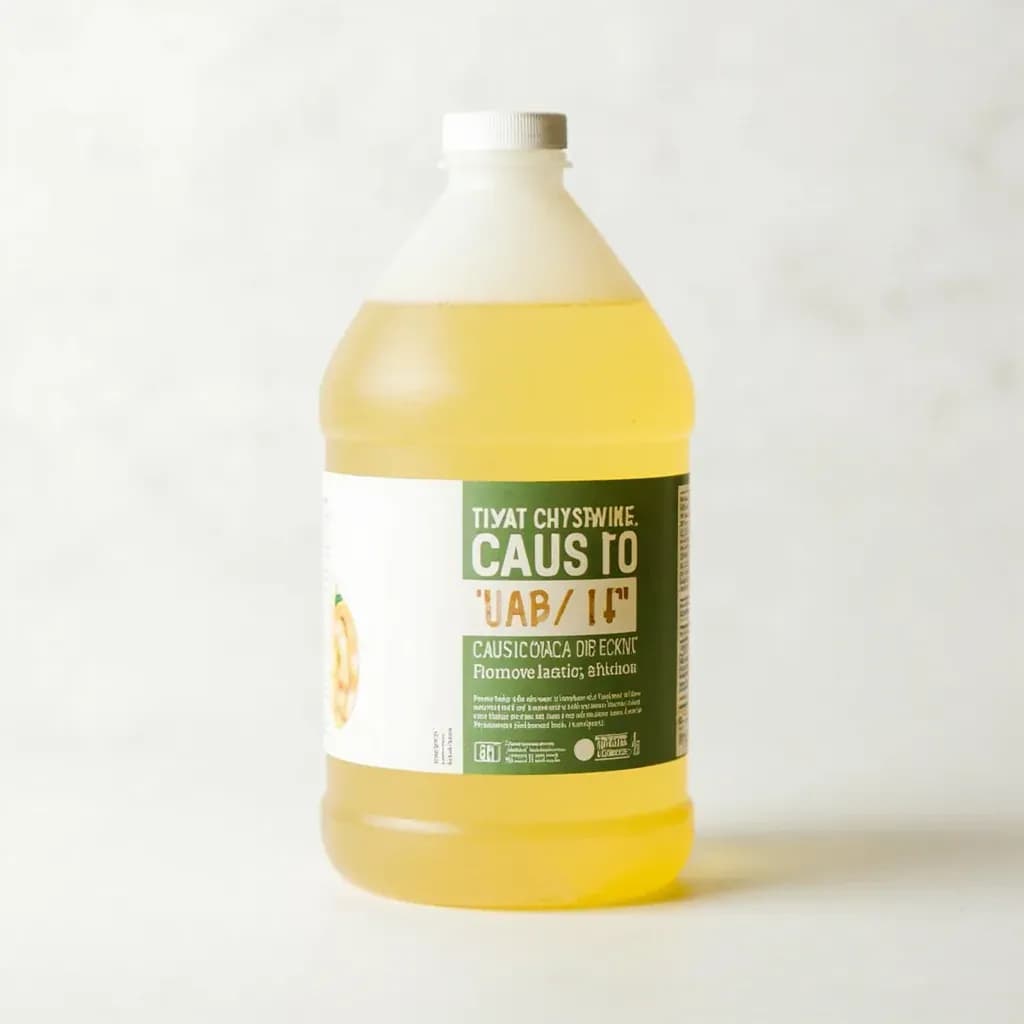
Sodium hydroxide solution used as a clean-in-place (CIP) agent to strip protein, fat, and scale from brewing tanks, dairy lines, and fermentation vessels. It dissolves stubborn organic soils that ordinary detergents cannot, then is fully rinsed and neutralized before any food contact. Caustic soda is highly corrosive, so it demands gloves, eye protection, and careful dilution; it is a process aid, never an ingredient.
Caustic soda is the food and beverage industry's heavy lifter when it comes to alkaline cleaning. Chemically it is sodium hydroxide (NaOH), the same compound sold in grocery stores as "lye" for pretzel browning and hominy making, but in a Clean-in-Place (CIP) context it arrives as an industrial reagent in much higher concentrations and in volumes meant for closed-loop circulation through tanks, pipelines, heat exchangers, and fillers. Its value in a brewery, dairy, or food plant comes down to two reactions: it saponifies fats, literally turning triglycerides into water-soluble soap, and it hydrolyzes proteins, breaking the films of whey, casein, hop residue, and yeast that hot water alone cannot shift. Together those two actions dissolve the bulk of the soils that build up inside stainless process equipment.
Behaviorally, caustic soda is aggressive in the way a good tool is aggressive. A 1–5% solution in water runs at roughly pH 13 and is highly caustic to skin and eyes, but that same alkalinity is exactly what lets it strip protein and fat at temperatures of 60–80 °C in a single 20–30 minute circulation. It is highly compatible with stainless steel 304 and 316, EPDM, PTFE, and Viton seals — the standard build of any commercial process line — but it should never see aluminum, galvanized steel, tin, or copper. Concentrated solutions are exothermic when diluted and will freeze in unheated storage, so the practical choices around caustic (which grade, which concentration, which temperature) shape a plant's whole CIP program.
The "CIP" in this entry is a process acronym, not a different chemical formulation. It refers to Clean-in-Place, the closed-loop practice of spraying and circulating cleaning solutions through process equipment without disassembly. Caustic soda is almost always the alkaline phase of that loop, paired with an acid phase (typically phosphoric or nitric) on a defined schedule to prevent mineral or beerstone/milkstone buildup that the alkaline step alone cannot remove.
Alternatives
Types & varieties
Most common commercial liquid; preferred for bulk CIP dosing because pumps and metering are easier than handling solids.
Lower-freezing-point liquid, easier to handle in winter or unheated storage; needs proportionally more volume for the same dose.
Solid spherical form, low dust compared to flakes; favored for on-site dilution or lower-volume users.
Solid form that dissolves quickly but generates more dust and demands more careful handling.
Required for CIP of brewing, dairy, and food lines that contact edible product; tighter heavy-metal limits than technical grade.
Proprietary CIP detergents built on NaOH plus sequestrants, surfactants, and sometimes chlorine donors for hard water or heavy protein soils.
The alkaline–acid cycle in CIP
No discussion of caustic soda in cleaning is complete without its acid counterpart. Caustic saponifies fats and hydrolyzes proteins, but it does not dissolve calcium oxalate (beerstone) or calcium phosphate (milkstone) — the mineral scales that build up over weeks of hot-side operation. The accepted pattern in well-run plants is a scheduled alternation: an alkaline wash (caustic, 2–3% at 70–80 °C for 20–30 minutes) to remove organic soil, followed on a separate cycle by an acid wash (typically 1–2% phosphoric or nitric acid at 50–65 °C) to dissolve mineral scale. Skipping the acid phase and "just using more caustic" is the single most common cause of stubborn deposits, off-flavors from biofilm, and eventually heat-exchanger fouling in brewing and dairy operations.
- Caustic attacks fat and protein — not mineral scale.
- Acid attacks mineral scale — not fat and protein.
- Weekly acid cleaning is a typical baseline; high-hardness water or heavy boil may demand more frequent cycles.
- Final rinse water pH should match incoming water pH before the line returns to production — verified by probe or test strip, not assumed.
Safe handling and storage
Concentrated caustic is unforgiving: a splash to the eye can cause permanent damage in seconds, and dissolving solid beads in water releases enough heat to flash-boil if water is added to caustic rather than the reverse. Operators should treat it as a regulated industrial chemical regardless of its familiarity as a kitchen lye, because the doses and concentrations used in CIP are far above anything a cook would handle at home. The essentials below are the minimum program a serious plant runs.
- Always add caustic slowly to cold water, never the reverse.
- PPE: chemical-splash goggles plus face shield, PVC or nitrile gauntlet gloves, rubber apron, closed rubber boots.
- Eyewash station and a buffered neutralizer (boric acid solution, not household vinegar) within arm's reach — water flushing is the primary first-aid response for any splash.
- Never store in aluminum, galvanized steel, or plain mild steel; use HDPE, polypropylene, or rubber-lined vessels.
- Keep containers tightly sealed — liquid caustic absorbs CO₂ from air and gradually loses strength, becoming sodium carbonate.
- Keep SDS accessible and train every operator; many jurisdictions require a written CIP chemical-handling procedure.
Common uses
Tips & pitfalls
- Always add caustic to cold water, never pour water onto solid caustic or concentrated liquor — the exothermic reaction can flash-boil and splash.
- Never mix caustic with acids, ammonia, or chlorinated cleaners — violent reactions release chlorine or chloramine gas.
- Do not use on aluminum, galvanized steel, tin, or copper; it dissolves aluminum and attacks soft metals. CIP loops should be stainless 304/316 with EPDM, PTFE, or Viton seals.
- For brewery CIP, dose to 2–3% w/w at 70–80 °C and circulate 20–30 minutes, then rinse with potable water until the final rinse pH matches incoming water.
- Alternate caustic with a phosphoric or nitric acid wash on a weekly (or scheduled) basis — caustic alone will not remove beerstone or milkstone, and the deposits will harden into a surface that even acid struggles to remove later.
- Verify concentration with titration or conductivity rather than assuming label strength; liquid caustic slowly carbonates in open tanks and loses activity.
- Add a chlorine donor (e.g., sodium hypochlorite) to the caustic loop when protein soil is heavy — but never combine it with acid in the same step, and never store or handle the two as a dry mixture.
- Keep a written CIP log with date, concentration, temperature, contact time, and final-rinse pH; most food-safety audits will ask for it.
Good to know
- Chemical name
- Sodium hydroxide (NaOH)
- Synonyms
- Lye, soda lye, white caustic
- Typical CIP concentration
- 1–5% w/w in water (2–3% for brewery CIP)
- CIP temperature
- 60–80 °C (140–176 °F)
- Contact time
- 20–30 minutes circulation
- pH (1% solution)
- ≈ 13
- Freezing point (50% liquor)
- ≈ 12 °C / 54 °F — solidifies in cold storage
- Grades
- Technical/industrial and food-grade (FCC); beverage and dairy use food-grade only
- Hazard
- Severe skin/eye corrosive; dissolution in water is strongly exothermic
Also called
Sodium Hydroxide · Lye (CIP) · Caustic Cleaner
Related

Paper Towels
Disposable sheets for spills, drying, and patting dry

Kitchen Towels
Reusable cloths for drying, gripping, and wiping

Oven Mitts
Heatproof gloves to handle hot pans and trays safely

Disposable Gloves
Single-use gloves for safe, mess-free handling

Cleaning Cloths
Reusable cloths for wiping counters and spills

Tortilla Warmer
Insulated holder that keeps tortillas warm and soft

Trivet
Heatproof stand that shields surfaces from hot pots

Ice Bath Setup
Bowl of ice water that halts cooking and sets color