Heat & Safety
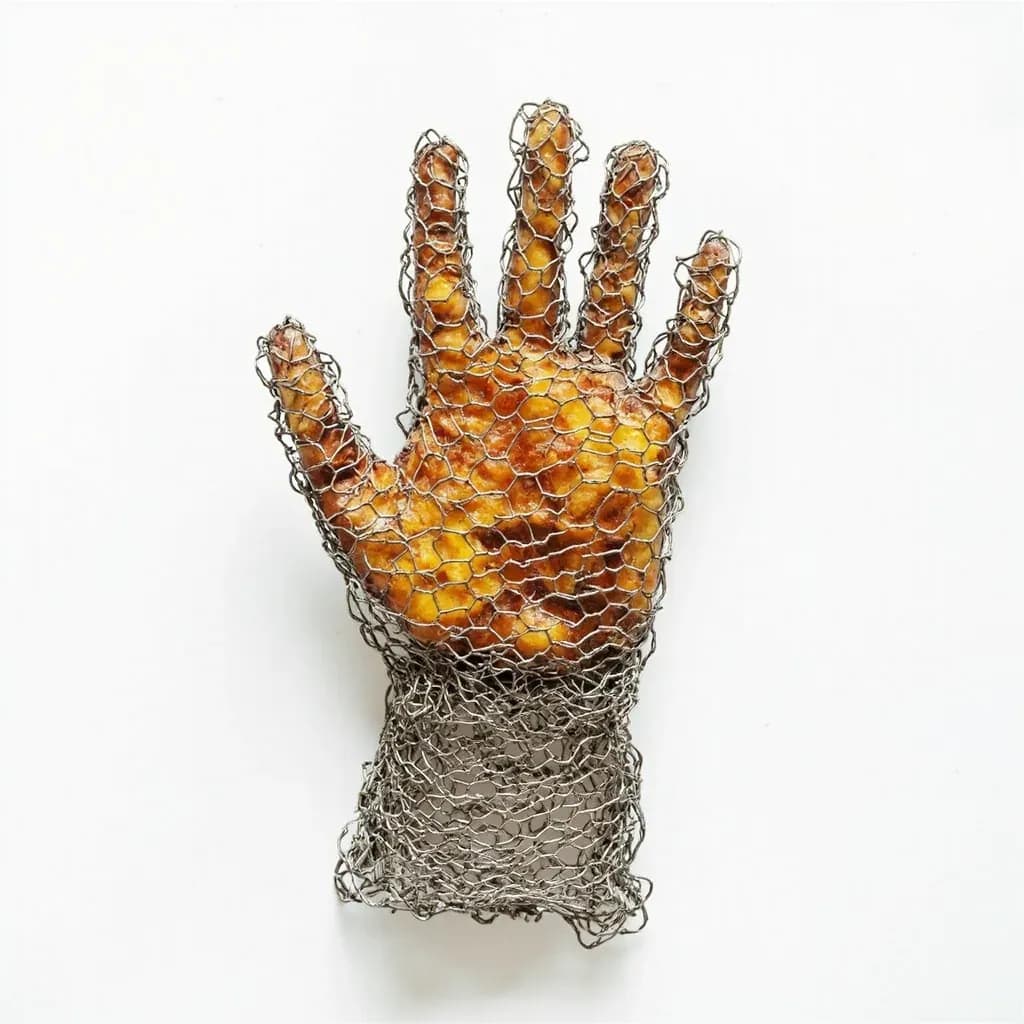
Cut-Resistant Chainmail Glove
A steel mesh glove that guards the hand against cuts when shucking oysters or boning meat.
A cut-resistant chainmail glove is woven from interlocking stainless-steel rings, like medieval armor. It protects the non-knife hand during high-risk tasks such as oyster shucking, breaking down meat, or using a mandoline. The mesh resists slicing without limiting grip, and it is dishwasher-safe for sanitizing between uses.
A cut-resistant chainmail glove is a fitted sleeve of interlinked stainless-steel rings — almost always 304-grade, joined in a four-in-one pattern so that each ring passes through four of its neighbors — engineered to keep a slipping knife from finding a gap to bite into. Because the rings are small, hard, and tightly closed, a blade edge cannot catch and slice through the way it would slice fabric or skin; instead it deflects across the crown of the mesh. Most kitchen-grade gloves use welded rather than riveted rings precisely because welded seams leave no crevices for meat juice, salt, or brine to lodge in, which is the difference between a glove that belongs in a HACCP plan and one that does not.
In practice the glove trades fingertip sensation and adds roughly 250–450 g per hand for the certainty that a glancing slip during a deboning pass or an oyster shuck will not open a tendon. That trade is acceptable — even welcome — for oyster bars, fish rooms, and butcheries where the alternative is stitches, and it is increasingly popular with home cooks tackling whole fish or breaking down a chicken. The honest limit: chainmail stops slicing and sliding cuts, not punctures. A needle-thin awl, a narrow boning tip, or a lobster pick driven straight in can still pass between rings, so the glove is a cut guard against the kind of damage knives actually cause in prep work, not a universal shield.
A last behavior worth knowing up front: stainless steel is not an insulator. The mesh will not protect you from a hot pan, a salamander, or a sheet-pan edge, and a gauntlet that dips into a fryer or a hot stockpot will conduct that heat straight to the skin. Treat it as a cut tool, not a heat tool, and it earns its place in the kit.
Alternatives
Types & varieties
Short cuff; preferred by oyster shuckers and counter staff who need maximum finger dexterity and no forearm contact
Covers the wrist and lower forearm; the everyday butcher's choice for poultry deboning and trim work
Extends to mid-bicep; used in whole-animal butchery, especially forequarter and shoulder breakdown where the blade can ride up the arm
Symmetrical cut fits either hand; practical for kitchens that rotate staff between tasks
Pre-curved for a single hand; usually more comfortable for long shifts and a touch lighter
Heavier-gauge, full-gauntlet style sized for primal-cut breakdown on beef and pork
Shorter, lighter style often paired with a cut-resistant glove on the knife hand; keeps the cuff out of the liquor
Modern hybrid that slips an HPPE or Kevlar liner inside the steel shell for added cut resistance and sweat management
Matching half- or full-front apron of the same rings, sold separately for torso protection during fish heading and carcass splitting
How the mesh stops a blade
A knife cuts because its edge catches on a surface and draws across it under pressure. Chainmail defeats that mechanism on two fronts: the rings are too small and too tightly closed for an edge to seat in, and the steel is hard enough that the edge slides off the crown of each ring rather than biting in. The result is that the blade is deflected along the surface of the glove instead of into it. The defense fails the moment a thin, pointed object is pressed straight in — lobster picks, narrow boning tips, skewers, and needle-thin awls can still pass between rings, which is why no one calls chainmail puncture-proof.
Care and inspection routine
Chainmail shrugs off the cleaning that destroys other PPE — hot water, sanitizer dips, and commercial dishwashers are all fine — but it does reward a few minutes of attention. Build a habit of inspecting and drying it the way you would a cast-iron pan.
- Rinse under hot water and scrub with a stiff-bristled brush after every use; trapped protein between rings is the main hygiene complaint.
- Sanitize in a dilute bleach or quat-amm dip per your kitchen's HACCP plan, or run through a commercial dishwasher.
- Dry the glove thoroughly before storage — water spots are cosmetic, but trapped moisture can pit cheaper alloys over time.
- Run a clean fingertip across the inside of the mesh before each shift; feel for any raised, cracked, or separated ring and retire the glove immediately if you find one.
- Store flat or loosely rolled. Folding the mesh sharply fatigues the welds over months of abuse.
Chainmail vs. modern fiber cut-resistant gloves
HPPE, Dyneema, and Spectra fiber gloves (ANSI/ISEA 105 cut levels A4 through A9) are far lighter, cheaper, and more dexterous, and they win easily for general prep — mandoline work, vegetable trimming, portioning on a slicer. They lose to chainmail in one specific scenario: a deboning knife delivering sustained, high-pressure cuts against bone. A fiber glove resists a sliding edge; it can still be sawed through by a stiff blade worked back and forth along a shank or a carcass. Chainmail is heavier and clumsy, but under that kind of abuse it is the only common kitchen glove that genuinely refuses to give.
Common uses
Tips & pitfalls
- Wear the glove on the hand that holds the food — your non-dominant hand — not on the hand that wields the knife.
- Fit matters more than thickness: a snug glove cannot let a blade tip catch between shifting rings, while a loose one is a hazard in itself.
- Do not use it for heat. Stainless conducts temperature fast; it is a cut guard, not a replacement for an oven mitt or heat-resistant glove.
- For oyster shucking, a shorter wrist-length glove often beats a gauntlet because the cuff is less likely to dip into the shell liquor and the extra finger dexterity helps.
- If you sweat heavily, slip a thin nitrile or cotton liner underneath to prevent chafing and to keep skin oils off the steel.
- Retire the glove the moment a ring is cracked, deformed, or separated — one broken link compromises the whole mesh.
Good to know
- Material
- 304-grade stainless-steel rings, interlinked four-in-one so each ring passes through four neighbors
- Construction
- Welded rings preferred for food service — no gaps for meat juice or brine to harbor bacteria, unlike riveted historical mail
- Cuff lengths
- Wrist (≈7 cm), mid-forearm (≈15–20 cm), and full gauntlet (≈25–35 cm); longer cuffs guard against knife tips riding up the arm during deboning
- Hand orientation
- Sold ambidextrous or hand-specific (L/R); most pros wear it on the non-dominant hand that holds the food
- Cleaning
- Hot rinse, stiff brush, sanitize in dilute bleach or quat-amm, or run through a commercial dishwasher; dry immediately to prevent water spotting
- Relevant standards
- EN 1082-1 and EN 14328 cover chainmail cut resistance in food processing; some models also cite ANSI/ISEA 105 cut levels
- Lifespan
- Years of daily use, but retire the glove the moment any ring is cracked, deformed, or separates — one broken link compromises the whole mesh
- Heat behavior
- Stainless conducts temperature quickly; the glove is a cut guard, not a heat-resistant glove, and should not replace an oven mitt
Also called
Steel Mesh Glove · Oyster Glove · Mandoline Glove
Related

Paper Towels
Disposable sheets for spills, drying, and patting dry

Kitchen Towels
Reusable cloths for drying, gripping, and wiping

Oven Mitts
Heatproof gloves to handle hot pans and trays safely

Disposable Gloves
Single-use gloves for safe, mess-free handling

Cleaning Cloths
Reusable cloths for wiping counters and spills

Tortilla Warmer
Insulated holder that keeps tortillas warm and soft

Trivet
Heatproof stand that shields surfaces from hot pots

Ice Bath Setup
Bowl of ice water that halts cooking and sets color