Storage & Containers
CO2 Cylinder
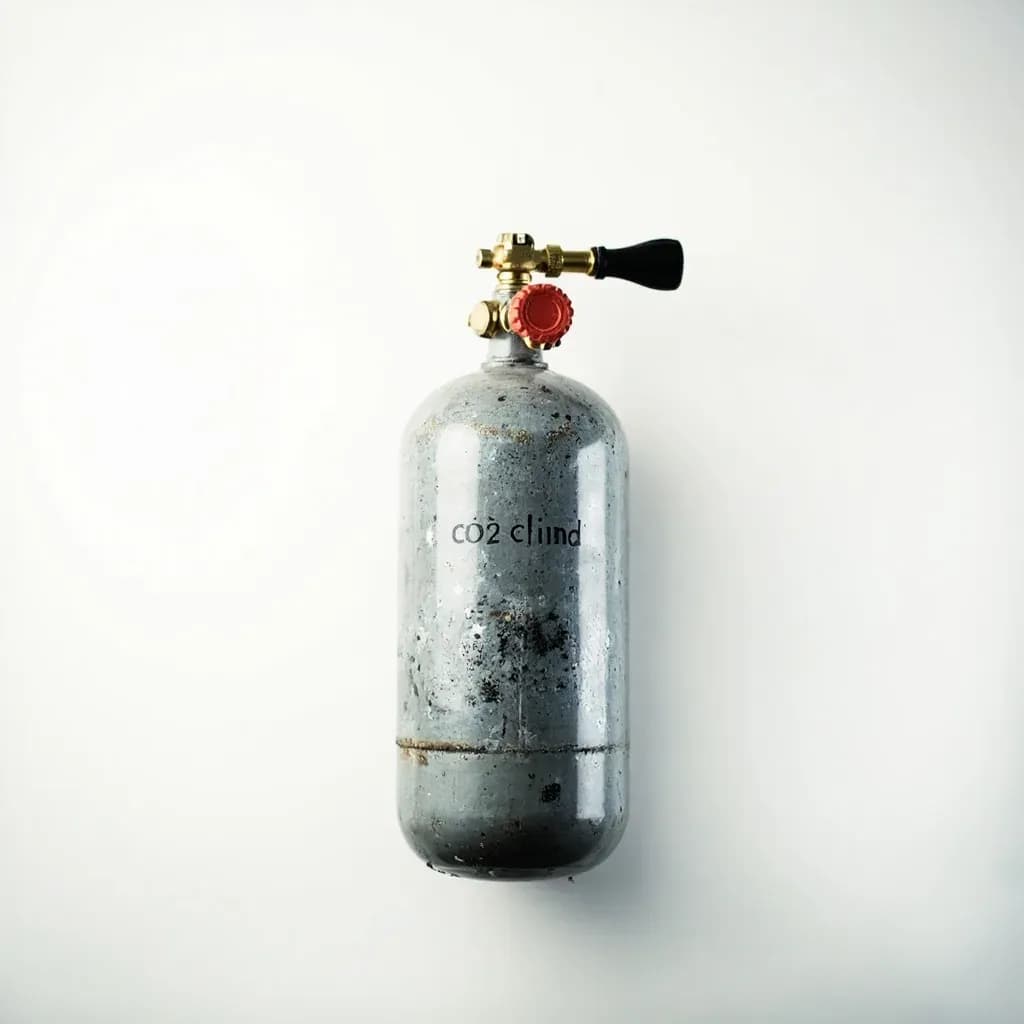
A pressurized carbon dioxide canister used to carbonate drinks or charge soda and keg systems.
A CO2 cylinder is a refillable steel or aluminum bottle of pressurized carbon dioxide. In the kitchen and bar it powers soda siphons, home carbonators, and draft beverage systems, and it is also used to flush oxygen from packaging to extend shelf life. The cylinder threads or clamps into a regulator that controls the gas flow into the liquid or container.
A CO₂ cylinder is a refillable pressure vessel that holds food-grade carbon dioxide under high pressure and releases it on demand to carbonate liquids or push them through a draft system. In the kitchen it does two distinct jobs: it dissolves CO₂ into a liquid to give it sparkle (seltzer, soda, kegged beer, kombucha on tap) and it provides the driving pressure that moves those carbonated drinks from keg to glass. Home cooks encounter it most often as a small threaded 8 g aluminum charger for a soda siphon, a 5 lb aluminum tank behind a kegerator, or a 20–50 lb cylinder behind a small bar's draft wall.
Inside the cylinder, CO₂ exists as a liquid with a vapor headspace at room temperature — the liquid/vapor boundary is what keeps tank pressure stable as you draw gas off, until the liquid is nearly gone. That behavior is governed by temperature: a tank in a 38 °F walk-in holds usable gas far longer than the same tank sitting at 70 °F, because pressure drops with temperature and a regulator at low pressure starves quickly. Heat is the other side of the same coin: a cylinder left in a hot car can climb to relief-valve pressure and vent, so storage temperature matters as much as dispense temperature.
Every beverage-grade cylinder in North America uses the CGA-320 valve, and the gas inside must be food-grade (labeled USP or E290). Industrial or welding CO₂ may carry trace compressor oil and tastes flat or off; it is not a safe substitute. Tanks are stamped with a hydrostatic-test date that determines when they must be requalified (12 years for aluminum, 5 for steel in the US) before a refiller will legally refill them — a detail that catches a lot of first-time homebrewers off guard.
Alternatives
Types & varieties
Disposable threaded aluminum cartridge; the de facto global standard for home soda siphons. One charger per liter.
Same thread and capacity as iSi; widely sold in Europe and a reliable cross-compatible cartridge.
The most common homebrew and kegerator size; lightweight, corrosion-proof, easy to swap.
Mid-size for serious home draft setups; roughly double the runtime of a 5 lb at the same temperature.
Largest aluminum cylinder most couriers will ship; popular for small bars and nitro cold-brew rigs.
Maximum aluminum size readily available; favored by taprooms and event dispense where weight matters.
Commercial and brewery standard; heavier and noticeably cheaper per pound of gas than aluminum.
Small cylinders (12 g to 20 oz) sometimes fitted with a CGA-320 adapter for mini-kegs; limited capacity, mostly a novelty.
Required for true stout and nitro pours; sold in standard cylinders and cannot be replicated with pure CO₂.
Temperature is the hidden variable
CO₂ pressure inside a cylinder is set by the temperature of the liquid, not by how much gas is left, until the liquid is almost gone. That means a tank in a cold walk-in behaves like a fuller tank, and a tank in a warm garage behaves like a nearly empty one — even when the gauge says otherwise. Cold liquid also absorbs roughly twice as much CO₂ as room-temperature liquid, so chilling everything (tank, keg, lines, glass) is the single most effective way to get a properly carbonated, properly poured drink with the least gas wasted.
- Chill kegs and force-carbonate at 33–38 °F for 24–48 hours rather than shaking and serving
- Keep the tank itself out of direct sun and away from heat sources; a cool tank regulates more cleanly
- For nitro, the gas blend must be cold to push beer through the restrictor plate at the right flow rate
CO₂ vs. N₂: when to use which
CO₂ both carbonates and pressurizes — it dissolves into the liquid to give sparkle. N₂ is nearly insoluble in beer and only pressurizes, which is why stout and nitro cold brew use it: tiny bubbles stay tiny and cascade into a creamy head rather than fizzing flat. Pure CO₂ cannot replicate a true nitro pour, no matter how the faucet is set; you need a blended gas tank and either a stout faucet or a restrictor plate.
- Use pure CO₂ for lagers, pilsners, IPAs, seltzers, kombucha, and any sparkling soda
- Use a 75% N₂ / 25% CO₂ blend for Irish stout, milk stout, and nitro cold brew
- Pure N₂ is reserved for pressurized dispense with no carbonation at all — rare in the kitchen
Storage, transport, and requalification
A CO₂ cylinder is a small pressure vessel and should be treated like one. Stand it upright, strap it, keep the protective cap on whenever the regulator is removed, and never let it sit in a hot car or next to a stove. The recertification date stamped on the shoulder is not a suggestion — gas suppliers will refuse to refill an expired cylinder, and the only path back into service is a hydrostatic retest at a certified shop or, more commonly, a tank swap.
- Store below 100 °F; aluminum cylinders vent through a fusible plug near 165 °F in a fire
- In transit, keep the cylinder upright so liquid CO₂ cannot reach the valve and slug into the regulator
- Replace the gas line every 2–3 years — Tygon and nylon tubing harden and crack long before they look worn
- If a tank is expired, swap rather than refill; most homebrew shops trade empties for tested, full tanks at a reasonable price
Common uses
Tips & pitfalls
- Use only food-grade CO₂ labeled USP or E290; industrial or welding CO₂ can carry trace oils that taint flavor and are not food-safe
- Always run beverage CO₂ through a two-stage regulator — single-gauge cheap regulators make carbonation levels guesswork and can starve a keg at the end of a tank
- Carbonate cold: liquid at 33–38 °F absorbs roughly twice as much CO₂ as liquid at 65 °F, so force-carbing in a refrigerator cuts both time and gas use
- Match pressure to style: about 10–12 psi at 38 °F for most lagers, 11–15 psi for British ales, and 20–30 psi for highly carbonated Belgians, saisons, and lambics
- Never invert a cylinder with a regulator attached — liquid CO₂ reaching the regulator damages seals and gives wildly inaccurate pressure readings; keep the tank upright in storage and transport
- Check the hydrostatic-test date stamped on the shoulder before buying or swapping a used tank; an expired aluminum cylinder is 12+ years past its stamp and a refiller will turn it away
- Do not over-tighten the regulator nut onto the CGA-320 valve — the threads are fine and deform easily; snug plus a quarter turn is plenty
- Bleed the valve briefly with the regulator closed before connecting, to clear any air or moisture that crept in during the last swap, and crack the regulator slowly on first use to avoid a pressure spike
Good to know
- Gas grade
- Food-grade CO₂, minimum 99.9% purity, labeled USP or E290
- Valve standard (US/CA)
- CGA-320 threaded connection; CGA-180 is for medical and industrial CO₂/O₂ blends and is not interchangeable
- Cylinder pressure
- 850–900 psi at 70 °F; dispensed to 8–30 psi at the regulator for beverage use
- Internal state
- Liquid CO₂ with vapor headspace below 87.9 °F; above that critical temperature it is gas only
- Home tank sizes
- 5, 10, 15, and 20 lb aluminum; 50 lb steel is the commercial standard
- Soda-charger yield
- One 8 g threaded charger carbonates roughly 1 L of water to seltzer pressure
- 5 lb tank yield
- Approximately 30–40 standard half-barrel kegs of beer, or several hundred liters of soda, depending on temperature
- Requalification (US, DOT)
- Aluminum every 12 years, steel every 5 years; date stamped on the cylinder shoulder
Also called
CO2 Canister · Carbon Dioxide Cylinder · Gas Cylinder
Related

Freezer Bags
Thick, sealable bags built to fight freezer burn

Storage Bags
Resealable bags for fridge storage and marinating

Storage Container
Lidded container for leftovers, prep, and meal kits

Glass Container
Oven-to-fridge glass that won't stain or hold odors

Plastic Container
Lightweight, stackable storage for everyday leftovers

Vacuum Sealer Bags
Airtight bags for long freezing and sous-vide

Reusable Bags
Washable silicone bags that replace single-use plastic

Mason Jar
Sealed glass jar for preserves, pickles, and storage