Wraps & Liners
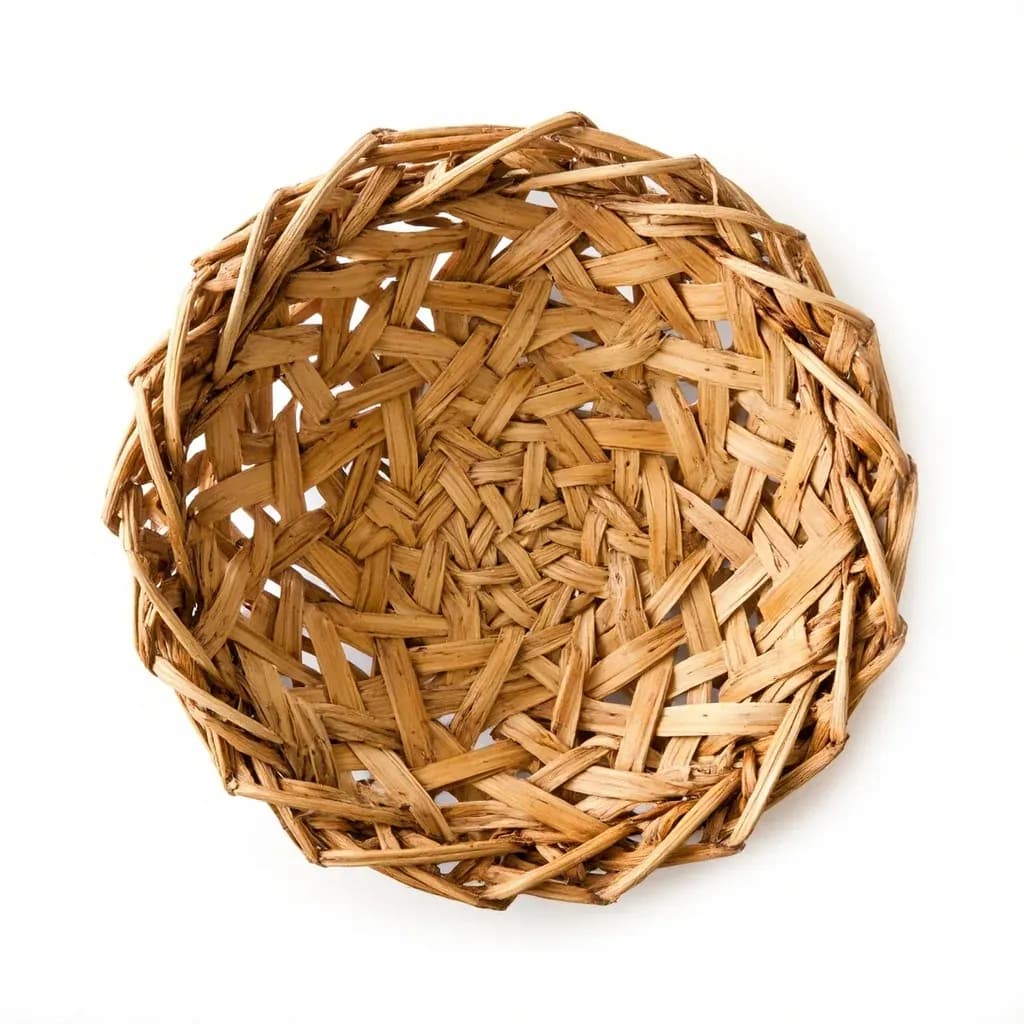
Woven Coconut Frond Basket
Hand-plaited basket or mat of fresh coconut leaves used to wrap, steam, or serve food in tropical cooking.
A woven coconut frond basket is plaited from fresh young palm leaves into a pouch or mat that holds food during cooking. Across Southeast Asia and the Pacific it is used to wrap rice for boiling into ketupat, to line steamers, and to present grilled and steamed dishes. The fronds impart a faint grassy aroma and are typically made fresh and discarded after a single use.
The woven coconut-frond basket is one of the few kitchen items that is simultaneously a cooking vessel, a flavoring wrapper, a serving piece, and a fully compostable package. Made by hand-plaiting strips split from young, still-green coconut leaflets, these containers range from small diamond-shaped rice pouches (ketupat) to flat steaming mats, oval trays, and round bowls. They have been a daily tool across the Malay Archipelago, the southern Philippines, and Sri Lanka for centuries, and the technique traveled with diaspora cooks to Suriname and the Caribbean.
In use the leaves behave a lot like banana leaf: pliable and faintly waxy when fresh, they tolerate hours of boiling or steaming but scorch quickly over open flame. As the rice or parcel cooks, the leaf releases a subtle coconut-vanilla aroma and a grassy sweetness that is gentle but unmistakable, particularly in long-boiled rice cakes. Pouches are essentially single-use; sturdier mats and serving trays, if dried flat in shade, can be reused many times before they soften and fray.
Outside the home kitchen the woven frond carries real cultural weight. In Malaysia, Brunei, Indonesia, and Singapore, ketupat is so tightly bound to Hari Raya Aidilfitri that the shape alone signals the holiday, and weaving it remains a skill passed from mother to daughter. For cooks elsewhere, the same vessels are most often encountered as steamer liners, decorative trays for kuih, or the biodegradable wrapping around a piece of street food at a pasar malam.
Alternatives
Types & varieties
The diamond-shaped pouch that defines the category; parboiled rice is sealed inside and boiled 4–6 hours. The signature dish of Hari Raya Aidilfitri across Malaysia, Indonesia, Singapore, and Brunei, where the shape alone signals the holiday.
A pyramid-shaped cousin wrapped in palas (screwpine) leaves, built on the same plaited coconut-leaf base — a useful bridge when you want the ketupat method with a different aromatic.
Triangular woven pouch from the Visayas and Mindanao, traditionally plaited from young coconut or buri palm leaflets; rice is steamed inside and the pouches are hung in pairs to drain.
A small, often decoratively patterned tray used in Malay cuisine to serve kuih, fritters, fruits, and condiments at weddings, kenduri, and Ramadan bazaars.
The generic Malay term for a plaited basket of any shape; doubles as a serving vessel for nasi, lauk, fruits, and ceremonial offerings.
Flat woven coconut-leaf mat used as a food liner, steaming platform, or plate substitute in Indonesian and southern Thai kitchens.
Choosing and Preparing the Basket
A cook in Southeast Asia can choose between fresh plaited baskets from a pasar or morning market and sun-dried mats and trays sold in kitchen shops. Fresh pouches should be used the same day they are plaited; once the leaf stiffens, it cracks along the folds and the weave will leak under boiling. Dried mats, by contrast, arrive stiff in the package but revive quickly: a 5–10 minute soak or mist in cool water restores enough flexibility to wrap snugly around food or line a steamer. Trays intended for dry serving — kuih, fritters, cut fruit — need no prep at all.
Beyond the Malay Archipelago
Plaited palm-leaf containers show up wherever coconut palms grow. Sri Lankan cooks use the closely related kolapath, and South Indian and Maldivian kitchens have their own versions of plaited palm-leaf pouches for festive cooking. The technique traveled with diaspora communities to the Caribbean and Suriname, where woven palm containers traditionally hold boiled provisions and cassava bread. Outside those communities, the basket most often enters a Western kitchen as a steamer liner, a one-time-use wrapper for street food, or a tray emptied, rinsed, and added straight to the compost.
Common uses
Tips & pitfalls
- Use fresh-plaited leaves the same day they are cut; within hours they stiffen and crack at the folds.
- Briefly mist or soak a pre-dried mat or basket in cool water for 5–10 minutes to restore flexibility before steaming.
- For ketupat, parboil the rice for 5–10 minutes first; raw rice expands too aggressively and bursts the weave.
- Fill pouches no more than two-thirds full — rice roughly doubles in volume as it cooks.
- Tie the final knot with a fresh, uncreased strip; the closure is the most common leak point.
- Keep the pot at a steady rolling boil; a violent boil sloshes grains out of any tiny gap.
- Test doneness by unwrapping one pouch — the rice should be firm, translucent, and hold its shape with no chalky center.
- Reuse serving trays only for dry or room-temperature foods; repeated steaming weakens the fibers.
- Refresh a tired mat by brushing both sides with coconut oil and air-drying in the sun to restore light water resistance.
Good to know
- Material
- Young coconut palm leaflets (Cocos nucifera), split into thin strips and plaited while fresh and pliable
- Origin
- Indigenous to the Malay Archipelago and wider tropical Asia; used for centuries across Indonesia, Malaysia, Singapore, Brunei, the southern Philippines, and Sri Lanka
- Heat use
- Safe for boiling (3–6 h) and steaming; not suitable for direct grilling or open flame, which chars the fibers
- Flavor imparted
- Subtle coconut-vanilla aroma with a faint sweet, grassy note to rice, sago, and steamed parcels
- Typical size
- Rice pouches 5–8 cm; serving trays and mats 15–45 cm across
- Reusability
- Fitted rice pouches are single-use; sturdier woven mats and baskets can be reused 5–20 times if dried properly
- Storage
- Keep dry and shaded; store flat or loosely rolled; brittle if stored under pressure or in humidity
- Biodegradable
- Fully compostable; pouches, mats, and rice residue break down in garden compost within weeks
Also called
coconut-frond · woven-basket · woven-mat · coconut-frond-mat · ketupat case · palm leaf basket
Related

Aluminum Foil
Wraps, covers, and tents food for the oven and grill

Parchment Paper
Nonstick liner for clean, even baking and easy release

Wax Paper
Moisture-resistant sheet for wrapping and counter prep

Plastic Wrap
Clings tight to cover bowls and wrap leftovers

Silicone Baking Mat
Reusable nonstick liner that replaces parchment

Cheesecloth
Loose-woven cloth for straining stock and bundling herbs

Beeswax Food Wrap
Reusable wax wrap that molds around bowls and produce

Piping Tips
Shaped nozzles that turn frosting into stars and rosettes