Heat & Safety
Coconut Husk (Fire Fuel)
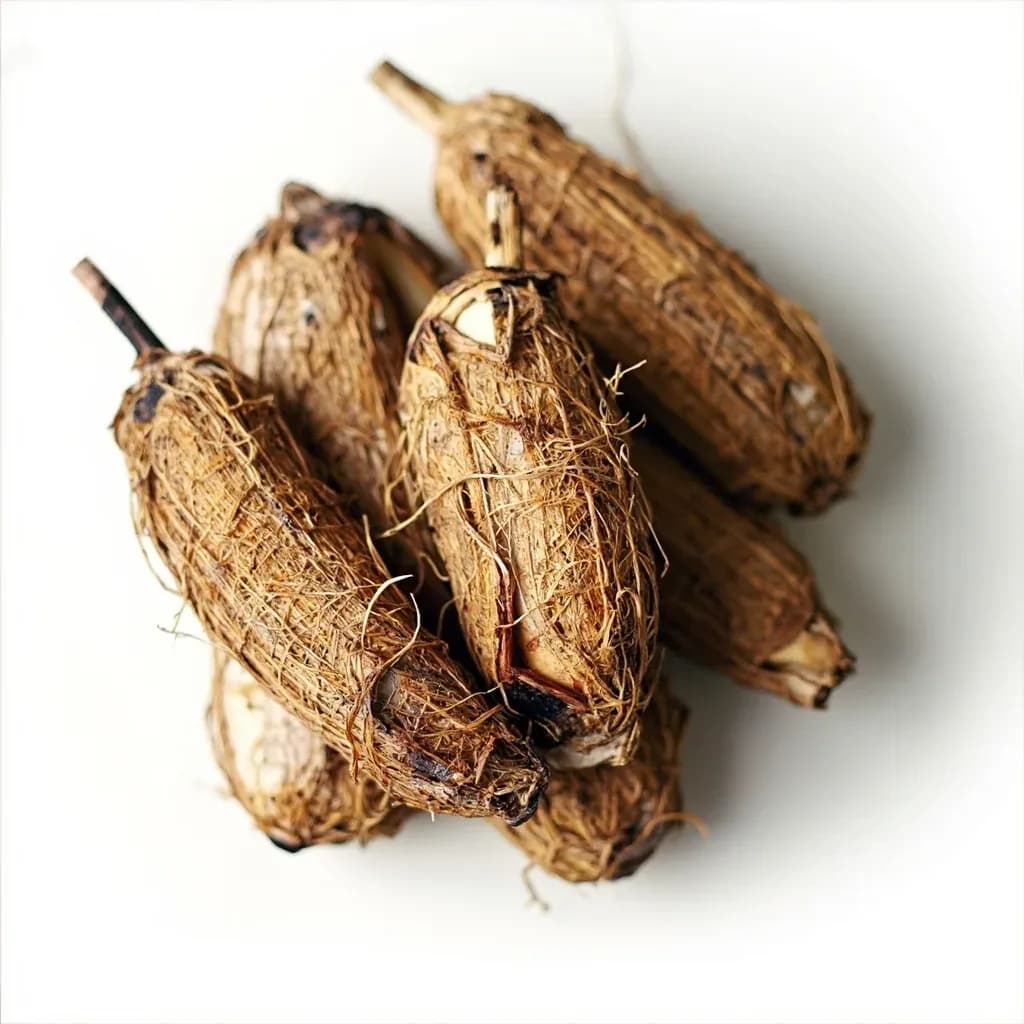
Dried coconut husk and shell burned as a fragrant, hot-burning cooking fuel.
The dried fibrous husk and hard shell of the coconut, burned as fuel in wood and charcoal cookery across the tropics. It ignites readily, burns hot, and lends a light smoky aroma well suited to grilling and slow roasting. Coconut-shell charcoal in particular burns cleanly with little ash, making it a favored fuel for satay and yakitori grilling.
The coconut palm is one of the most useful food plants on earth, and the parts left over after the water and meat are harvested are a serious cooking fuel in their own right. Two distinct materials come from a single fruit: the fibrous outer husk (the mesocarp) and the hard inner shell (the endocarp). They look related, but they burn differently and serve different roles at the fire. The husk acts like a fast, fragrant kindling — light, fibrous, quick to flame. The shell is dense and high in fixed carbon, behaving much like premium hardwood charcoal: slow, hot, and almost smokeless once lit.
For cooks in coconut-growing regions — from Kerala and Sri Lanka to the Philippines, Indonesia, Vietnam, the Caribbean, and coastal East Africa — this dual nature has shaped traditional cooking. The husk lights the morning fire under a clay chulha; the shell, broken into halves, keeps the embers glowing through a long simmer of curry or rice. In modern kitchens, both materials appear as packaged charcoal and briquettes, prized for a clean, faintly sweet smoke that does not bully the flavor of the food.
What makes coconut fuel worth knowing about beyond the tropics is the numbers. Dried shell runs roughly 7,500–8,500 BTU per pound, comparable to or better than most hardwoods, and once carbonized it carries around 70–80% fixed carbon — higher than typical wood charcoal. It is also a genuine waste-stream fuel, made from what would otherwise be piled beside copra-drying racks and coconut-milk factories, which is why it has spread into grills, tandoors, and hookahs well beyond where the trees grow.
Alternatives
Types & varieties
The intact fibrous outer covering; catches a flame quickly and gives a fragrant, short-lived fire. Best used as tinder or kindling under logs.
Husk cut into strips or pieces; easier to handle, dries faster, and suits small stoves and supplemental fuel.
The hard inner shell — the classic cooking fuel. Slow, very hot, low-smoke once ignited, and easy to split into cooking-sized pieces.
Carbonized shell sold as lumps; very high fixed-carbon content, virtually smokeless, and the standard fuel for shisha and high-end grilling.
Ground husk fiber compressed (often with a starch or molasses binder) into pillow- or oval-shaped briquettes; uniform burn, good for everyday stoves.
Carbonized shell fines pressed with a binder; long, even burn favored for grills and tandoor-style ovens.
Processed shell charcoal used for water and air filtration; not a cooking fuel, but the same feedstock and easily confused in trade.
Husk vs. Shell: Two Different Fuels
The fibrous husk is essentially nature's tinder — loose, stringy, full of air channels, and quick to catch a flame but quick to burn out. Treat it like straw or pine needles: starter fuel, not the main course of heat. The hard shell is a dense, lignified material with a high carbon content; it lights more reluctantly but, once ignited, holds a bed of glowing embers for a long time. If you are grilling fish or chicken over a kettle grill, reach for shell charcoal. If you are coaxing a wood fire to life in a clay stove or a sigri, a few strips of dry husk will do more than a whole bundle of hardwood kindling. Mixing the two on purpose — husk underneath as the lighter, shell on top as the long burner — is how traditional cooks have always done it.
Drying and Storing Whole Fuel
Wet husk is the single biggest reason coconut fuel disappoints. Fresh green husk carries a very high moisture load and will only smolder, choking the fire with thick white smoke and depositing tar and unburned condensates on grates and pots. Spread whole husks in a single sunny layer for one to two weeks, turning every couple of days; the material is ready when it turns from pliable to brittle and the fibers snap rather than bend. Shell halves dry faster — a few days of strong sun is usually enough — but they should also feel noticeably lighter and sound hard and dry when tapped. Store finished fuel off the ground on a pallet or raised rack, in a covered but ventilated shed. Moisture wicks back into dry husk faster than most cooks expect, and a damp cache during monsoon season is a common cause of failed firings.
Common uses
Tips & pitfalls
- Dry thoroughly before burning — sun-dry husks one to two weeks (or kiln-dry) until they feel light, brittle, and rattle when handled. Damp fuel is the number-one cause of poor performance.
- Stack loosely with airflow while drying to prevent mold and uneven drying.
- Use shell pieces or shell charcoal for sustained grilling heat; reserve fibrous husk for quick boiling-water jobs or as starter fuel under logs.
- Pair with a small amount of hardwood kindling to get a clean initial flame. Coconut fuel lights, but pure husk can be slow to catch on its own without a true tinder.
- Avoid using loose husk on open grates in windy conditions unless shielded — the embers are light and blow into ash quickly.
- Expect a faint, sweet aroma rather than the resinous punch of mesquite or hickory. It is a feature, not a fault, especially for seafood and mild white meats.
- Store off the ground on a raised rack in a covered shed. Ground moisture wicks back into dry husk surprisingly fast, and a single wet week can ruin a stockpile.
- Do not confuse shisha-grade 'coconut briquettes' (smaller, formulated for low odor) with grilling briquettes unless the package specifically states cooking use.
- Empty ash trays regularly — coconut ash is low in volume but very fine, and it clogs airflow faster than the pile looks like it should.
- Buy shell charcoal from reputable sources; low-grade product is sometimes bulked out with sawdust or browns unevenly.
Good to know
- Material
- Outer fibrous husk (mesocarp) and hard inner shell (endocarp) of the mature coconut; sometimes used together, usually best apart.
- Calorific value — shell
- Roughly 7,500–8,500 BTU/lb (≈16,500–18,700 kJ/kg), on par with or higher than most hardwoods.
- Calorific value — husk fiber
- About 6,500–7,500 BTU/lb; lower density but lights far more easily.
- Moisture requirement
- Must be dried below roughly 15% moisture before burning; fresh or 'green' husk will only smolder and smoke.
- Burn characteristics
- Shell burns hot and slow with steady embers; husk fiber lights fast and burns out quickly. Carbonized shell is around 70–80% fixed carbon.
- Smoke and flavor
- Mild, clean smoke when properly dried — less acrid than most softwoods — with a faint, sweet, woody note on grilled food.
- Ash
- Low volume; ash is light grey and very fine, so grill trays clog faster than they appear to.
- Sustainability
- A byproduct of the coconut water, milk, and oil industries, turning a waste stream into high-BTU fuel rather than cutting timber.
Also called
Coconut Husk Fuel · Coconut Shell Charcoal · Coir Fuel
Related

Paper Towels
Disposable sheets for spills, drying, and patting dry

Kitchen Towels
Reusable cloths for drying, gripping, and wiping

Oven Mitts
Heatproof gloves to handle hot pans and trays safely

Disposable Gloves
Single-use gloves for safe, mess-free handling

Cleaning Cloths
Reusable cloths for wiping counters and spills

Tortilla Warmer
Insulated holder that keeps tortillas warm and soft

Trivet
Heatproof stand that shields surfaces from hot pots

Ice Bath Setup
Bowl of ice water that halts cooking and sets color