Wraps & Liners
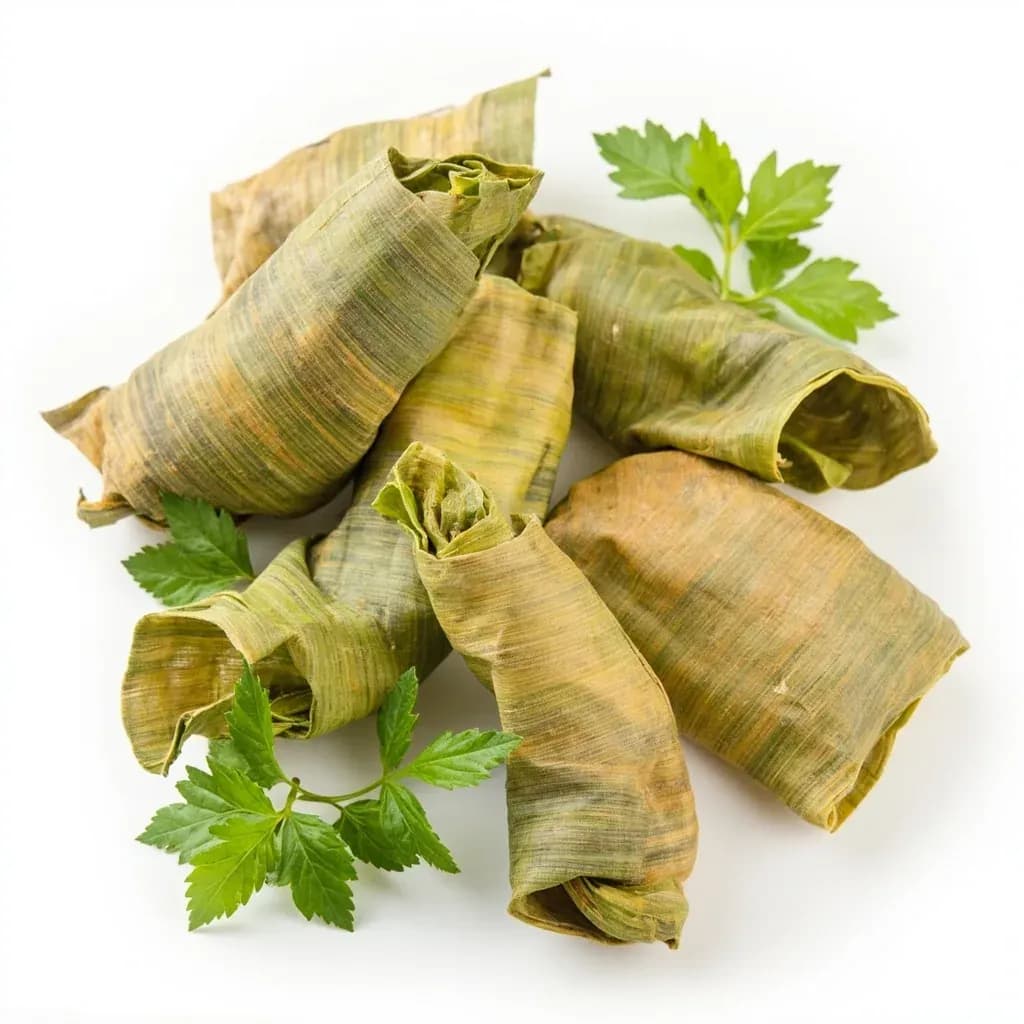
Young Coconut Leaf Wrapper (Janur)
Tender young coconut palm fronds woven to wrap rice cakes like ketupat and lontong.
Janur is the pale young leaf of the coconut palm, prized in Indonesian and Malay cooking for weaving into pouches and casings. Cooks plait it into diamond shapes for ketupat or cylinders for lontong, then fill with rice and boil so the rice cooks into a firm cake. The fresh leaf adds a faint grassy aroma and a decorative, festive shape.
Janur is the tender, still-furled leaflet of the coconut palm — picked before the young frond has opened into its familiar feathery shape. In that closed stage the leaflets are pale cream to yellow-green, smooth, and slightly waxy, with a suppleness that older coconut leaves lose the moment they harden in the sun. For cooks across Indonesia, Malaysia, Singapore, Brunei, and southern Thailand, janur is the defining wrapper of two of the region's most important rice dishes: ketupat, the diamond-woven compressed rice cake served at Hari Raya and Lebaran, and lontong, the sausage-shaped rice log that anchors everything from gado-gado to sayur lodeh.
The leaf's behavior in the pot is what makes it special. Its natural wax sheds water rather than absorbing it, so a properly woven ketupat does not boil in a soggy husk but in its own tightly held steam, picking up a faint, clean coconut note along the way. It is also forgiving of long cooking: the leaflets can take 4–6 hours of hard boiling without disintegrating, and they release the compressed rice cleanly when cut and rinsed. The trade-off is supply. Outside Southeast Asia, janur is the single hardest component to source for an authentic ketupat, which is why most overseas recipes default to banana leaf or muslin — both acceptable, neither the same.
Culturally, janur carries weight beyond the kitchen. The woven ketupat is an emblem of forgiveness and renewal at Eid, and the same young frond, split and shaped, becomes the bright yellow 'janur kuning' that decorates Javanese weddings and selamatan ceremonies. As a material it is a by-product of coconut cultivation: each palm produces several young fronds a year without harm to the tree, making it one of the more sustainable traditional wrappers still in daily use.
Alternatives
Types & varieties
Common in Malaysia and Sumatra; woven flat into a diamond or rhombus that compresses rice into a neat pillow.
The Javanese icon; a continuous pair of woven strips forms a tight 3D pouch, the diamond-shaped cake most associated with Eid.
Leaflets used whole and rolled into a tight cylinder, tied at both ends, to compress rice into a sausage-shaped log.
Smaller leaflets folded into little cones or parcels for spiced grated coconut, fish, or tempeh before steaming.
Used in parts of Sumatra to parcel fish or chicken before grilling; less common than banana leaf for this purpose.
The same young frond split and shaped into ornamental cones, arches, and tassels for Javanese weddings and selamatan; not always a food-contact use.
Sourcing and Storing Janur
In the wet markets of Jakarta, Kuala Lumpur, and Singapore, janur is sold in tight bundles of pale, still-curled leaflets, most heavily stocked in the weeks leading up to and during Ramadan, and through the Eid celebrations that follow. Outside Southeast Asia it is genuinely difficult to find; some specialty grocers and Indonesian online shops stock it refrigerated or frozen, and a few import it air-freighted in damp cloths. If you are growing your own or buying from a coconut grove, the rule is simple: take only the youngest spears whose leaflets are still pressed flat against the central rib. Older, opened fronds will crack the moment you try to bend them, and no amount of soaking will bring them back.
- Buy or pick the day you plan to wrap; fresh janur is the only kind that weaves without splitting.
- Wrap unused leaflets in a barely damp tea towel, slide into a perforated plastic bag, and refrigerate; they keep 5–7 days this way.
- Sun-dried janur is sold in some markets for decorative work; soak overnight in warm water before use, and accept that it will never match fresh suppleness.
Weaving Ketupat: What the Wrapper Demands
A tight ketupat is less about cleverness than about respecting the leaf. Each strip is a single leaflet stripped clean from the central rib; the width and length of those strips determines the final size of the cake. The traditional Javanese diamond weave uses two long strips worked in a continuous over-under pattern, locked off at the top and bottom with a small knot. Beginners should expect a dozen failed attempts before producing a pouch tight enough to hold rice under boiling — loose weaves leak starch into the pot and the rice inside never compresses properly.
- Cut all strips to the same length (trim the pointed tip and the thick base) so the finished weave sits square.
- Soak any strip that feels stiff in cool water for 20–30 minutes, then pat dry before you start — a dry leaflet snaps mid-weave.
- Strip leaflets off the rib with a sharp knife pulled along the grain, not by tearing; ragged edges split during the long boil.
- Leave a clear gap at the final tie. Rice expands as it cooks; an over-tight closure bursts the wrapper and ruins the shape.
Cooking and Unwrapping
Janur's waxy surface means a ketupat or lontong needs serious time in the pot to cook through. Rice inside a tight woven pouch is essentially pressure-cooked in its own steam, and that takes hours, not minutes. Cutting one open too early reveals a chalky, underdone center; cutting one open at the right moment reveals a firm, evenly translucent cake that releases cleanly from the leaf.
- Boil ketupat for 3–4 hours at a bare simmer for small pouches, 5–6 hours for large ones; top up the pot with boiling water to keep the temperature steady.
- For lontong, double-wrap the cylinder — a single layer leaks starch, clouds the cooking water, and turns the rice gluey.
- Lift the finished pouches into cold water for a minute before untying; the wrapper peels away cleanly instead of tearing the surface of the rice.
Common uses
Good to know
- Material
- Young leaflets of the coconut palm (Cocos nucifera), harvested before the frond fully unfurls.
- Names
- Janur (Indonesian/Malay); daun kelapa muda; occasionally 'young coconut leaf' in English recipes.
- Color
- Pale cream to light yellow-green when fresh; deepens to tan and brown with age and drying.
- Texture
- Smooth, pliable, slightly waxy, naturally water-resistant; sheds liquid rather than soaking it up.
- Typical length
- Individual leaflets run 40–80 cm before splitting; the whole young frond can reach 1–2 m.
- Primary regions
- Indonesia (Java, Sumatra, Sulawesi, Kalimantan), Malaysia, Singapore, Brunei, southern Thailand, Mindanao.
- Shelf life
- Use within 1–2 days of harvest at peak pliability; wrapped in a damp cloth and refrigerated it keeps 5–7 days.
- Sustainability
- A by-product of coconut harvesting; each palm yields several young fronds a year without being cut down.
Also called
Palm/Coconut Leaf Wrapper (Janur) · Janur · Young Coconut Frond
Related

Aluminum Foil
Wraps, covers, and tents food for the oven and grill

Parchment Paper
Nonstick liner for clean, even baking and easy release

Wax Paper
Moisture-resistant sheet for wrapping and counter prep

Plastic Wrap
Clings tight to cover bowls and wrap leftovers

Silicone Baking Mat
Reusable nonstick liner that replaces parchment

Cheesecloth
Loose-woven cloth for straining stock and bundling herbs

Beeswax Food Wrap
Reusable wax wrap that molds around bowls and produce

Piping Tips
Shaped nozzles that turn frosting into stars and rosettes