Wraps & Liners
Collagen Casing
Edible manufactured casing made from collagen for stuffing sausages and snack sticks.
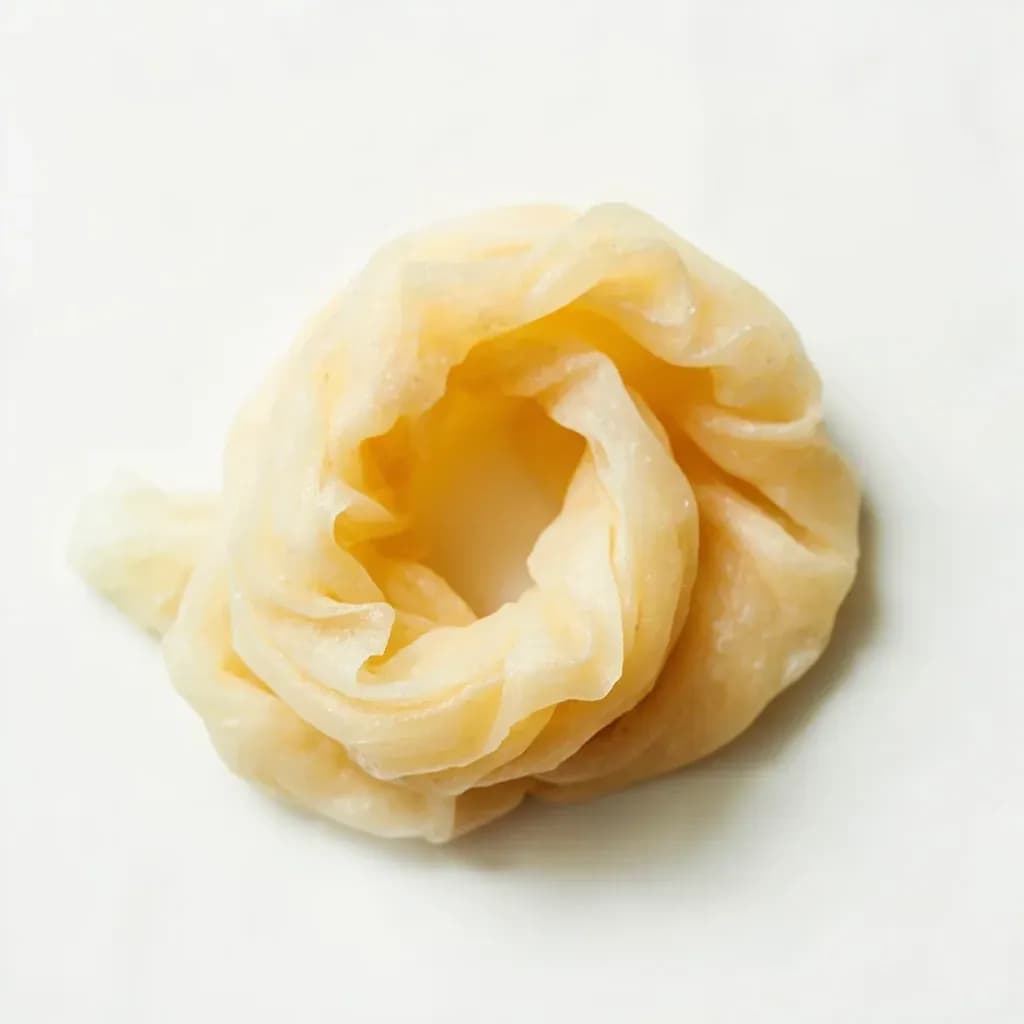
A uniform, edible casing extruded from processed animal collagen, used as an alternative to natural intestine for stuffing fresh and smoked sausages. It comes in consistent diameters and pre-cut lengths or shirred strands, giving even links and a clean bite. Collagen casings are easy to load, take smoke well, and skip the cleaning that natural casings require.
Collagen casings are extruded tubes manufactured from purified animal collagen — most commonly bovine hide split, with porcine and ovine versions also available. The hide's corium layer is ground, solubilized, and reformed into continuous tubes of remarkably uniform diameter, then dried and shipped flat or in coils. Unlike natural casings, which inherit the variability of animal intestines, collagen tubes deliver batch-to-batch consistency in size, tensile strength, and permeability, which is why they dominate the commercial snack-stick and fresh breakfast-link markets in North America.
What a cook notices most is how the casing behaves: it shrinks in lockstep with the meat during cooking, producing a tight, wrinkle-free skin; it is permeable enough for smoke and flavor exchange yet strong enough to be stuffed at moderate pressure; and it is eaten with the product in most cases. The grade you buy determines everything else — fresh (edible) grades will shrink and split once internal temperatures climb above roughly 150 °F / 65 °C, while cross-linked 'smokable' grades are engineered to tolerate thermal processing. Matching grade to recipe is the single most important decision a sausage maker makes.
Alternatives
Types & varieties
Thin-walled, for fresh breakfast sausage, bratwurst, Italian sausage, and merguez. Eaten with the product.
Cross-linked to resist heat and smoke; used for snack sticks, kielbasa, and smoked bratwurst.
Supplied with a metal loop clip already crimped at one end; designed for hanging snack sticks on a smoker rod.
Thicker, denser collagen made for dry-cured salami and summer sausage; removed (peeled) before slicing and eating.
Larger-diameter edible collagen sized to mimic natural hog casings (about 28–32 mm).
Small-diameter edible collagen (17–19 mm) used in place of natural sheep casings for snack sticks and breakfast links.
Matching Grade to Recipe
Collagen casings are engineered for a specific end use, and the wrong grade will fail in obvious ways. The two-way split is fresh versus smokable, then edible versus peelable.
- Fresh / edible: raw or poached sausages only — breakfast links, fresh Italian, bratwurst, merguez. Cannot survive a hot smoker.
- Smokable / edible: the workhorse for hot-smoked and semi-dry products — snack sticks, kielbasa, and smoked bratwurst.
- Peelable / inedible: dense tubes used to shape and hold dry-cured salami and summer sausage during long ferments and air-drying; the casing is removed before slicing.
- When in doubt, assume a standard 'edible' casing is fresh grade unless the label explicitly states 'smokable' or 'processed.'
Rehydration and Handling
Dry collagen tubes are stiff and brittle. Rehydration restores pliability and is non-negotiable; under-soaked casings split on the stuffing horn, and over-soaked ones tear under pressure.
- Submerge in cool (not warm, not hot) water for 20–30 minutes; the casing should feel soft and slippery, like a wet noodle.
- Older stock or stiff casings may need 45–60 minutes; if any area still feels paper-like, soak longer.
- Slide the open end onto the stuffing horn and let water fill the tube, then run the entire strand onto the horn — this prevents air pockets.
- Keep unused hydrated casings in a sealed container fully submerged in cool water in the refrigerator; change the water daily and use within 3–4 days.
Common uses
Tips & pitfalls
- Always rehydrate in cool — not warm or hot — water; hot water softens the casing too much and causes tearing on the stuffing horn.
- Use a stuffing horn matched to the casing diameter — a 19 mm casing needs a 10–12 mm horn for proper slip-on fit; too tight a horn blows out the casing, too loose a horn wrinkles it.
- Lubricate the horn and the outside of the casing with food-grade oil or water to prevent binding and blowouts during stuffing.
- Stuff slowly and steadily; a pneumatic or hand-crank stuffer gives far better control than a stand-mixer attachment for tight casings, and overstuffing is the single most common cause of bursting.
- Do not pierce the casing with a needle or knife during stuffing — small holes let fat and moisture escape and create 'fat-out,' a greasy, shrunken appearance after cooking.
- Choose 'smokable' casings for any recipe that goes into a hot smoker; standard fresh casings will shrink, wrinkle, and split once internal temperatures climb above 150 °F / 65 °C.
- If a casing cracks while soaking, discard it; a cracked casing will burst under stuffing pressure no matter how careful you are.
- Avoid storing dry casings in humid environments — they will absorb moisture, clump together, and lose tensile strength before you ever use them.
Good to know
- Material
- Bovine collagen extracted from hide splits (cowhide); porcine and ovine versions also manufactured
- Form
- Tubular, shipped dry and packed flat or in coils; rehydrated before stuffing
- Edibility
- Most collagen casings are eaten with the sausage; thicker 'peelable' grades are removed before slicing
- Standard soak time
- 20–30 minutes in cool water before stuffing
- Storage (unopened)
- 1–2 years in a cool, dry place, sealed in original packaging
- Storage (opened)
- Reseal in the original pouch or store fully submerged in a saturated salt brine; refrigerate brine-soaked casings
- Typical diameters
- 14–50 mm; 17, 19, 21, and 26 mm are common for snack sticks and fresh sausages
- Smoking suitability
- Only 'smokable' grades tolerate thermal processing; standard fresh casings will shrink and split in a smoker
Also called
Collagen Sausage Casing · Edible Collagen Casing
Related

Aluminum Foil
Wraps, covers, and tents food for the oven and grill

Parchment Paper
Nonstick liner for clean, even baking and easy release

Wax Paper
Moisture-resistant sheet for wrapping and counter prep

Plastic Wrap
Clings tight to cover bowls and wrap leftovers

Silicone Baking Mat
Reusable nonstick liner that replaces parchment

Cheesecloth
Loose-woven cloth for straining stock and bundling herbs

Beeswax Food Wrap
Reusable wax wrap that molds around bowls and produce

Piping Tips
Shaped nozzles that turn frosting into stars and rosettes