Storage & Containers
Date Label / Sticker
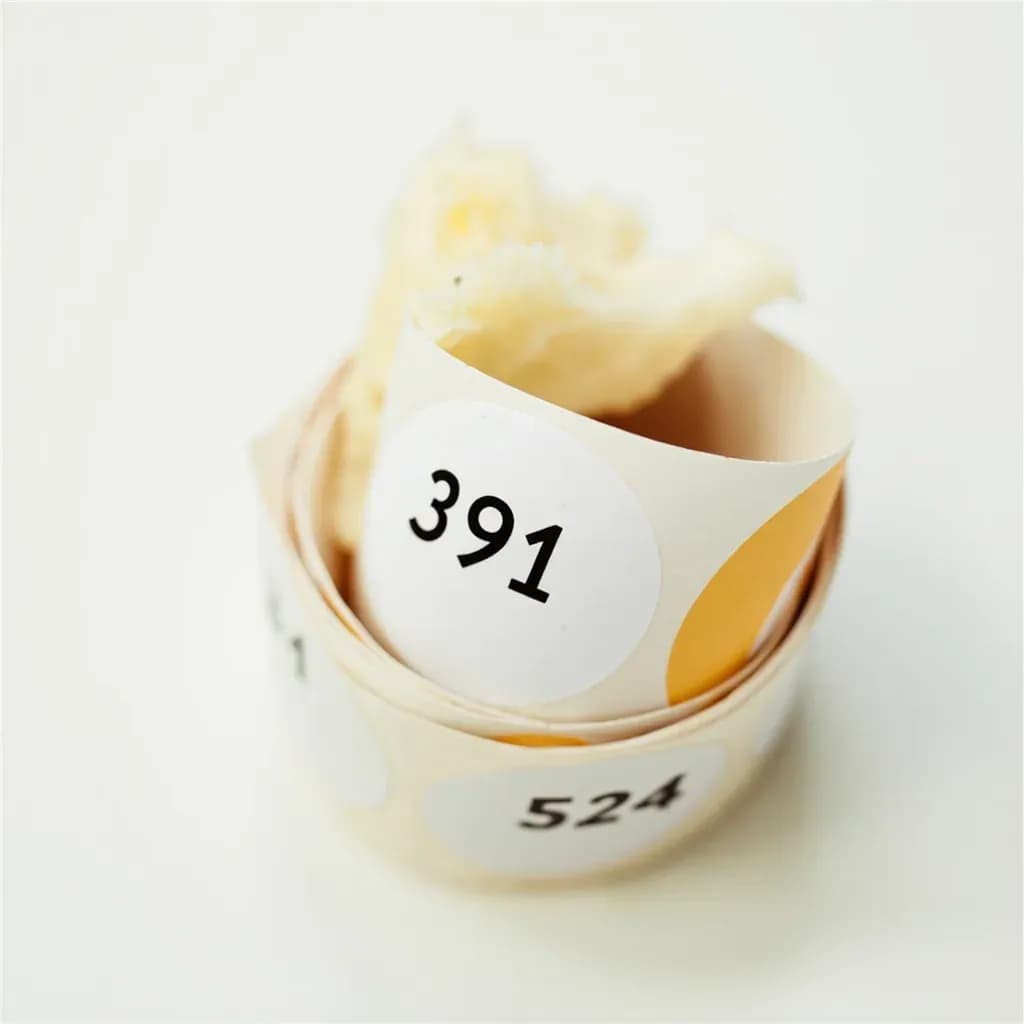
Food-safe sticker marking prep or use-by dates for stock rotation.
An adhesive label, often dissolvable, used to mark the prep date and use-by date on containers, pans, and packaged food. It underpins first-in-first-out rotation and food-safety compliance in any working kitchen. Dissolvable versions wash off cleanly in a sink, leaving no gummy residue on reusable containers.
A date label is the small but indispensable adhesive tag that turns a covered hotel pan, a deli tub, or a chest freezer bag into a trackable item. In commercial kitchens, where the FDA Food Code requires ready-to-eat TCS (Time/Temperature Control for Safety) foods held longer than 24 hours to be date-marked, these stickers are not optional. In a home kitchen, they are the simplest tool for enforcing FIFO (first in, first out) rotation, keeping leftovers visible against the back of the fridge, and turning a black hole of a chest freezer into something you can actually inventory.
What separates a true date label from a strip of masking tape is the adhesive: a food-safe, often FDA-compliant glue that holds at refrigerator or freezer temperatures, leaves no residue on reusable containers, or — in the dissolvable form — washes off in 30 to 90 seconds in a commercial dishwasher. The face stock matters too. Plain paper works for short-term dry storage; synthetic polypropylene or vinyl is needed for blast chillers, walk-in freezers, and anything that will sweat or frost over.
Used well, a date label is a one-second decision that prevents a five-minute guessing game three days later. Used carelessly — wrong date format, wrong placement, faded ink, lid-only labeling — it becomes wallpaper, and the dates mean nothing.
Alternatives
Types & varieties
Adhesive and paper dissolve in 30–90 seconds in water or a commercial dishwasher; the standard choice for reusable plastic containers, deli tubs, and hotel pans.
Pre-printed with a weekday name in one- or two-week formats; allow line cooks to mark a container in seconds during service.
Peel off cleanly without residue; suited to glass jars, Cambro lids, and equipment surfaces that are repeatedly reused.
Strong bond for long-term storage such as walk-in shelving, bulk dry-goods bins, and freezer inventory that will not be moved.
Plain or ruled fields for handwritten prep/use-by dates, contents, and initials; flexible enough for any rotation system.
Destructible film that tears if peeled; used on takeout containers, drug storage, and allergen-controlled meals.
Used with handheld or countertop thermal printers in high-volume operations; print date, time, item name, and employee code automatically.
Pre-printed 'Contains: peanut / dairy / gluten' or 'Vegan / Kosher / Halal' style stickers, often color-coded for instant recognition.
Synthetic face stock with low-temp adhesive rated to -40°F/-40°C; stay attached and legible inside blast chillers and walk-in freezers.
The 7-Day Rule Explained
The 7-day hold time is the most commonly cited number in American commercial kitchens, and it is worth understanding precisely. Under the FDA Food Code, ready-to-eat TCS food prepared on site and held at 41°F (5°C) or below may be served up to 7 days from the day of preparation, with the day of prep counted as Day 1. The clock does not restart if the food is moved, re-portioned, or transferred to a clean container. Many European codes use a tighter 3-day window for cooked chilled foods, and several categories — cooked rice, sliced deli meats, cut melon, raw fish — begin to lose margin well before the 7-day ceiling. Treat the date label as a legal maximum, not a comfort zone.
- Day of prep = Day 1; 7 days later is the discard trigger.
- Combining a date label with a prep time and employee initial gives full HACCP traceability.
- Re-dating is not allowed: once the original date passes, the food is out of spec.
Color Coding and Its Limits
Day-of-week color labels gained popularity in US food service during the 1970s and 80s and became near-universal with HACCP adoption in the 1990s. The North American palette (red Monday through black Sunday) is the most common, but UK and Australian kitchens often use different colors, and some operations split the week using solid versus striped patterns to extend the same roll across a 14-day cycle. Color coding is fastest at the line — a cook can slap a red dot on a prep pan without breaking stride — but it has two real limits. It tells you the day of prep, not the time, and it is useless for any food held more than seven days. For freezer inventory or long cures, write the full date.
- Pre-printed color dots are a speed tool, not a substitute for a written date on long-hold items.
- Train new staff on your specific color map; do not assume the palette is universal.
- Keep a backup roll of blank writable labels for anything that does not fit the day-dot system.
Dissolvable Labels: The Labor-Saver
Dissolvable labels were developed in the 1980s specifically to cut container-wash labor in high-volume operations. Both the paper and the adhesive break down in warm water, which means a stack of soiled Cambros does not need to be picked, scrubbed, and scraped before it goes through the dishwasher. They do, however, fail in two predictable ways: they dissolve prematurely if they get wet before use, and they can clog wash tanks if loaded dry and left to accumulate. Pre-soak heavily labeled containers in warm water for a minute before they enter the machine, and store the roll in a dry drawer.
- Pre-soak heavily labeled containers for 60 seconds before dishwashing.
- Keep the roll sealed and dry; humidity causes the edges to stick together.
- Use dissolvable labels only on containers that will be washed within a day or two of soiling.
Common uses
Tips & pitfalls
- Adopt one consistent date format and use it everywhere — ISO 8601 'YYYY-MM-DD' is unambiguous and is increasingly the default in trained kitchens.
- Place the label on the side or front edge of the container, never on a food-contact surface, and never directly on a film seal that will be removed before service.
- Use a permanent marker specifically designated for labels; ballpoint pens smear on many plastic surfaces and label stocks.
- On walk-in shelves, place the date label at the front edge so it remains visible as the container is pulled forward — labels on the lid disappear the moment something is stacked on top.
- Re-tape or re-label containers whose date labels have come off during handling, but treat any container you find with no label at all and no known prep date as a discard trigger rather than a guess.
- Combine a day-of-week color label with a short handwritten time and employee initial for full traceability in a HACCP audit.
- Pair date labels with sensory checks and calibrated thermometer readings; a date is a tool, not a guarantee of safety, and cooked rice, sliced deli meat, and cut melon often need to be discarded well before the 7-day mark.
- For freezer storage, write the date in a high-contrast marker — black on white works best — because frost obscures pale inks and makes dates unreadable within weeks.
Good to know
- Item type
- Food-safe adhesive label for marking prep, use-by, sell-by, or expiration dates on containers, packaging, and storage vessels.
- Primary materials
- Paper or synthetic face stock (polypropylene, vinyl) with FDA-compliant adhesive; dissolvable versions use water-soluble adhesive on pulp paper.
- Common sizes
- 1" x 2" and 1.5" x 2" rectangles are standard; 1" round dots and 2" x 3" rectangles are also common. Commercial rolls typically hold 500–1,000 labels.
- Regulatory context (US)
- FDA Food Code §3-501.17 requires date marking on ready-to-eat TCS foods held longer than 24 hours; the Food Code updates on a 4-year cycle.
- Maximum hold time (US commercial)
- 7 days at 41°F (5°C) or below, counting the day of preparation as Day 1.
- Freezer / microwave tolerance
- Synthetic and dissolvable labels are generally freezer-safe to -40°F (-40°C); plain paper labels are not microwave-safe and can char or ignite.
- Day-of-week color code (North America)
- Mon = red, Tue = orange/tan, Wed = yellow, Thu = green, Fri = blue, Sat = purple, Sun = black, with two-week systems using solid vs. striped patterns to distinguish weeks.
- Notable commercial brands
- Daydots, National Checking Company, Avery, and ITW (Hobart legacy) are the major suppliers; generic equivalents are widely available.
Also called
Labels / Date Stickers · Date Stickers · Dissolvable Date Labels · Date Label Sticker · Day Dot
Related

Freezer Bags
Thick, sealable bags built to fight freezer burn

Storage Bags
Resealable bags for fridge storage and marinating

Storage Container
Lidded container for leftovers, prep, and meal kits

Glass Container
Oven-to-fridge glass that won't stain or hold odors

Plastic Container
Lightweight, stackable storage for everyday leftovers

Vacuum Sealer Bags
Airtight bags for long freezing and sous-vide

Reusable Bags
Washable silicone bags that replace single-use plastic

Mason Jar
Sealed glass jar for preserves, pickles, and storage