Heat & Safety
Diatomaceous Earth (Filter Media)
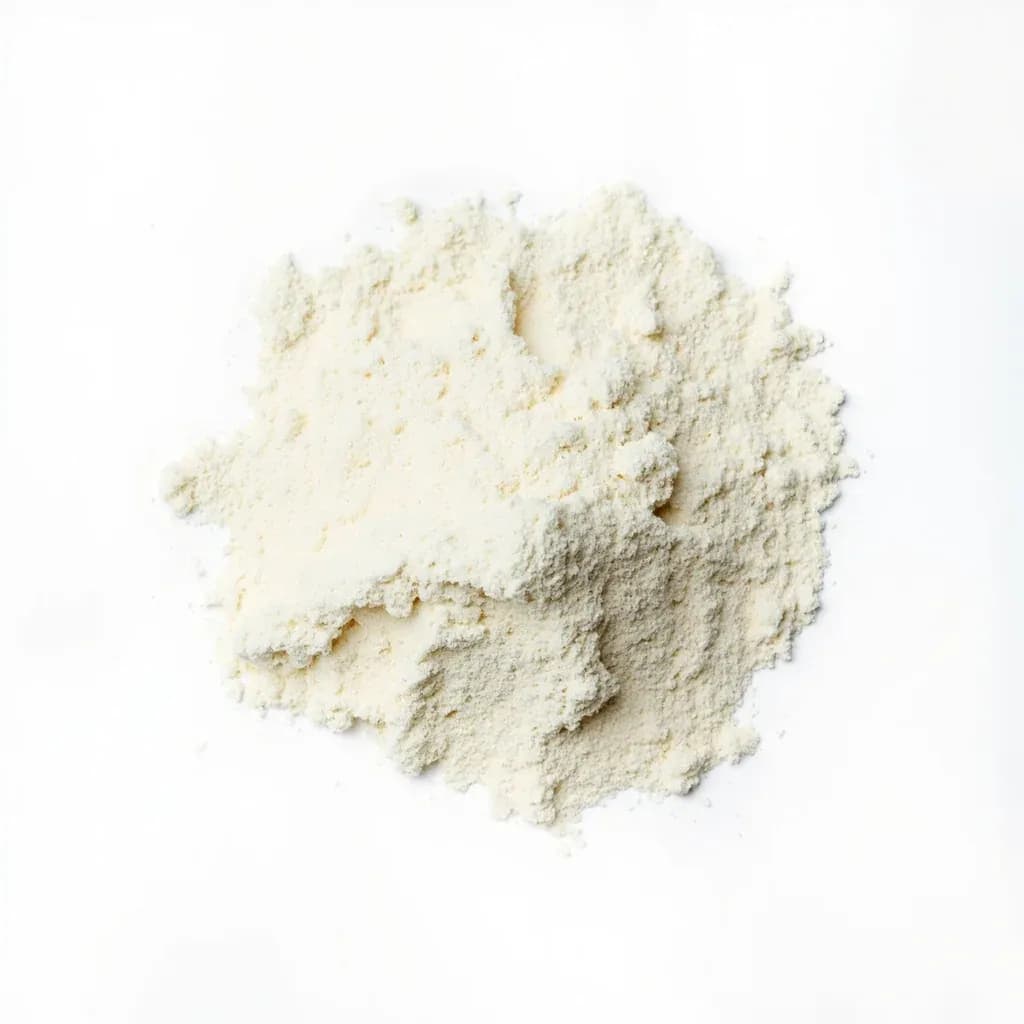
Fine fossil-diatom powder used as a filter aid to clarify beer, wine, and oils.
A fine powder of fossilized diatom shells used as a filter aid to polish liquids to brilliant clarity. In brewing, winemaking, and oil refining it coats a filter screen and traps yeast, haze, and fine sediment as liquid passes through. Only food-grade DE is used; the inhalable dust requires a mask during handling.
Diatomaceous earth is the powdered, fossilized remains of diatoms — microscopic, single-celled algae whose silica skeletons settled on ancient sea floors into deposits sometimes hundreds of feet thick. Mined from those beds (most famously near Lompoc, California), the powder that reaches a brewery, winery, or commercial kitchen is almost pure amorphous silicon dioxide: chalky white to pale buff, light enough to float on water when first added, and chemically inert. In food and beverage work, DE is treated as a filter aid rather than a filter — a powder that builds a working surface rather than a fabric or membrane that comes ready-made.
What makes DE effective is the structure of those tiny diatom shells. Each grain is riddled with pores and channels at the micrometer scale, so when a slurry of DE is deposited on a filter support, the resulting cake is a labyrinth of voids and surfaces. Liquids pass through, but yeast cells, protein particles, hop polyphenols, and other haze-forming solids lodge throughout the matrix. Because trapping happens at depth, not just on the top surface, DE is a depth filter — and the cake itself is the active medium. That is also why brewers and winemakers speak of pre-coating the filter and body-feeding the stream: they are building and maintaining a working cake, not just passing liquid through a screen.
For a cook, brewer, or small producer, DE earns its place when clarity matters and a cartridge or pad filter is not quite enough — bright beer, polished wine, clear cooking oil, sparkling cider. The trade-off is real, however: dry DE is a serious respiratory hazard, the food-grade version is the only one that belongs anywhere near food, and dialing in the right grade and rate takes a little practice.
Alternatives
Types & varieties
Coarse, high-permeability grade; fast flow rate, used for rough clarification and as a pre-coat.
Intermediate grade balancing flow and clarity; widely used as a body-feed medium.
Very fine, flux-calcined grade producing highly polished, bright filtrate — the classic bright-beer polish.
Long-established fine natural-calcined filter aid used in wine and beverage work.
Fine natural-calcined filter aid, intermediate between Standard Super-Cel and 545 on the flow-versus-clarity curve.
Lighter color and lower bulk density; milder processing but retains more crystalline silica and is less common as a filter aid.
Heat-treated to burn off organics and lighten color; the typical filter-aid form for food and beverage use.
High-temperature processing that sinters particles into agglomerates; the basis of the finest polishing grades such as 545.
How a DE filter cake works
A DE filter is not the screen or pad beneath the cake — it is the cake itself. When a thin slurry of DE is circulated over a filter support (a plate, a leaf, a candle, or a pad), the diatom grains bridge across the openings and stack into a porous layer a few millimeters thick. Liquid then has to wind through the channels between and inside the grains, and that tortuous path is what traps particulates. Because trapping happens throughout the depth of the layer, the cake can absorb a great deal of solid load before flow collapses — but it will eventually blind, and that is what body-feeding is for. Adding a small amount of DE to the incoming product keeps the cake permeable by interleaving fresh porous grains with the solids being filtered, extending the run considerably. Two-stage filtration — a coarser pre-coat and a finer polish, or a coarse body feed followed by a fine body feed — is the standard industrial pattern for this reason.
- The cake is the active medium, not the support beneath it.
- Pre-coat first to build a clean, uniform layer; then add body feed to keep that layer from blinding with the product's own solids.
- Finer grades trap smaller particles but at the cost of flow rate — expect to balance clarity against throughput for every product.
Choosing a grade
DE grades are numbered (and sometimes named) by permeability: the higher the number, the finer the particles, the slower the flow, and the brighter the filtrate. A brewer doing a rough polish of a hazy farmhouse ale might reach for Celite 512 or Standard Super-Cel in the body feed; the same brewery finishing a pale lager for packaging will turn to Celite 545. Switching grades is not a small decision — moving from a coarse grade to a fine one can strip hop aroma and delicate fruit character right along with the haze, which is why the standard advice is to test a small batch whenever you change grades, and to keep filtration as coarse as the target clarity allows.
- Coarse grades (e.g., 512) — fast flow, rough clarification, good for pre-coat and high-solids body feed.
- Intermediate grades (e.g., 503, Hyflo Super-Cel) — the workhorse range for general beer and wine clarification.
- Fine grades (e.g., 545) — slow, polishing filtration for bright, shelf-stable beer and clear oils.
- When in doubt, start coarser than you think you need; you can always run the filtrate through a second pass.
Common uses
Tips & pitfalls
- Always wear an N95 or, preferably, a P100 respirator (not a paper dust mask) when scooping, pouring, or mixing dry DE — the respirable crystalline-silica fraction is a serious inhalation hazard.
- Use only food- or beverage-grade filter DE. Pool/spa-grade DE is a different product and is not approved for contact with anything people will drink.
- Always pre-mix DE into a smooth slurry with cold water (or with beer or wine, in context) before introducing it to the filter or vessel. Dry-dumping DE into a tank is a common mistake that produces clumps the filter cannot disperse.
- Pre-coat the filter with slurry and recirculate it through the system until the runoff runs clear before you divert to product. The first cloudy liquid contains channeled DE, not finished product.
- Add body feed gradually and in proportion to the solids load: too little and the cake blinds quickly, too much and you waste filter aid and slow flow unnecessarily.
- Store DE bone-dry in a sealed container. Moisture causes hard lumps that will not disperse and will plug the filter the moment they hit the slurry tank.
- For beer, make slurries with de-aerated or CO₂-purged water to minimize oxidation pickup during filtration.
- If a DE filter is left standing overnight, drain it fully and rinse with cold water; residual sugar and protein will sour in the cake and contaminate the next batch.
- Discard the first and last fractions of any DE-filtered run if clarity or flavor profile looks off; mid-run is the sweet spot.
- Test a small batch first when switching grades — moving from a coarse to a fine grade can strip flavor and hop aroma along with haze.
Good to know
- Composition
- Fossilized skeletons of diatoms (single-celled aquatic algae), composed primarily of amorphous (non-crystalline) silicon dioxide (SiO₂).
- Solubility
- Insoluble in water, acids, and most organic solvents; chemically inert in normal use.
- Particle size range
- Typically 1–100 μm depending on grade; permeability and median pore size vary widely between numbered grades.
- Processing types
- Natural (uncalcined) DE; calcined DE (heat-treated to reduce volatiles and lighten color); flux-calcined DE (mixed with flux and fired, producing higher-bulk-density material used for fine polish).
- Pre-coat rate
- Roughly 1–2 lb per 10 ft² (≈0.5–1.0 kg/m²) of filter surface, applied as a slurry and recirculated until runoff runs clear.
- Body-feed rate
- Roughly 0.5–2 lb per 100 US gal (≈0.6–2.4 g/L) of product, adjusted up for high-protein or unfiltered beer.
- Food vs. pool grade
- Food/beverage-grade filter DE is approved for contact with consumables; pool/spa-grade DE is a different, non-food product and must never be used to filter anything people will drink.
- Respiratory hazard
- Dry handling generates respirable crystalline silica (especially cristobalite in calcined grades); chronic inhalation can cause silicosis. An N95 or, preferably, a P100 respirator is essential when handling the dry powder.
Also called
DE Filter Media · Kieselguhr · Filter Aid Powder
Related

Paper Towels
Disposable sheets for spills, drying, and patting dry

Kitchen Towels
Reusable cloths for drying, gripping, and wiping

Oven Mitts
Heatproof gloves to handle hot pans and trays safely

Disposable Gloves
Single-use gloves for safe, mess-free handling

Cleaning Cloths
Reusable cloths for wiping counters and spills

Tortilla Warmer
Insulated holder that keeps tortillas warm and soft

Trivet
Heatproof stand that shields surfaces from hot pots

Ice Bath Setup
Bowl of ice water that halts cooking and sets color