Storage & Containers
Dish Drying Rack
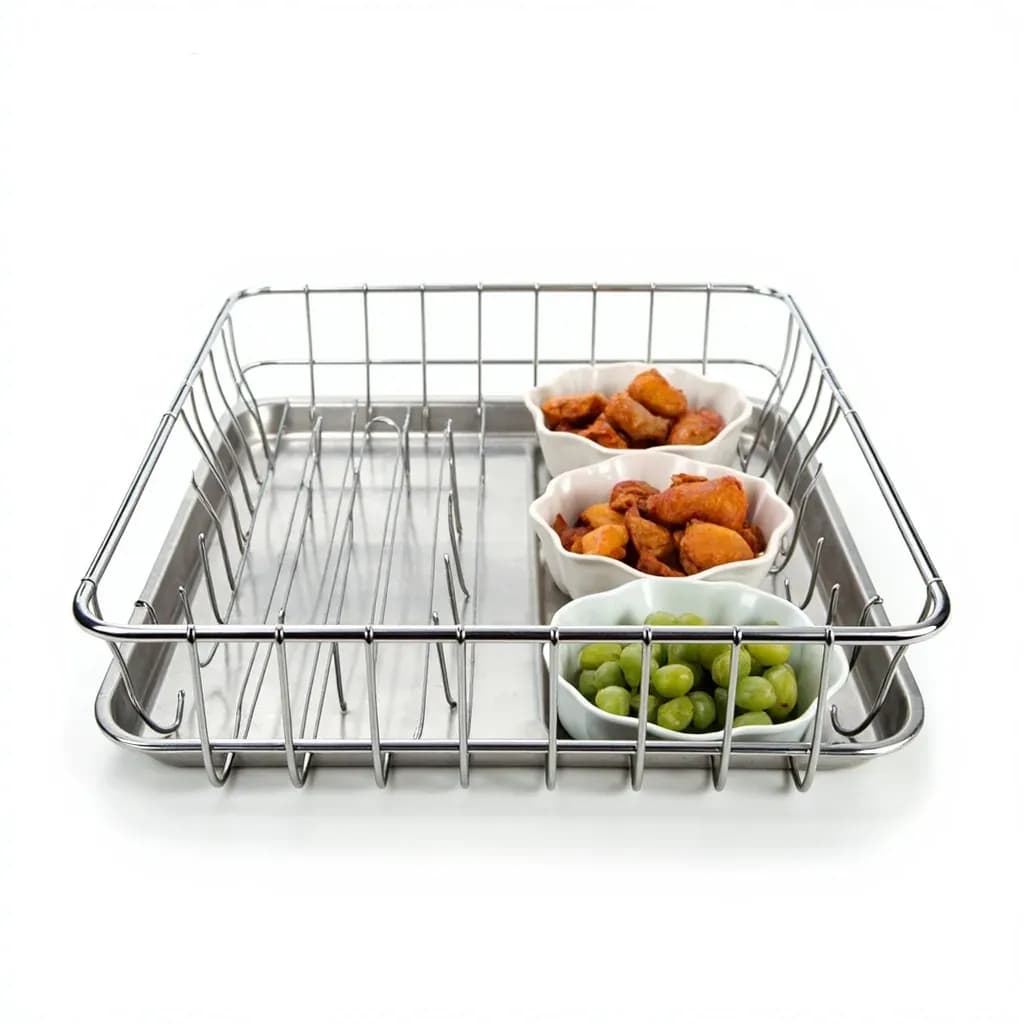
A slotted rack that holds washed dishes upright so they air-dry and drain.
A dish drying rack is a slotted metal or plastic frame that stands beside the sink to hold clean dishes, plates, and utensils. Items lean upright so water drains into a tray or directly into the sink and air circulates to dry them. Many include a removable cutlery cup and a drip tray that empties easily.
A dish drying rack is, at heart, a passive drying system: a slotted frame that holds washed dishware at the angle gravity needs to pull water off, with a drip tray underneath to catch what falls and let it evaporate or drain away. It is the hand-washing equivalent of what a dishwasher does by machine — draining, evaporating, and keeping dishes off a wet countertop — and it remains a daily workhorse in any kitchen without a dishwasher, and a useful adjunct even where one exists.
The design choices that matter most are easy to miss at a glance. Material grade determines whether the rack will rust onto your plates in two years or quietly last a decade; 304 stainless steel or a quality coated wire is the standard worth paying for. Drainage geometry matters even more: a flat tray under the rack is a mildew farm, while a truly sloped tray with a spout that overhangs the sink keeps water moving out of the kitchen entirely. Small parts — the utensil caddy, the drip tray — should lift out for cleaning, because that is where biofilm accumulates fastest.
In a working kitchen the rack earns its footprint by handling not just dinnerware but cutting boards, produce, lids, and the occasional mid-cycle dishwasher landing zone. Wood and bamboo versions look beautiful on an open counter but demand the most careful drying habits; stainless and high-grade plastic are the workhorses. Capacity claims on the box assume a tidy tower of plates — once bowls, mugs, and a saucepan join the load, expect to use roughly a third more space than the rating suggests.
Alternatives
Types & varieties
The classic freestanding style with a drip tray; sits beside or partly over the sink.
Spans the sink basin so water drains straight into the plumbing and counter space is reclaimed.
A flat silicone-and-steel grid that rolls up for storage and doubles as a trivet.
Upper tier for bowls, mugs, or a cutting-board slot; roughly doubles capacity on the same footprint.
Drains into a fixed channel; common in small apartments and commercial kitchens.
Built into a false-front drawer; drains through a bottom channel into a removable tray.
Aesthetic and naturally antimicrobial when oiled; must be kept dry to prevent mold.
Restaurant-kitchen workhorse; durable and hygienic when made from grade 304 steel.
Light, inexpensive, and often top-rack dishwasher-safe; prone to staining and cracking over time.
A wire basket that slides out of a base cabinet; standard in many European kitchens.
Choosing a material
Material is the single best predictor of how long a rack will last and how much upkeep it will demand. The trade-offs are real, and the right answer depends on your counter, your water, and how much you want to fuss over it.
- Grade 304 stainless steel: the standard for rust resistance and longevity (10+ years). Avoid racks labelled simply 'stainless' with no grade — lower-chrome steel will rust noticeably faster, often within a year or two in a wet environment, and can leave orange marks on dishes.
- Chrome-plated wire: lighter and cheaper than solid stainless, but the plating fails first at welds and bends. Hand-dry after washing to stretch its life to 4–6 years.
- Bamboo and beech: warm-looking and biodegradable, with natural antimicrobial properties. They need monthly oiling with food-grade mineral oil and must never go in the dishwasher. Expect 2–5 years of service.
- BPA-free plastic: cheapest and often fully top-rack dishwasher-safe, but prone to staining from turmeric, tomato sauce, and coffee, and to surface micro-crazing after 2–4 years.
Drainage geometry — the detail that decides whether the rack works
The drip tray is where most racks fail in daily use. A flat pan under the tines holds a permanent puddle and grows biofilm within days; a properly sloped tray with a spout aimed into the sink keeps water moving and the rack nearly self-maintaining. When shopping, tilt the rack in the store (or look closely at product photos) and check for a clear tilt toward a defined spout — not a flat tray with a removable grid sitting inside. The single best habit, once you own one, is to position the spout so it overhangs the sink; this turns a daily chore (emptying the tray) into a non-event.
Common uses
Tips & pitfalls
- Position the rack so the drip-tray spout overhangs the sink — a flat tray that pools water grows mildew within days and develops an off smell that transfers to clean dishes.
- Empty and wipe the drip tray every day; standing water is the main source of odor and the biofilm that recontaminates the rack.
- Hand-dry the metal frame after cleaning it; trapped moisture under the tray is what makes chrome and lower-grade stainless rust through.
- Don't stack dishes face-down flat against one another — water pools in the contact ring and leaves spots. Lean each piece against its own tine or slot.
- Set glassware at a slight downward angle on the tines so the interior drains instead of holding a puddle that deposits minerals on the bottom.
- Oil wood and bamboo racks monthly with food-grade mineral oil and never put them in the dishwasher; soaking is the fastest way to split the joints.
- Reserve a dedicated slot or bin for knives — tines dull edges quickly, and blade-down storage prevents cuts when unloading.
- Deep-clean the utensil caddy weekly by removing it and running it through the dishwasher or scrubbing it in hot soapy water; it harbors more bacteria than the rest of the rack combined.
- If the rack leaves rust marks on dishes, the steel is likely a low-chrome grade; switch to 304 stainless or a coated rack.
- In hard-water areas, wipe spots off dishes with a microfiber cloth before they fully dry to avoid mineral scale.
Good to know
- Primary function
- Holds washed dishware upright so gravity drains water into a drip tray while air circulation finishes drying.
- Core components
- A slotted or ridged main rack, a drip tray (ideally sloped with a drain spout), and usually a separate utensil caddy or knife slot.
- Common materials
- Stainless steel (grade 304 for true rust resistance), chrome-plated wire, BPA-free plastic, bamboo or beech, and food-grade silicone over a steel core.
- Typical capacity
- A standard single-tier countertop rack holds roughly 10–15 plates plus a few bowls, mugs, and a small utensil bin.
- Countertop footprint
- Most freestanding racks are 36–50 cm (14–20 in) wide and 30–40 cm (12–16 in) deep; two-tier versions stand 35–45 cm tall.
- Drainage direction
- Better freestanding racks tilt the tray toward a spout that overhangs the sink; flat-tray designs rely on manual emptying and grow mildew quickly.
- Dishwasher-safe parts
- On quality models, only the drip tray and utensil caddy are top-rack dishwasher-safe; the frame itself is hand-wash only.
- Approximate price range
- Budget plastic from around $15; mid-range stainless or bamboo $30–$80; premium brands (Simplehuman, Brabantia, Joseph Joseph) $80–$200.
Also called
dish-rack · Drying Rack · Plate Rack
Related

Freezer Bags
Thick, sealable bags built to fight freezer burn

Storage Bags
Resealable bags for fridge storage and marinating

Storage Container
Lidded container for leftovers, prep, and meal kits

Glass Container
Oven-to-fridge glass that won't stain or hold odors

Plastic Container
Lightweight, stackable storage for everyday leftovers

Vacuum Sealer Bags
Airtight bags for long freezing and sous-vide

Reusable Bags
Washable silicone bags that replace single-use plastic

Mason Jar
Sealed glass jar for preserves, pickles, and storage