Heat & Safety
Disposable Cutlery
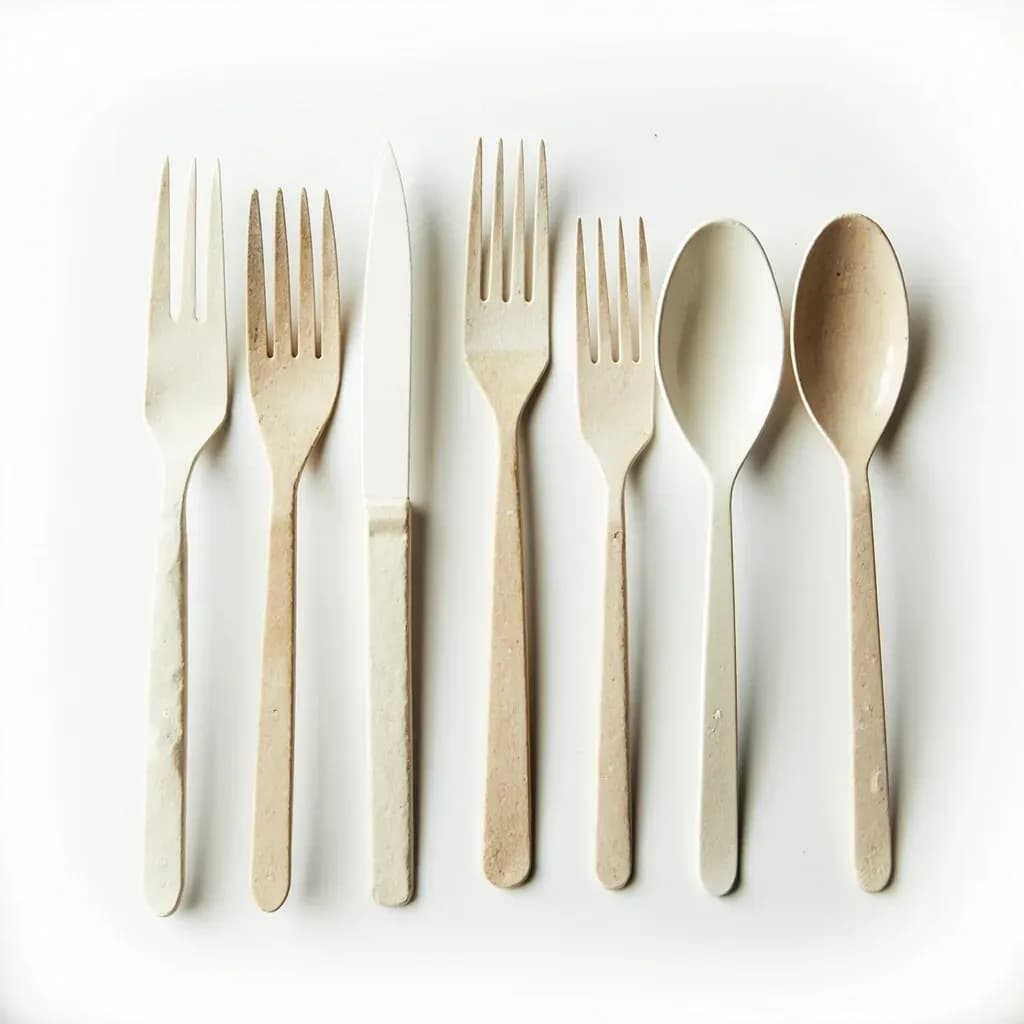
Single-use forks, knives, and spoons for serving, tasting, and events.
Single-use forks, knives, and spoons of plastic, wood, or compostable fiber, supplied for events, sampling, and takeout service. In a working kitchen they also serve as throwaway tasting and portioning tools where washing is impractical. Compostable and wooden versions are increasingly chosen over plastic for sustainability.
Disposable cutlery — single-use forks, knives, spoons, sporks, and the specialty tools that show up alongside them — is a working ingredient in any kitchen that caters, packs to-go meals, runs a tasting bar, or feeds a crowd. The category looks trivial until you actually have to choose: a fork that bends in a cassoulet, a spoon that softens in broth, or a "biodegradable" handle that sits in a landfill for a decade are all common, expensive mistakes. Picking the right disposable is really a small materials decision disguised as a service decision.
The single most important variable is temperature. Polystyrene and standard PLA begin to deform in roughly the 55–80 °C (130–175 °F) range, which rules them out for anything served hot. Polypropylene, CPLA, wood, bagasse, and palm leaf are the materials that survive a hot main course, a ladle of stew, or a fresh-poured coffee. Match the utensil to the food and a disposable fork feels like a real fork; miss the match and the dish arrives with a bent, leaching implement in it.
The second decision is environmental, and it is murkier than the marketing suggests. Most disposables labeled biodegradable or compostable — including PLA, CPLA, and many wood or bagasse products — are certified only for industrial composting (ASTM D6400, EN 13432, BPI mark) and need sustained heat and humidity to break down. Thrown in a landfill, a backyard pile, or a region that does not accept PLA in its organics stream, they behave like ordinary plastic. Buy for the disposal stream you actually have, not the one the box advertises.
Alternatives
Types & varieties
Rigid, glossy, low cost; the classic party and catering look. Cold and room-temperature foods only.
Milky, slightly flexible, higher heat tolerance; common for hot soups, takeaway mains, and coffee stirrers.
Plant-starch bioplastic that looks nearly identical to PS. Loses shape above about 60 °C — keep away from hot liquids.
Heat-treated PLA rated for hot foods up to roughly 90 °C; the closest visual match to traditional plastic in a compostable form.
Smooth sanded finish with a natural look. Birch is the standard; bamboo is denser; poplar is the budget option. Cheap pieces can splinter at the tine tips.
Molded from the fibrous pulp left after juice extraction. Sturdy, microwave-tolerant, and a strong choice for hearty or wet foods.
Pressed from areca palm leaf sheath; no two pieces look alike. The sturdiest and most heat-tolerant bio-disposable, but premium priced.
Common for spoons, soup spoons, and stirrers; weak and rarely used for knives.
Hybrid fork-and-bowl tool; standard for festival, quick-service, and bulk-pack use.
Short, often two-pronged, used for sample flights, buffets, and passed canapés.
Narrow, sometimes two-pronged, designed for shellfish and cocktail service.
Baked from rice, sorghum, or wheat flour; eaten after use. Available in plain, sweet, or savory flavors.
Matching Material to Temperature
The temperature of the dish you are serving should drive the material you buy, not the look of the box. This is the most common source of failures on a buffet line or in a delivery bag.
- Cold and room-temperature service (salads, charcuterie, cheese boards, cold desserts, cocktail canapés): PS and PLA are fine and the cheapest option.
- Hot service up to ~90 °C (steamed vegetables, rice dishes, pasta, soups just below a boil): CPLA, wood, bagasse, or palm leaf. PP also works but reads as plastic.
- Hot service above ~90 °C (boiling stews, freshly brewed tea or coffee, oven-to-table trays): PP, bagasse, or palm leaf only.
- Never ladle hot food into a PS or standard PLA container you also intend to stir or eat from with that same disposable.
What 'Compostable' Actually Means
Almost every certified compostable disposable is certified for industrial composting, not backyard piles or landfill conditions. The certification tells you the material is designed to break down, not that it will break down in your trash.
- ASTM D6400, ASTM D6868 (for coated paper), and EN 13432 cover North American and European industrial compostability respectively.
- The BPI mark is the most common US indicator; look for it on the box, not just the word "compostable" in the marketing.
- Industrial facilities run 131–160 °F (55–71 °C) with controlled humidity and aeration — conditions a backyard pile cannot sustain year-round.
- If your waste hauler does not accept PLA, your "compostable" forks will go to landfill and persist like conventional plastic for years.
- Wood and bagasse without polymer coatings are the safest bets in regions with limited industrial composting, since they break down faster in lower-temperature systems.
Sourcing and Storage Checklist
A few habits separate a disposable program that works from one that fails on a busy Saturday night.
- Ask for FDA 21 CFR or EU 10/2011 documentation when buying PLA, CPLA, or any imported wooden cutlery — cheap unbranded stock is where food-contact problems show up.
- Order a sample case of any new supplier and stress-test it: submerge a fork in hot broth, snap a knife at the joint, and press the tines into a dense grain bowl.
- Store disposables flat and dry. Humidity warps wood and bagasse and degrades PLA over a season, so keep them off concrete floors and out of steam rooms.
- Keep a small stock of reusable metal cutlery as backup; catering orders arrive short-counted or with cracked forks more often than suppliers admit.
- Buy by weight grade, not just by case count. A 4 g polypropylene fork outperforms a 2.5 g polystyrene fork in almost every real dish.
Common uses
Tips & pitfalls
- Match the material to the food temperature: never serve hot soup, stew, or freshly brewed tea in polystyrene or standard PLA — they soften and can leach.
- For any hot main, default to PP, CPLA, wood, bagasse, or palm leaf rather than PS, regardless of how the box is marketed.
- Bagasse and palm leaf handle dense, sauced, or grilled items far better than the same thickness of PS or PLA — a real difference in a short rib or a saucy pasta.
- CPLA is the closest visual stand-in for traditional plastic; pair it with kraft plates and unbleached napkins for a high-end compostable place setting.
- Heavier-gauge forks (sold as "heavyweight" or "premium") bend less and read as more substantial to diners — worth the small upcharge for plated events.
- Inspect wood cutlery along the tine edges before buying bulk; cheap pieces splinter and will end up in the complaint line, not the dish.
- Do not assume "biodegradable" means backyard-compostable; almost all certified disposables need an industrial facility to break down in any reasonable time.
- Check local waste hauler rules before buying PLA — many regions exclude it from standard organics streams, which defeats the sustainability pitch.
- For tasting flights and cocktail forks, choose shorter lengths (8–10 cm) so guests can manage them in one hand while holding a glass.
- Keep a small backup of reusable or metal cutlery for VIPs and last-minute course changes; disposables can arrive damaged or short-counted.
Good to know
- Standard length
- Dinner-size forks, knives, and spoons measure roughly 15–18 cm (6–7 in); tasting and cocktail sizes run 8–10 cm (3–4 in)
- Polystyrene (PS)
- Softens around 70–80 °C (160–175 °F); cold and room-temperature foods only
- Polypropylene (PP)
- Stable to roughly 120 °C (250 °F); the standard choice for hot-fill and takeaway hot meals
- PLA / CPLA
- PLA softens near 55–60 °C (130–140 °F); CPLA tolerates hot foods up to about 85–90 °C (185–195 °F)
- Bagasse & palm leaf
- Bagasse is microwave-tolerant to ~100–120 °C; palm leaf tolerates boiling water and brief oven contact — the toughest bio-based options
- Weight grades
- Typically sold as light (~2–3 g), medium (~4 g), and heavyweight (~5–6 g+) per fork; heavier gauges resist bending in dense foods
- Compostability standards
- ASTM D6400 / D6868 (US) and EN 13432 (EU) certify industrial compostability; BPI is the common US certification mark
- Cost tier
- Plastic (PS/PP) is cheapest, then PLA/CPLA and wood, with palm leaf the most expensive
Also called
Disposable Cutlery Kit · Disposable Plastic Utensil · Single-Use Cutlery · Plastic Flatware
Related

Paper Towels
Disposable sheets for spills, drying, and patting dry

Kitchen Towels
Reusable cloths for drying, gripping, and wiping

Oven Mitts
Heatproof gloves to handle hot pans and trays safely

Disposable Gloves
Single-use gloves for safe, mess-free handling

Cleaning Cloths
Reusable cloths for wiping counters and spills

Tortilla Warmer
Insulated holder that keeps tortillas warm and soft

Trivet
Heatproof stand that shields surfaces from hot pots

Ice Bath Setup
Bowl of ice water that halts cooking and sets color