Storage & Containers
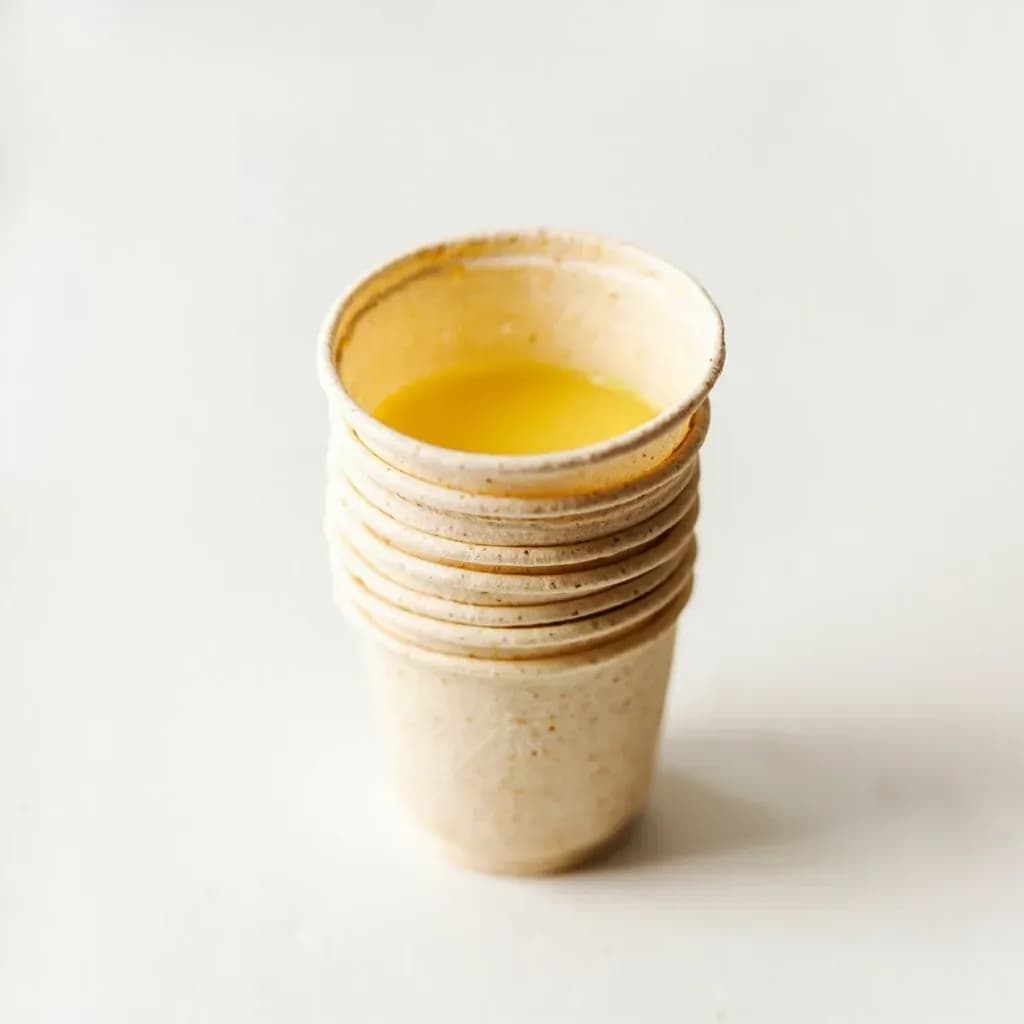
Disposable Tasting Cup
Tiny single-use cup for sampling sauces, drinks, and portioned tastes.
A small single-use cup of plastic, paper, or fiber used to offer sample tastes of sauces, soups, drinks, and dressings. Kitchens and tasting rooms use them for portioned sampling, quality checks, and service without cross-contaminating a shared spoon. Tiny shot-size versions also serve for measuring or pre-portioning small ingredient amounts.
A disposable tasting cup is the small single-serve vessel used to portion out samples of sauces, broths, oils, spirits, beer, coffee, and just about anything else that benefits from a controlled, repeatable dose — from a measured spirit pour on a flight to a quick dab of demi-glace during service. Most range from 1 to 4 ounces, with a flared rolled rim that adds rigidity and gives the drinker a clean lip contact. The cup's job is simple but specific: hold a measured, uniform sample that a guest or cook can taste without committing to a full portion, then disappear when the tasting is done.
Beyond service, these cups are quietly essential in prep work. A cook building a sauce, balancing a vinaigrette, or seasoning a stock needs a way to taste repeatedly without dirtying a spoon or glass, and a stack of 1- or 2-ounce cups next to the stove is one of the cheapest quality-control tools in any professional kitchen. The choice of material — polypropylene, polystyrene, PET, PLA, or paper — matters more than most people realize, because it dictates heat tolerance, clarity, and whether the cup ends up in the compost bin or the landfill.
For sensory evaluation, color is a deliberate choice. Clear PS or PET lets you judge viscosity and hue at a glance; opaque black or white cups strip out visual cues so a panel can isolate aroma and flavor, which is why coffee and whiskey professionals reach for them.
Alternatives
Types & varieties
Translucent, sturdy, microwave- and hot-liquid-safe; the workhorse for coffee cupping, soup shots, and any hot tasting.
Crystal-clear and rigid; the clearest visual for beer, wine, and sauce samples, but not suited to hot liquids.
Glass-like clarity with better impact resistance than PS; common for cold beverages and frozen tastings like gelato.
Compostable, white or kraft; holds sauces, condiments, ice cream, and hot samples like broth shots.
Traditional style for cold foods and dry tastings; less heat-resistant than PLA-lined paper.
Clear bioplastic comparable to PS in clarity, commercially compostable, but heat-sensitive and not for hot service.
Fluted 1 oz cup printed with mL and teaspoon markings; doubles as a tasting and measuring cup at the prep station.
Standard cup body with a clear dome cover for whipped cream-topped drinks, mousses, parfaits, or any sample carrying a tall garnish.
Opaque PP or paper used in whiskey and coffee cupping to remove visual cues so aroma and palate can be evaluated without color bias.
Choosing the Right Cup for the Job
The right cup is a decision about three things: temperature, visibility, and disposal. Match the resin to the service, because the wrong cup will soften, lose shape, or fail at the worst moment.
- Hot sauces, broths, consommés, and coffee: PP or paper/PLA-lined — both tolerate ~200 °F and won't soften in the hand.
- Cold beer, wine, spirits, and any sample where clarity matters: PS or PET, where the resin stays glass-like and rigid.
- Gelato, sorbet, and ice-cream flights: PET or PS, which hold up at freezer temperatures without cracking.
- Eco-forward service or markets where compost is collected: PLA or PLA-lined paper, both BPI-certifiable for commercial composting.
- Blind or sensory panels (whiskey, coffee, olive oil): opaque black or white to remove color cues and force attention onto nose and palate.
Setting Up a Tasting
A good tasting flight is uniform. Inconsistent cups, fills, or temperatures give inconsistent results, especially in professional sensory work.
- Pre-warm or pre-chill cups to the same temperature before pouring so each sample cools at the same rate.
- Fill to the same level across the flight — roughly 1 oz for spirits, 2 oz for sauces, 3.25–4 oz for cupping bowls.
- Use a flat lid for sipping flights and a dome lid only when a sample carries foam, whipped cream, or a tall garnish.
- Number or label cups in advance when running blind panels; do not rely on memory when comparing six samples.
- For cupping, the Specialty Coffee Association protocol specifies larger cupping bowls, but 1 oz disposable cups are widely used to distribute samples from a master set.
Common uses
Tips & pitfalls
- Match the material to the temperature: PP or paper/PLA-lined for anything hot, PS or PET for cold only — PS softens and becomes uncomfortable to hold above ~150 °F.
- If you want diners to evaluate aroma, choose a flat lid that peels back partially rather than a sealed dome, which dulls the nose.
- Don't assume 'compostable' means backyard-compostable; PLA and PLA-lined paper almost always require a commercial facility with controlled heat and moisture.
- Use opaque black or white cups when you want the taster to focus on nose and palate — clear PS or PET can bias the palate toward whatever color the liquid happens to be.
- For coffee cupping, pre-warm the cups and fill each to the same level so samples cool at the same rate and stay comparable.
- Avoid stacking filled cups more than a few high; lightweight plastic deforms under the weight of the stack and the bottom cups will lean or spill.
- Recycle only when the local stream accepts the resin — most curbside programs do not take PS even where it carries a #6 chasing-arrows symbol.
- Reach for dome lids only when the sample has a tall foam or garnish; otherwise the extra headspace spreads aroma and weakens the nose.
Good to know
- Category
- Disposable servingware / portion containers
- Typical capacities
- 1 oz (30 mL), 2 oz (60 mL), 3.25 oz (100 mL), 4 oz (120 mL); 1 oz is the cupping standard
- Primary materials
- Polypropylene (PP, #5), polystyrene (PS, #6), PET, paper with PLA or wax lining, and PLA (corn-starch bioplastic)
- Heat tolerance
- PP and paper/PLA-lined cups handle roughly 190–210 °F; PS is not recommended above ~150 °F
- Cold tolerance
- PS and PET stay rigid down to ~32 °F without becoming brittle
- Standard rim
- Rolled rim for rigidity and clean drinking contact
- Lid options
- Flat lid (sipping/tasting) and dome lid (foam, whipped cream, tall garnish)
- Compostability
- PLA and PLA-lined paper cups are commercially compostable (BPI-certified versions exist); PP and PS are recyclable only where local facilities accept them
- Pack sizes
- Sold in sleeves of 50–100 and cases of 1,000–2,500
- Origin
- Paper portion cups developed in the early 20th century for ice cream and oyster service; modern small plastic tasting cups became standard in coffee cupping and beer/wine flights in the late 20th century
Also called
Tasting Sample Cups · Disposable Tasting Cup · Sample Cup · Portion Cup
Related

Freezer Bags
Thick, sealable bags built to fight freezer burn

Storage Bags
Resealable bags for fridge storage and marinating

Storage Container
Lidded container for leftovers, prep, and meal kits

Glass Container
Oven-to-fridge glass that won't stain or hold odors

Plastic Container
Lightweight, stackable storage for everyday leftovers

Vacuum Sealer Bags
Airtight bags for long freezing and sous-vide

Reusable Bags
Washable silicone bags that replace single-use plastic

Mason Jar
Sealed glass jar for preserves, pickles, and storage