Heat & Safety
Flour-Dust Respirator Mask
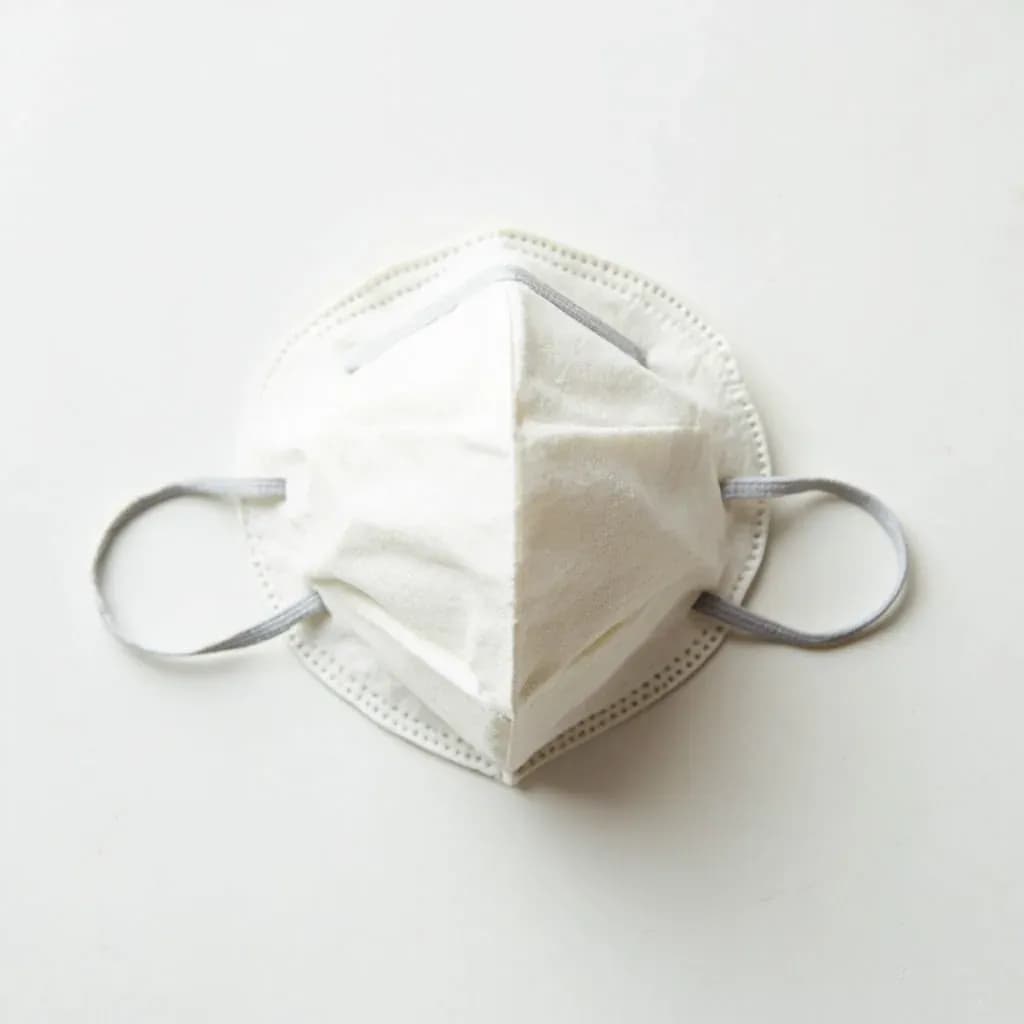
A disposable particulate mask worn to keep airborne flour and fine powder dust out of the lungs.
A flour-dust respirator mask is a lightweight, often disposable face mask rated to filter fine airborne particulates. Bakers and large-batch cooks wear one when scooping, sifting, or dumping flour, cocoa, or other powders that throw up clouds of dust. A snug nose-bridge clip and an N95-style or FFP2 rating make it far more effective than a loose cloth mask against the finest particles.
A flour-dust respirator is a tight-fitting facepiece that filters airborne particles out of the air you breathe, and in a kitchen that means the fine cloud of flour, sugar, cocoa, spice, and grain dust generated whenever you sift, weigh, decant, grind, or sweep dry ingredients. For a serious home baker or pastry cook this is not paranoia — baker's asthma is one of the oldest recognized occupational lung diseases, described by Bernardino Ramazzini in 1700, and it is still triggered today by repeated inhalation of wheat, rye, barley, and soy flours and by dough improvers such as fungal alpha-amylase. The respirator is the last line of a layered defense that also includes local exhaust ventilation, wet-mop cleaning instead of dry sweeping, and sensible ingredient substitutions where possible.
How a particulate respirator behaves is mostly a story about fit rather than the filter media itself. A modern disposable model is built from multi-layer non-woven polypropylene with an electrostatic melt-blown layer that mechanically and electrostatically traps particles across the relevant size range, with worst-case performance at roughly 0.3 microns — the most penetrating size, where mechanical and electrostatic filtration are least effective. That media is only useful while the seal between mask and skin holds; any gap, beard stubble, or deformity in the nose wire turns the device into an expensive sieve. Disposable units are single-shift items, generally rated for roughly eight hours of use or until they become soiled, damp, or noticeably hard to breathe through, and they cannot be washed and reused without destroying the electrostatic charge that does most of the work.
For an occasional home baker sifting a cup or two of flour, a properly fitted disposable N95-class mask is generally considered adequate. For daily professional use — mill work, commercial pastry production, confectionery dusting — the bar is higher: elastomeric reusable respirators with P100 cartridges are the standard, and in the United States OSHA 29 CFR 1910.134 requires a written respiratory protection program, medical clearance, and fit-testing for anyone required to wear one on the job. Worth noting separately: flour dust is also combustible, with airborne concentrations between roughly 40 and 60 g/m³ capable of igniting, which is why industrial mills and bakeries enforce dust suppression and ignition-control rules that go well beyond what a respirator alone can address.
Alternatives
Types & varieties
The workhorse for home and prosumer kitchen use; available in cup, flat-fold, and duckbill shapes; ≥95% particulate filtration.
Higher filtration (≥99% and ≥99.97%); preferred for fine cocoa, confectioners' sugar, and prolonged spice grinding.
Built-in one-way exhalation valve reduces heat and moisture buildup inside the mask; comfortable for long bakery shifts but exhausts unfiltered breath.
European equivalents; FFP2 comparable to N95, FFP3 comparable to N100; common specification outside North America.
Reusable silicone or rubber facepiece with screw-on P100 or P100-plus-organic-vapor cartridges; standard in commercial bakeries and mills.
Adds an activated carbon web for odors and some organic vapors; still particulate-only, not a true chemical cartridge.
Regional equivalents of N95; verify certification marks (NIOSH, CE, KOSHA, SAI Global) to avoid counterfeits.
Baker's asthma and why flour dust is special
Wheat flour is not just an irritant — its proteins (along with those of rye, barley, and soy, and enzymes such as fungal alpha-amylase used as dough improvers) are recognized respiratory sensitizers. Repeated inhalation can produce occupational asthma, rhinitis, and conjunctivitis, and once sensitized a baker may react to concentrations far below any visible dust cloud. Symptoms — wheeze, chest tightness, runny nose, eye irritation — often worsen at the start of the work week and improve on days off, which is a useful diagnostic clue. Sensitization is generally permanent, so prevention matters more than treatment.
The hierarchy of controls
A respirator is the last line of defense, not the first. Engineering controls come first: local exhaust ventilation at weighing and sifting stations, enclosed mixers, and ingredient transfer systems that don't puff dust into the air. Administrative controls — scheduling the dustiest jobs when fewest people are present, rotating tasks — come next. Only after those are addressed does PPE enter the picture. At home, the equivalent looks like sifting over a sheet pan rather than into the air, wiping surfaces with a damp cloth instead of a dry brush or compressed air, decanting bulk flour slowly, and keeping lids on containers of cocoa and powdered sugar.
Fit, fit, fit
Filtration efficiency means nothing if the seal leaks. A properly fitted N95 should pull inward slightly when you inhale sharply and show no air escaping at the nose, chin, or cheeks when you exhale gently. Common reasons a good mask fits badly: an unadjusted nose wire, hair (including stubble) crossing the seal line, dented or creased media, and weight changes of roughly 10 lb or more that alter face geometry. Dental work, scarring near the seal, and pregnancy can all require refitting. Annual fit-testing is the occupational standard, and OSHA requires it for required workplace use under 29 CFR 1910.134.
Combustible dust — the other reason to take flour seriously
Fine flour suspended in air is explosible. The minimum explosible concentration sits somewhere around 40–60 g/m³ for common wheat flours, and a primary dust explosion can loft settled dust into a secondary, far larger cloud. Industrial mills and bakeries therefore manage dust as a process hazard: housekeeping by vacuum or wet mop (never compressed air), enclosed conveyance, dust collection with explosion relief, and ignition-source control — measures that no respirator substitutes for. Even at home, sweeping a flour-dusted floor with a dry broom creates exactly the kind of suspended cloud a respirator exists to keep out of your lungs.
Common uses
Tips & pitfalls
- Do a positive and negative pressure seal check every time you don the mask: inhale sharply so the mask collapses gently toward your face, then exhale and feel for leaks around the nose, chin, and cheeks.
- Any beard stubble at the seal line destroys the fit; clean-shaven at the seal is the only reliable option, or move to a powered air-purifying respirator (PAPR).
- Throw away disposable masks at the end of the shift, or the moment they feel damp, soiled, or noticeably harder to breathe through — they cannot be washed without ruining the electrostatic filter layer.
- N95/N99/N100 respirators filter particulates only; they will not protect against organic vapors, fumigants, or CO₂ from dry-ice processes, which need different cartridges or supplied air.
- Valved models are easier to wear for long shifts but exhaust unfiltered breath, so do not use them where exhaled breath could affect others (shared kitchens, around immunocompromised coworkers).
- Handle only by the straps and wash your hands after removing a used mask; the outside is the dirty side.
- Cup-shaped and duckbill respirators stay cooler than flat-fold models during extended sifting, while flat-fold designs pack flatter and are easier to stash in an apron pocket.
- Refit annually, and any time you gain or lose more than about 10 lb, have dental work, or develop scarring near the seal line.
- Do not substitute a bandana, neck gaiter, cloth face covering, or ordinary surgical mask for fine flour dust — their filtration is well below N95 and they leak around the edges.
- Buy from reputable distributors; counterfeit KN95 and N95 masks have been a recurring problem, especially through third-party marketplaces, so look for a legible certification mark on the mask itself.
Good to know
- Type
- Personal protective equipment (PPE); tight-fitting particulate respirator
- Filter efficiency
- N95 ≥95%, N99 ≥99%, N100 ≥99.97% of airborne particles at the most-penetrating size of ~0.3 microns
- Common standards
- NIOSH N95/N99/N100 (US); EN 149 FFP1/FFP2/FFP3 (Europe); KN95 (China); KF94 (Korea); P2 (Australia)
- Construction
- Multi-layer non-woven polypropylene with an electrostatic melt-blown filter between inner and outer cover webs
- Fit requirement
- Tight-fitting; user seal check required every donning; facial hair at the seal line compromises protection
- Service life
- Disposable units are single-shift (~8 hours); replace when soiled, damp, deformed, or when breathing resistance rises
- Storage
- Cool, dry place in original packaging, away from dust, sunlight, and chemicals; typical shelf life 2–5 years
- Cost
- About $0.50–$3 per disposable unit; reusable elastomeric respirators with P100 cartridges run $25–$60 plus cartridge replacements
Also called
Particulate Mask · Flour Mask · Dust Mask
Related

Paper Towels
Disposable sheets for spills, drying, and patting dry

Kitchen Towels
Reusable cloths for drying, gripping, and wiping

Oven Mitts
Heatproof gloves to handle hot pans and trays safely

Disposable Gloves
Single-use gloves for safe, mess-free handling

Cleaning Cloths
Reusable cloths for wiping counters and spills

Tortilla Warmer
Insulated holder that keeps tortillas warm and soft

Trivet
Heatproof stand that shields surfaces from hot pots

Ice Bath Setup
Bowl of ice water that halts cooking and sets color