Wraps & Liners
Fibrous Casing
A tough cellulose-reinforced casing used to stuff large, smoked, and cooked sausages.
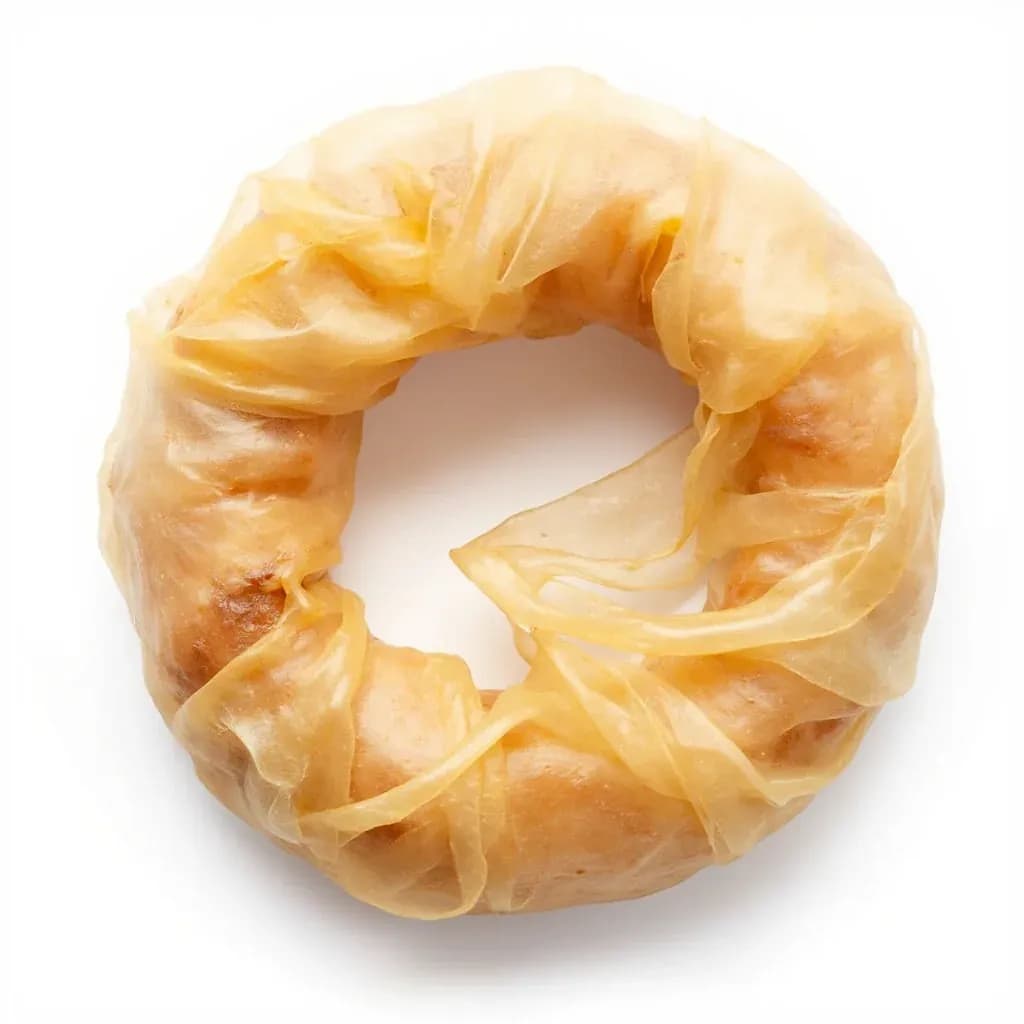
Fibrous casing is a strong, non-edible casing made from cellulose reinforced with paper fibers. It is used to stuff large-format sausages like summer sausage, salami, and bologna that need to hold shape during smoking and cooking. It is soaked before stuffing for flexibility, often comes printed or mahogany-tinted, and is peeled off before slicing.
Fibrous casing is the workhorse tube of the commercial sausage world: a paper-like sleeve of long, oriented cellulose fibers bonded into a tube strong enough to hold a 30-pound bologna or a hanging wheel of salami through hours of cooking, smoking, and drying. Unlike natural hog or beef casings, it is inedible and must be peeled or cut away before the sausage reaches the table, but it offers a size range and structural reliability those casings cannot match, covering nearly every cooked and smoked sausage format made industrially at calibers from roughly 40 mm up to 120 mm and beyond.
The casing is porous rather than airtight, which is exactly what you want for a product that needs to breathe: smoke penetrates evenly, moisture leaves in a controlled way during drying, and the surface develops a uniform color and a tight, wrinkle-free finish as the meat cooks and shrinks against the wall. That permeability is also why fibrous casings are paired almost universally with smoked or dried products (salami, summer sausage, pepperoni) and large cooked items (bologna, mortadella, braunschweiger) — formats where natural casings would either be too small or too inconsistent to do the job cleanly.
For a home cook or small-scale butcher, choosing fibrous is a deliberate trade. You accept the inedibility and the extra peeling step in exchange for a uniform shape, a surface that prints and smokes beautifully, and the confidence that a heavy product will not burst on the smokehouse stick. Knowing how to soak it, match it to your stuffing horn, and handle it from horn to peel is the difference between a clean, retail-ready sausage and one that splits during stuffing or leaks fat in the oven.
Alternatives
Types & varieties
Long rolls of unseamed tubing on a spool; requires a stuffer with a horn and tying at the open end after filling
Pleated and compressed onto a stick for fast manual or high-speed stuffing; the standard in commercial shops
Sealed at one end with a metal clip so the open end slips straight onto the stuffing horn
Engineered with a tear strip or weakened seam so the casing strips off cleanly in one piece after cooling
Tough bonded tube without a tear feature; removed by slitting lengthwise before slicing
Pre-printed with logos, net weight, and code-dates for retail-ready presentation on the finished sausage
Available in smoke-amber, mahogany, and other shades to influence the surface color of the finished product
Used for snack sticks, small salami, and dry sausage formats where a slim profile is wanted
The workhorse range for bologna, mortadella, summer sausage, and liverwurst
For whole-ham-style products, large-format salami, and cooked specialties that need to hang their weight
Choosing the Right Format and Caliber
Match the casing to your product and your equipment before you start grinding. Caliber is dictated by the finished diameter you want on the board or in the display case; the format (flat, shirred, pre-tied) is dictated by your stuffer. Home butchers working with a 5- or 10-pound horizontal stuffer typically use flat or pre-tied stock slipped over the horn, while commercial operations running through a high-speed vacuum stuffer rely on pre-shirred casing on a stick for speed and consistency.
- Snack sticks and slim dry sausages: 40–55 mm
- Standard bologna, summer sausage, mortadella, liverwurst: 60–80 mm
- Whole-ham-style and large specialty loaves: 90–120+ mm
- Flat stock for small batches and short production runs
- Pre-shirred for any operation stuffing more than a few links at a time
- Pre-tied when you want to skip the tying step and keep the line moving
Soaking, Stuffing, and Peeling
Fibrous casing is unforgiving of rough handling at three specific moments: soaking, stuffing, and peeling. Treat it gently at each step and the sausage will come out of the smokehouse with a clean, tight surface; push it at any of those steps and you will see seam splits, fat leaks, or torn rinds.
- Soak in warm (not hot) water — about 30–40°C — until pliable; hot water weakens the seam and leads to blowouts on the horn
- Size the stuffing horn to the casing caliber so the cuff slides on without stretching or tearing
- Stuff to roughly 85–90% of theoretical capacity to leave room for fat and moisture expansion during cooking
- Prick any trapped air pockets with a sterile pin before hanging in the dryer or moving to the smokehouse
- Cool the stuffed product before transferring into a hot smokehouse to reduce casing splits from thermal shock
- For peelable casings, let the sausage cool fully before peeling so the surface skin does not tear away with the casing
- For non-peelable casings, slit lengthwise with a sharp knife before portioning or slicing
Peelable vs. Non-peelable
The choice between peelable and non-peelable comes down to how the finished product is presented. Peelable casings are designed for products that will be sliced — bologna, mortadella, summer sausage — where a clean, undamaged rind at the cut face matters for appearance. Non-peelable casings are the right call for products sold whole and portioned at the counter, or for any application where the casing is going to be removed and discarded before slicing anyway.
Common uses
Tips & pitfalls
- Always soak fibrous casings in warm water, never hot — water that is too hot weakens the seam and causes blowouts on the stuffer horn.
- Do not overstuff; aim for roughly 85–90% of theoretical capacity so fat and moisture have room to expand during cooking without splitting the casing.
- Avoid pinholes — once the cellulose is punctured it will not reseal, and the hole will leak fat through the rest of the cook.
- Match the stuffing horn diameter to the casing caliber to prevent tearing at the cuff where the casing meets the horn.
- Prick any trapped air pockets with a sterile pin before hanging in the drying chamber, or you will end up with bald spots and uneven drying.
- Cool the stuffed product before moving it into a hot smokehouse to reduce thermal-shock splits.
- If using a peelable casing, let the sausage cool completely before peeling so the cooked surface skin stays intact on the meat.
- Store leftover soaked casings under refrigeration in clean water and use within 24–48 hours; standing water at room temperature grows microbes quickly.
Good to know
- Material
- Longitudinally oriented cellulose fibers (typically from wood pulp or cotton linters) bonded into a paper-like tube
- Edible
- No — must be peeled or cut away before eating
- Permeability
- Porous to smoke, moisture, and flavor; not airtight, which is desirable for smoked and dried products
- Strength
- High tensile strength; holds shape through stuffing, hanging, cooking, and drying without stretching out of round
- Typical diameters
- Roughly 40 mm to 120+ mm (calibers 40–120+), with custom sizes up to about 200 mm for specialty items
- Soaking
- Soak in warm water (about 30–40°C / 85–105°F) for 20–30 minutes before stuffing to soften and remove brittleness
- Shrinkage
- Shrinks tightly around the meat during cooking and drying, giving a uniform, wrinkle-free surface
- Pre-use storage
- Store dry, sealed, away from humidity and direct sunlight; unopened shelf life is typically 1–2 years
- Sterilization
- May come pre-sterilized from the supplier or require a brief dip in food-grade sanitizer before stuffing
Also called
Cellulose Fibrous Casing · Sausage Casing · Salami Casing
Related

Aluminum Foil
Wraps, covers, and tents food for the oven and grill

Parchment Paper
Nonstick liner for clean, even baking and easy release

Wax Paper
Moisture-resistant sheet for wrapping and counter prep

Plastic Wrap
Clings tight to cover bowls and wrap leftovers

Silicone Baking Mat
Reusable nonstick liner that replaces parchment

Cheesecloth
Loose-woven cloth for straining stock and bundling herbs

Beeswax Food Wrap
Reusable wax wrap that molds around bowls and produce

Piping Tips
Shaped nozzles that turn frosting into stars and rosettes