Wraps & Liners
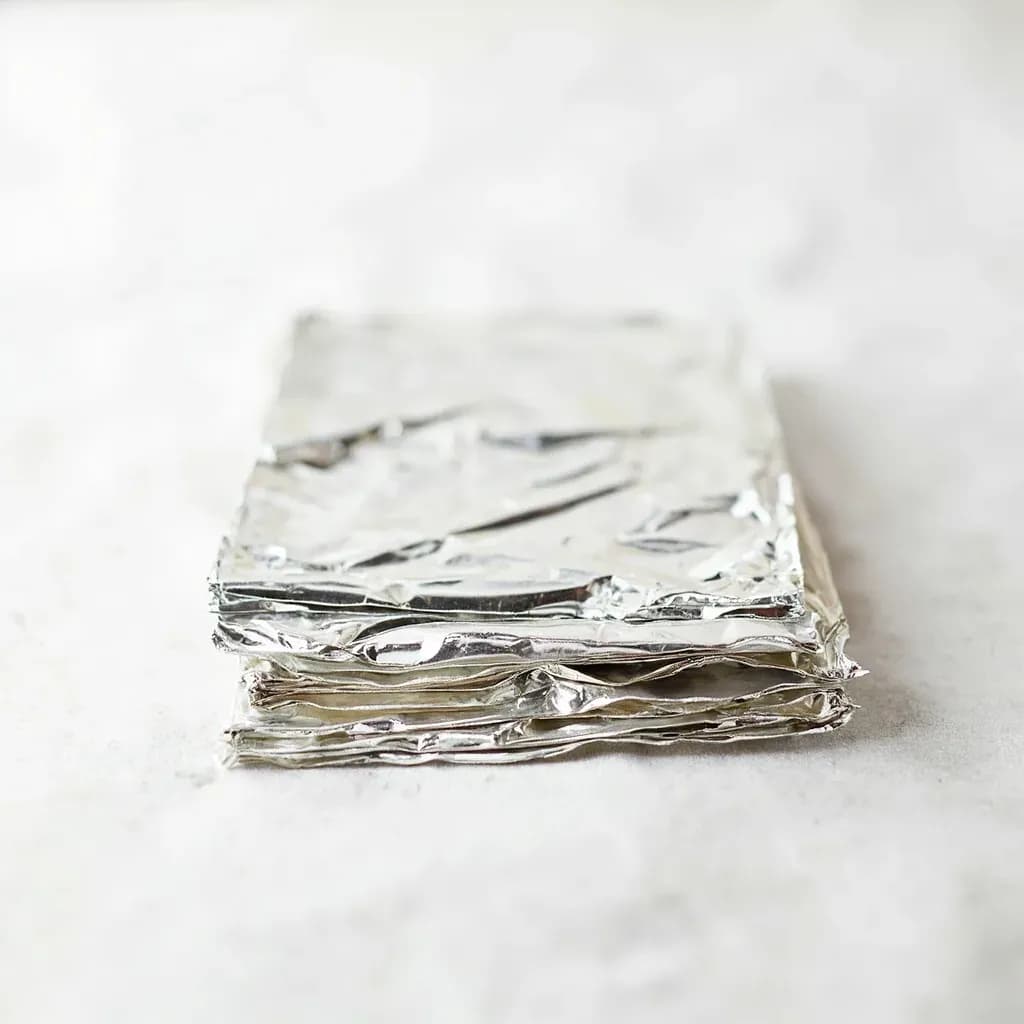
Pre-Cut Foil Sheet
Individual sheets of aluminum foil for wrapping, covering, or lining without tearing from a roll.
Pre-cut foil sheets are flat, ready-sized pieces of aluminum foil that save time over pulling and tearing from a roll. Cooks use them to wrap potatoes and fish for baking, tent roasts, line pans, and pack food to go. Heavy-duty versions resist puncturing on the grill and hold up to direct flame and high oven heat.
Pre-cut foil sheets solve one of the most persistent small frustrations in a working kitchen: the need for a piece of aluminum foil of the right size, right now, without wrestling with a roll. Each sheet is a fixed rectangle — most often 12 by 10.75 inches in food service — that pops out of a dispenser box cleanly and ready to use, eliminating the awkward tear, the mis-sized piece, and the half-ream of foil rattling across the prep counter. The metal itself behaves exactly as aluminum always has: it reflects radiant heat, conducts efficiently through the sheet, and can be crimped, folded, or molded into whatever shape the cook needs.
The format exists for speed and consistency. In a deli, sandwich shop, or busy line, a cook can wrap a burger, line a sheet pan, or tent a roast in the time it would take to find the end of a roll, unroll enough, and tear it off. In the home kitchen, the appeal is similar but quieter: the box sits on the counter or in a drawer, and the cook always knows the sheet will be the size they expect. Because the sheets are interleaved in the box rather than stacked flat, only one comes out at a time, and the slightly thicker gauge used in commercial packs resists the kind of finger-tears that plague thin household rolls.
A few behaviors are worth keeping in mind. Aluminum foil tolerates the heat of a conventional oven, grill, or broiler with ease — the metal does not melt until roughly 1,220 °F — but it is not microwave-safe; the metal reflects microwave radiation and can arc and spark inside the chamber. It is essentially impermeable to moisture and odor, which makes it an excellent freezer wrap. And the persistent shiny-versus-dull question has a settled answer: both sides perform identically, because the two finishes are simply the two faces of two sheets that were milled together and separated at the end of the rolling process.
Alternatives
Types & varieties
Lighter weight; suited for wrapping, covering, lining pans, and cold storage
Thicker and more puncture-resistant; preferred for grilling, bone-in meats, and high-heat roasting
Stacks inside a dispenser box so a single sheet pulls out cleanly without tearing
Smaller pre-cuts (around 12 × 12 in or 14 × 14 in) commonly used in delis and quick-service kitchens
Larger pre-cuts (roughly 18 × 24 in) sized to line a standard half-size sheet pan
Coated on one side to reduce sticking, marketed for grilling cheese, fish, and eggs
The Shiny-and-Dull Question
Cooks have been arguing about this for decades, and the answer is settled. Aluminum foil is produced by passing a thick slab of metal between rollers in a continuous mill; the final, thinnest pass stacks two sheets against each other, and when they are separated the side that touched the rollers comes out shiny while the side that touched the other sheet comes out dull. Both sides are pure aluminum with the same gauge, the same thermal conductivity, and the same reflectivity in practice. Tests by Reynolds and other manufacturers have confirmed the difference is, for cooking purposes, unmeasurable. Choose whichever side is convenient; neither will brown, crisp, or shield differently.
Building a Better Foil Packet
The en papillote technique — food steamed in a sealed foil pouch — depends entirely on the integrity of the seal. A loose packet leaks steam, the food dries out, and the cook gets a roasted effect instead of a steamed one. The shape of the seal matters as much as the tightness: long, folded crimps hold steam better than pinched-together corners, and the short ends should be folded, not twisted, so they lie flat under the heat.
- Center the food on the sheet with at least 2 inches of margin on every side.
- Bring the two long edges up over the food and crimp them together in 1/2-inch folds, working the length of the seam three or four times.
- Fold in each short end twice, tucking the folded edge underneath the packet so it locks against the weight of the food.
- Pierce the top once or twice with a paring knife if you want some steam to escape and the top to brown; leave it sealed for a fully steamed, tender result.
Common uses
Tips & pitfalls
- Use heavy-duty sheets for anything on the grill, anything with bones, or any wrap that will be moved or jostled a lot — standard gauge tears too easily.
- Loosely tent foil over roasts so it never touches the food directly; tight contact transfers heat aggressively and will burn the surface underneath.
- To line a sheet pan with easy removal, press the sheet in, crimp the corners, and leave an overhang on two sides so the whole batch lifts out as a single piece.
- Avoid prolonged contact with highly acidic or salty foods (tomato sauce, citrus, brines) if you are sensitive to aluminum pickup; line with parchment first in those cases.
- For sticky work like candy-making or caramel, lightly mist the dull side with oil or reach for a release-coated sheet.
- Crinkle a sheet into a ball, then flatten it back out for a surprisingly effective non-slip liner under a cutting board or mixing bowl.
- If a sheet rips mid-use, do not discard it — layer a second sheet over the tear, or fold the torn sheet into a smaller piece; the box format makes replacement cheap.
- Never place foil on the floor of a toaster oven where it can contact the heating elements; it can ignite or fuse permanently to the metal.
Good to know
- Material
- Aluminum alloy (typically AA 8006 or AA 8111), FDA-approved for direct food contact
- Standard sheet size (food service)
- 12 in × 10.75 in (305 × 273 mm)
- Standard gauge thickness
- ~0.00063 in (16 µm)
- Heavy-duty gauge thickness
- ~0.00075–0.001 in (19–25 µm)
- Heat tolerance
- Safe in conventional ovens, grills, and broilers; aluminum melts at ~1,220 °F / 660 °C
- Microwave safety
- Not microwave-safe; the metal reflects microwaves and can arc and spark
- Freezer compatibility
- Suitable; provides a moisture- and odor-proof wrap
- Shiny vs. dull sides
- Identical performance; the two finishes are an artifact of the rolling process, not a functional difference
Also called
Heavy-Duty Aluminum Foil · Foil Wrap · Tin Foil Sheet
Related

Aluminum Foil
Wraps, covers, and tents food for the oven and grill

Parchment Paper
Nonstick liner for clean, even baking and easy release

Wax Paper
Moisture-resistant sheet for wrapping and counter prep

Plastic Wrap
Clings tight to cover bowls and wrap leftovers

Silicone Baking Mat
Reusable nonstick liner that replaces parchment

Cheesecloth
Loose-woven cloth for straining stock and bundling herbs

Beeswax Food Wrap
Reusable wax wrap that molds around bowls and produce

Piping Tips
Shaped nozzles that turn frosting into stars and rosettes