Storage & Containers
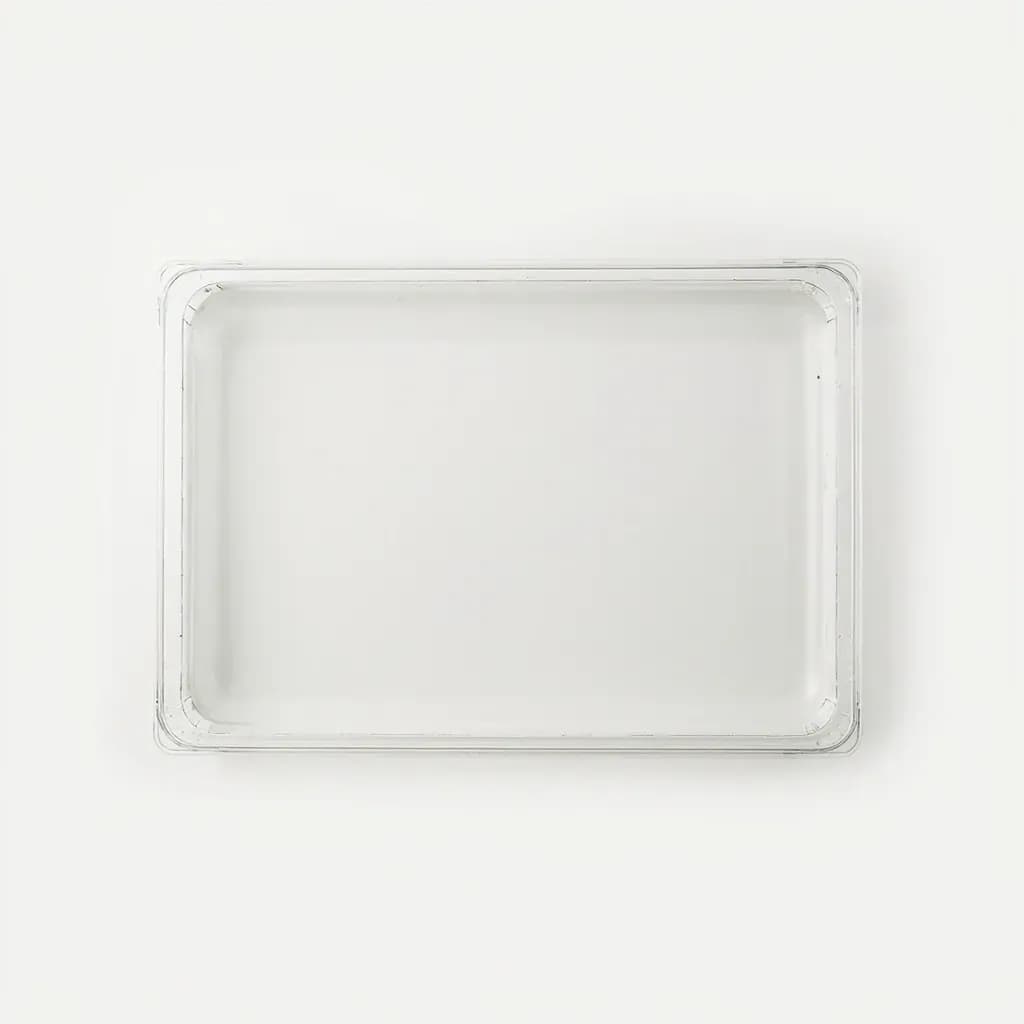
Food Storage Pan Lid
Snap-on or sliding cover that seals sheet pans, dough trays, and food pans for storage.
A food storage pan lid is a fitted cover, usually clear polycarbonate or polyethylene, sized to standard sheet pans, dough trays, and gastronorm pans. Kitchens use them to cover proofing dough, stack prepped pans, and keep food protected in coolers and on speed racks. Solid lids seal in moisture while ventilated or hinged versions allow access, and they let pans nest and stack to save space.
A food storage pan lid is the rigid or semi-rigid cover that seals a sheet pan, hotel pan, dough box, or food-storage container, turning an open tray into a stackable, contamination-resistant unit. In a working kitchen these lids do the unglamorous work that keeps prep organized and food safe: they lock in moisture during cold holding, block cross-contamination in the walk-in, and let a cook stack hotel pans on a rolling rack without crushing the top layer. The geometry is standardized around two systems — the North American sheet-pan family (full, half, third, quarter) and the European Gastronorm (GN) family (1/1, 1/2, 1/3, 1/4, 1/6, 1/9) — so a well-stocked kitchen's lid inventory should mirror the pans actually in service, not accumulate ad hoc. Material choice drives behavior: clear polycarbonate is rigid and lets staff read contents at a glance, soft polyethylene stretches to grip a rim, and stainless is the only option that tolerates heat, sharp utensils, or the inside of a steam table.
Alternatives
Types & varieties
Soft polyethylene or silicone-edge lid that stretches and grips the rim of a sheet pan or hotel pan; common for half and full sheet pans and a low-cost replacement option.
Rigid plastic lid with a flange that slides onto the rolled rim of a sheet pan; stays put during transport and won't pop off in a rolling rack.
Clear, rigid, see-through lid for hotel pans and food boxes; contents are identifiable at a glance and stacks with matching pans.
Stamped or rolled 18/8 (304) or 18/0 (430) stainless lid for steam-table pans; the only option that tolerates heat and doubles as a false bottom.
Polycarbonate lid with a slot to cradle a serving or tasting spoon, common in self-service and prep stations.
High-domed plastic lid sized for proofing boxes; provides clearance so proofed dough can rise without welding to the underside.
Proprietary polycarbonate lid engineered to stack and seal Cambro CamSquare, Camwear, and food boxes; known for tight, repeatable fit.
Stainless hotel-pan lid with perforations; functions as a false bottom for draining, blanching, or steaming, not as an airtight seal.
Choosing the Right Material
Material drives how a lid behaves in service, and a cook who understands the trade-offs buys smarter. Polycarbonate is the workhorse of cold prep lines: clear, rigid, and typically NSF-certified, it stacks precisely and lets anyone in the walk-in see what's inside without lifting a thing. It does, however, cloud after hundreds of dishwasher cycles and will warp at temperatures above 210°F, so it never goes near an oven or a steam well. Polyethylene is cheaper, softer, and grippier — it stretches to seal a rim that polycarbonate cannot — but it clouds faster, scratches easily, and tolerates less heat. Stainless steel is the only lid that belongs on a hot line: it shrugs off the salamander, the steam table, and the edge of a knife, and a 1/3 GN stainless lid is the traditional false bottom for draining blanched vegetables or holding proteins above pan juices. For most kitchens a mixed inventory — polycarbonate for cold storage, stainless for hot service — is the right call.
- Polycarbonate: clear, rigid, typically NSF-certified; for cold storage and prep-line visibility only.
- Polyethylene: flexible, low-cost, grippy; good for sheet-pan snap-on duty but clouds fastest.
- Stainless (18/8 or 18/0): heat-tolerant and knife-tolerant; the only choice for steam tables, ovens, and false-bottom work.
- Copolyester: a newer alternative that is lighter than polycarbonate and BPA-free, often sold under brand names like Eastman Tritan.
Sizing Systems: Sheet Pan vs. Gastronorm
Two standardization systems dominate commercial kitchens, and lids only fit what they were designed for. The North American sheet-pan family — full 18 × 26 in, half 18 × 13 in, plus non-standard 'third' (about 13 × 9.5 in) and 'quarter' cuts used in bakeries and butcher shops — governs most U.S. prep tables and rack ovens. The European Gastronorm family — anchored by the 530 × 325 mm GN 1/1 module and scaled down to 1/2, 1/3, 1/4, 1/6, and 1/9 — governs hotel pans, steam tables, and most modern combi-oven racks. A GN 1/1 and a full sheet pan are both 'full-size' standards in their respective systems, but the actual dimensions differ (GN 1/1 = 530 × 325 mm vs. full sheet = 460 × 660 mm), the proportions are different, and the rim profiles don't match — so a sheet-pan lid will not seal a hotel pan and vice versa. When stocking a new kitchen, audit the pans first, then buy lids in the matching standard, and remember that GN lids are sized by pan fraction AND depth, so a 1/3 GN lid rated for a 100 mm pan will not seat cleanly on a 1/3 GN pan at 65 mm.
- Sheet-pan lids follow the 18 × 26 in full-pan family: full, half, and the non-standard third and quarter cuts.
- Gastronorm lids follow the 530 × 325 mm module: 1/1, 1/2, 1/3, 1/4, 1/6, 1/9 at standard depths of 65, 100, 150, 200 mm.
- Match lid to pan by stamping, not by eye — a 1/3 GN lid at 100 mm will not seat on a 1/3 GN pan at 65 mm.
- Most modern combi-ovens and rolling racks accept GN pans, which is why GN has become the global default for new builds.
Common uses
Tips & pitfalls
- Let hot food drop to at least 40°F / 4°C before snapping on a lid — sealing while warm traps steam, causes condensation, and accelerates bacterial growth in the cool-down danger zone.
- Never put a polycarbonate or polyethylene lid in a hot oven, salamander, or on a flattop; the material will warp and may leach. Use stainless lids for any heat exposure.
- Snap-on lids stretch out with age; retire one the moment it stops gripping — a loose seal costs spoilage and invites cross-contamination.
- Sanitize lids flat in the commercial dishwasher's open rack; folding or flipping them mid-cycle traps rinse water that breeds biofilm in storage.
- When nesting lids for storage, leave a small gap so they do not vacuum-seal together — pulling them apart later can crack a polycarbonate lid.
- Color-code lids by station or product group (red for raw proteins, blue for produce, green for dairy) to reduce cross-use; most commercial lines sell color options.
- For dough proofing, lightly oil or spray the lid's interior so risen dough does not weld itself to the plastic and tear on removal.
- Date and label every lid before stacking — clear polycarbonate exists precisely so a glance beats a guess at 6 a.m. in a dim walk-in.
Good to know
- Category
- Storage & Containers
- Primary Materials
- Polycarbonate, polyethylene (HDPE/LDPE), stainless steel, copolyester
- Standard Sheet Pan Sizes
- Full (18 × 26 in / 460 × 660 mm), Half (18 × 13 in / 460 × 330 mm), Third (13 × 9.5 in), Quarter (9.5 × 13 in)
- Gastronorm (GN) Lids
- Match GN pan fractions 1/1, 1/2, 1/3, 1/4, 1/6, 1/9 at standard depths 65, 100, 150, 200 mm
- Temperature Range
- Polycarbonate -40°F to 210°F (-40°C to 99°C); polyethylene -40°F to 160°F; stainless steel effectively unlimited
- Dishwasher Safe
- Most commercial lids are commercial-dishwasher safe; always verify manufacturer spec
- Common Certifications
- NSF/ANSI Standard 2 for food equipment; FDA food-contact compliant; BPA-free labeling common on polycarbonate and standard on copolyester
- Recycling Code
- PC (polycarbonate, #7), HDPE (#2), LDPE (#4) — stamped on the lid edge
- Primary Brands
- Cambro, Rubbermaid, Carlisle, Vollrath, Winco, Tablecraft, Araven, Lock&Lock
Also called
Sheet Pan Cover (Lid) · Dough Tray Lid · pan lid · tray cover
Related

Freezer Bags
Thick, sealable bags built to fight freezer burn

Storage Bags
Resealable bags for fridge storage and marinating

Storage Container
Lidded container for leftovers, prep, and meal kits

Glass Container
Oven-to-fridge glass that won't stain or hold odors

Plastic Container
Lightweight, stackable storage for everyday leftovers

Vacuum Sealer Bags
Airtight bags for long freezing and sous-vide

Reusable Bags
Washable silicone bags that replace single-use plastic

Mason Jar
Sealed glass jar for preserves, pickles, and storage