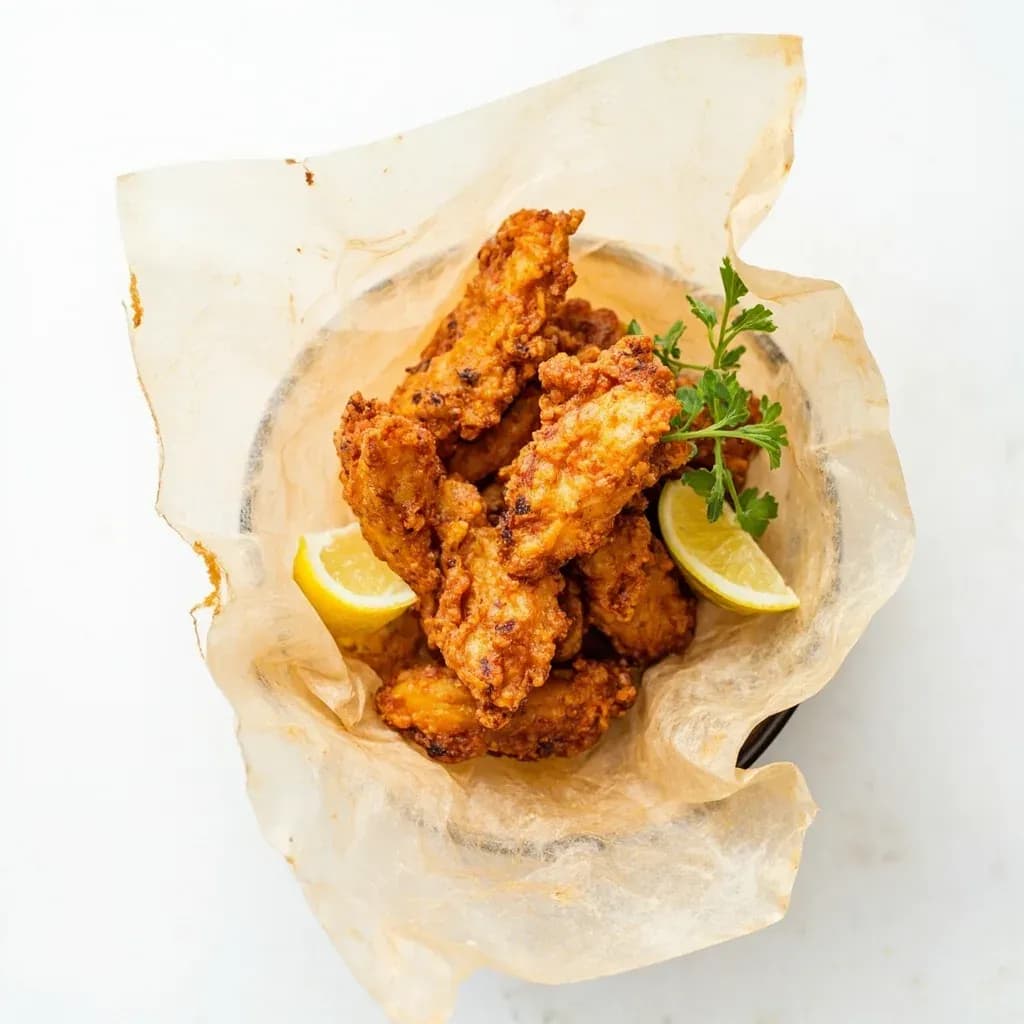
Wraps & Liners
Oil-Draining Paper (Carta Assorbente)
Absorbent paper that blots excess oil from fried foods after cooking.
A highly absorbent paper laid on a tray or plate to drain and blot excess oil from fried foods straight out of the pan. It keeps fritters, cutlets, and chips crisp rather than greasy and absorbs surface fat before serving. Cooks often pat the top of the food as well to wick away clinging oil.
Oil-draining paper — carta assorbente, or more specifically carta per frittura in Italian kitchens — is a plain, food-grade sheet made from virgin paper pulp, designed to wick surface oil away from fried food without falling apart or leaving fibers behind. Unlike a paper towel, it is manufactured without inks, dyes, optical brighteners, or recycled stock, and it has a controlled porosity that pulls oil through while remaining stable under brief contact with hot food. In trattorie and friggitorie it is as standard as salt, layered onto plates and trays so that fritto misto, supplì, and panelle arrive at the table glistening but not greasy.
The paper earns its place in a fry station through a simple behavior: oil migrates from the food's surface into the sheet by capillary action, leaving the crust drier, lighter, and less prone to going soggy in the minutes between fry and serve. Because it is thin and porous, heat escapes quickly through the sheet instead of being trapped against the crust as steam. A hot, freshly fried morsel sits on a single sheet for a brief drain and comes away noticeably less oily; heavier items like fried zucchini blossoms or baccalà benefit from two sheets or a fold to handle the volume of oil released.
It is important to understand what the paper is not. It is not parchment, which is siliconized to resist moisture and is poorly suited to wicking away large amounts of oil from hot food. It is not wax paper, which would soften and contaminate the food. It is not a multi-ply kitchen roll, which is too thick and insulating, softening the crust while failing to wick efficiently. Used once and composted, it does a small, specific job extremely well — and a cook who knows the difference turns out cleaner, crisper fried food.
Alternatives
Types & varieties
The everyday Italian absorbent sheet used to drain fried food on a tray or plate; thin, porous, unbleached.
'Straw paper' — a slightly thicker, straw-colored absorbent sheet, often double-layered for higher oil capacity.
Pre-cut round or rectangular sheets shaped to fit deep-fryer baskets; usually heavier weight and more heat-tolerant.
Quilted or multi-ply pads for draining larger batches; hold more oil before becoming saturated.
A sturdier, higher-heat version sometimes used interchangeably; treated to resist sticking and tolerate longer heat exposure.
Food-grade absorbent sheets sold at fish counters; usable at home for draining but not always matched in porosity.
Setting up a draining station
The classic Italian setup, mimicked in any serious fry station, is faster than plating a fresh sheet each time and keeps the cook's hands out of the oil. A rimmed sheet pan or platter is lined with one or two sheets of oil-draining paper, ideally set over a wire rack so air circulates beneath the food as it drains. Swap the paper between batches rather than piling new food onto saturated sheets, and have a clean stack within arm's reach of the fryer.
- Line a rimmed tray with one or two sheets; double up for very oily items such as fried squash blossoms or salt cod
- Set a wire rack on top of the paper for high-volume frying, so bottoms don't go soggy from pooled oil
- Keep a stack of fresh sheets at arm's reach and change the paper between batches to keep wicking active
- For basket-fried small items like fritto misto, toss the food in a paper-lined bowl to absorb oil all over, then transfer to a serving plate with a fresh sheet
- When holding fried food briefly in a low oven, layer sheets between pieces to prevent sticking and absorb weeping oil
Common uses
Tips & pitfalls
- Use two sheets layered, or fold a single sheet into quarters, when draining very oily items like fried zucchini blossoms or baccalà
- Replace the paper between batches — once saturated, it stops wicking and will make the next batch soggy instead of draining it
- Do not leave fried food sitting on the paper longer than necessary; trapped steam softens the crust you just worked to crisp
- Never reuse oil-soaked sheets, and never put them in a hot oven or near an open flame — they ignite easily
- Choose unbleached, food-certified paper; avoid recycled or printed paper, which can transfer inks, dyes, or contaminants to hot food
- If you only have paper towels, use a single layer of low-ply — thick kitchen rolls insulate rather than wick and trap steam under the food
- For the cleanest result, lay a sheet on a wire rack set over a tray so air circulates under the food as it drains
- Pre-warming the sheet briefly in a low oven before use helps it absorb more oil on first contact
Good to know
- Also known as
- Carta assorbente, carta paglia, carta per frittura, carta fritti, absorbent paper, grease-absorbing paper
- Material
- Virgin food-grade paper pulp, typically unbleached or lightly bleached, free of inks, dyes, and optical brighteners
- Common sizes
- Around 25 x 30 cm, 30 x 40 cm, and 40 x 50 cm; fryer-liner sizes up to 60 x 80 cm exist
- Heat tolerance
- Standard kitchen sheets tolerate brief contact with hot oil (up to roughly 190–200°C) for draining; some oven-grade versions are rated higher
- Reusability
- Single-use only; oil-soaked paper becomes a grease-fire risk if reheated and loses absorbency
- Storage
- Keep in the original wrapper, away from moisture, strong odors, and heat sources; shelf life is effectively indefinite if kept dry
- Cost range
- Inexpensive; typically sold in packs of 50–500 sheets
- Disposal
- Unbleached, food-soiled sheets are generally compostable; bleached sheets or large amounts of food-soiled paper should follow local guidelines and must never be flushed
Also called
Oil-Draining Paper · Carta Assorbente · Frying Paper · Absorbent Paper
Related

Aluminum Foil
Wraps, covers, and tents food for the oven and grill

Parchment Paper
Nonstick liner for clean, even baking and easy release

Wax Paper
Moisture-resistant sheet for wrapping and counter prep

Plastic Wrap
Clings tight to cover bowls and wrap leftovers

Silicone Baking Mat
Reusable nonstick liner that replaces parchment

Cheesecloth
Loose-woven cloth for straining stock and bundling herbs

Beeswax Food Wrap
Reusable wax wrap that molds around bowls and produce

Piping Tips
Shaped nozzles that turn frosting into stars and rosettes